
Cambricon and Moore Threads — one is headquartered in Zhizhen Tower, the other in Wangjing International R&D Park. The distance between the two offices is more than just geography; it marks the threshold between loss and profit. In Q2, Cambricon delivered RMB 2.311 billion in net profit attributable to its parent company, while Moore Threads posted a net loss of RMB 11.56 million. Measured by profitability, the half-year reports tell the story of two different origins, two different survival strategies, and the interim results of a fiercely competitive industry still in its early innings.
A company's DNA is written in its founder's résumé. Cambricon's Chen Tianshi entered USTC's gifted youth class at 16, earned his PhD at 25, and became the youngest full researcher at the CAS Institute of Computing Technology at 31. Moore Threads' Zhang Jianzhong, by contrast, climbed from an ordinary engineer at Nvidia to global vice president and general manager for China, where he oversaw the company's GPU market share grow from below 50% to over 80%. One office is led by an academic who moved from lab to market; the other, by an industry veteran who moved from corporate leadership to entrepreneurship.
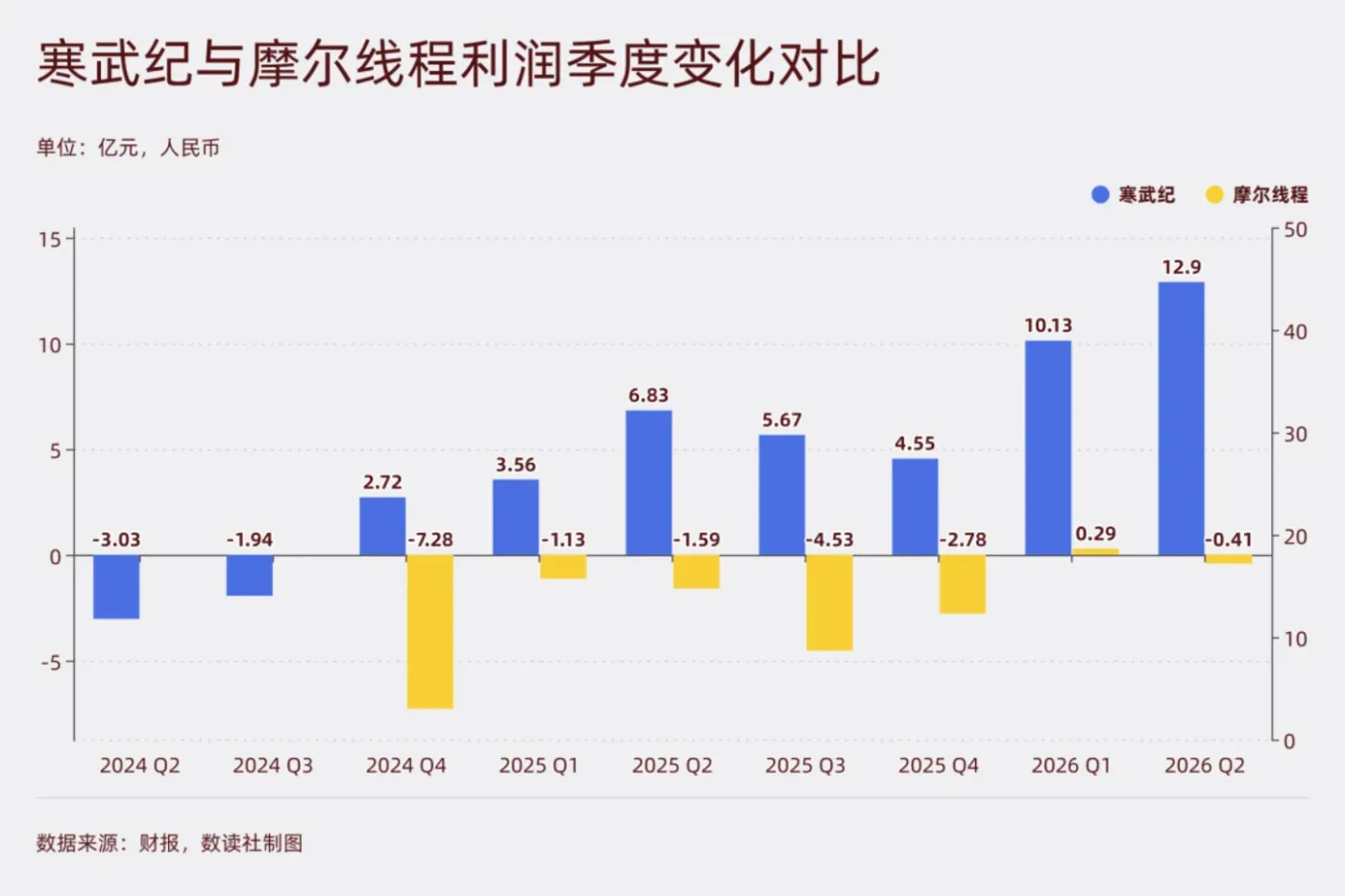
The academic camp, Cambricon, believes first in technological barriers. For nearly its first six years, the company did essentially one thing: develop its proprietary MLU instruction set. It has filed 2,901 patent applications and been granted 1,834, yet those early years were cash-burning ones — accumulated losses exceeded RMB 4 billion by the time of its IPO. The industry camp, Moore Threads, believes first in understanding demand. From day one, it positioned itself around full-function GPUs covering AI compute, graphics rendering, and video encoding/decoding — launching five generations of chip architecture in five years, chasing accumulation with speed. By June 2026, it had filed 2,167 patent applications.
The two financial statements show sharply different efficiency metrics: Cambricon's 1,007 R&D staff generated RMB 5.95 million in per-capita revenue in H1; Moore Threads' 1,019 R&D staff generated RMB 1.7 million each — just 28.6% of Cambricon's figure. But these numbers don't reflect a gap in capability — they reflect a difference in stage. Cambricon's R&D has entered its harvest period; Moore Threads is still in its siege phase. The scissors gap in input-output ratio has yet to reverse.
The Entity List forms another hidden watershed. Cambricon was added in December 2022; Moore Threads followed ten months later. Cambricon's answer is written into its balance sheet: RMB 8.248 billion in inventory plus RMB 2.914 billion in prepayments, together accounting for 61% of total assets — largely wafers locked in ahead of time, cash exchanged for 12 to 18 months of certainty. Moore Threads has kept its options open, planning an H-share issuance to open a second financing channel and using new debt to maintain operational safety.
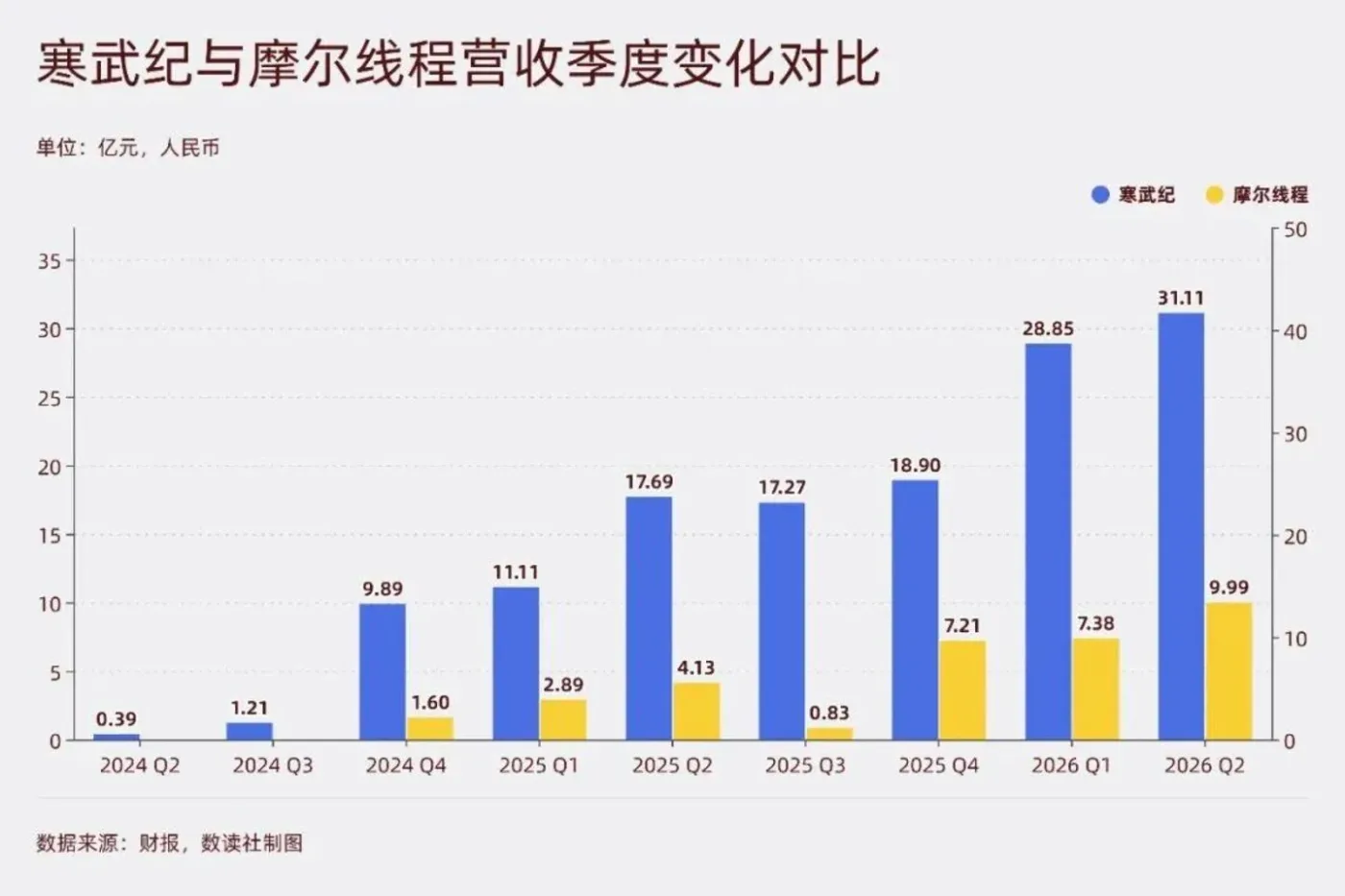
Each bet carries its own price. Cambricon's is a heavier balance sheet — RMB 8.248 billion in inventory could turn from asset to burden if demand fluctuates, and it has already booked RMB 397 million in inventory impairment losses in H1. Moore Threads faces greater volatility: gross margin has slid from 78% to 57%, and the financial pressure of mass production and sustained R&D keeps it on the edge. Industry research projects that domestic solutions will approach 90% of China's high-end AI chip market by 2026 — a market large enough to accommodate multiple parallel technical routes.
For the AI industry, these two paths are not a zero-sum game. Cambricon has proven that a commercial闭环 can be built from fundamental technology upward; Moore Threads is testing whether ecosystem and speed can close the gap. Meanwhile, for AI computing platforms, multi-source heterogeneous chip access and unified scheduling are becoming increasingly critical — enterprises no longer need to stake their fate on a single supplier. Instead, platform-level compute orchestration can combine the strengths of different chips. This is precisely the focus of StarWar Cloud's investment in GPU computing platforms and compute scheduling orchestration.