
Companies that want to use AI but dare not actually deploy it are becoming a new frontier for large model adoption. The pharmaceutical, financial, and manufacturing sectors face a triple bind: when cloud APIs fluctuate, agent tasks running on those interfaces risk interruption or failure; encouraging teams to lean on AI causes token bills to burn through budgets at alarming speed; and most critically, privacy, security, and compliance constraints make it impossible to hand sensitive data over to online models and cloud APIs.
The keyword for a solution is "local." Recently, YuanKong Intelligent, affiliated with Peking University, partnered with HP to install open-source large models, agent frameworks, and proprietary knowledge tailored for office, financial, and scientific research scenarios directly onto local devices. The models and frameworks come from YuanKong—its family of Boxer open-source models is available in both dense and sparse-activated versions, topped by two agent products, YuanKong AI Work and YuanKong AI Science. The underlying computing power comes from HP's standard laptops, GB10-architecture-based desktop computing boxes, and workstations.
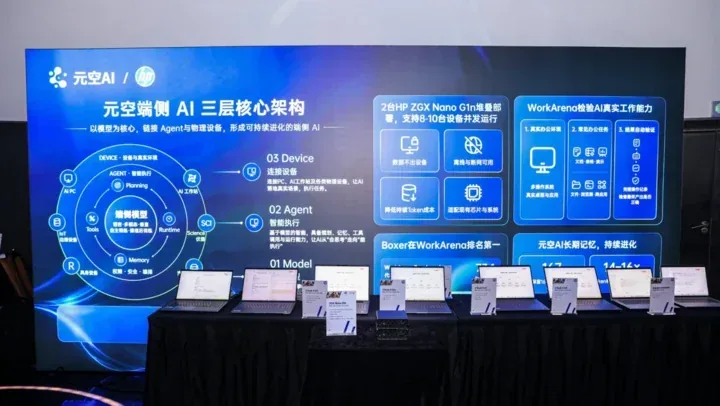
The demonstration scenarios are strikingly concrete. On an HP ZGX Nano running fully offline, YuanKong AI Work invoked local models to automatically scan, parse, classify, and archive 53 invoices in minutes, generating local reports. On another device, the system offline-processed a bank statement containing thousands of entries and flagged the rapid fund-in-fund-out patterns characteristic of money laundering. Wi-Fi off, business running as usual.
YuanKong's approach to model parameters is equally pragmatic. The team concluded that models under 3B parameters can only function as chatbots, while trillion-parameter models are too unwieldy—so they are targeting the "productivity sweet spot" of 20B to 100B parameters. They have released a 27B dense model and a 35B-A3B sparse model, achieving hundreds of tokens per second in prefill speed and hundred-millisecond latency locally, with support for offline operation, lossless checkpoint recovery, and long-term memory.
The cost calculus is another ace up their sleeve. Cloud deployment means ongoing subscription expenses, while the local approach is a one-time capital outlay: for a 100-person team heavily calling overseas flagship closed-source APIs, monthly cloud costs can reach hundreds of thousands of RMB—over a million RMB annually. A single GB10-based ZGX Nano workstation can offset its hardware cost within one or two months of API savings alone. HP also highlights a hidden cost of the cloud: the risk of proprietary know-how being "reverse-distilled" out of your organization.
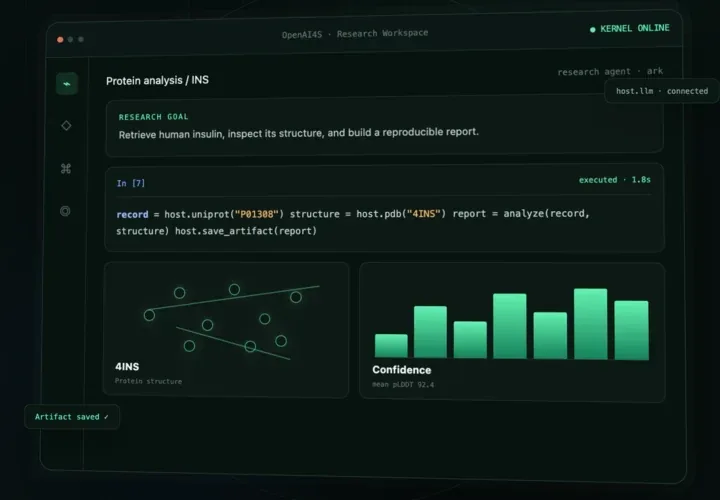
A deeper thesis concerns the large model industry itself. There is a growing consensus that the marginal returns of pretraining-scale scaling laws are diminishing; the real incremental value now lies in post-training and reinforcement learning, with real-world deployment anchored in physical devices. YuanKong AI Science, born out of Peking University's School of AI for Science, is attempting to connect robotic arms, inspection instruments, and other real laboratory equipment through a unified abstract protocol layer, closing the loop between dry experiments and wet experiments.
Once models are deployed on physical devices and local nodes, the distribution of compute across cloud, edge, and endpoint becomes dynamic: heavy training in the cloud, real-time inference closer to business operations, and sensitive data staying local. How to allocate heterogeneous compute resources by scenario and enable unified scheduling and metering becomes a platform-layer challenge—and precisely the direction in which StarWar Technology continues to invest with its GPU computing platform and compute scheduling initiatives.