
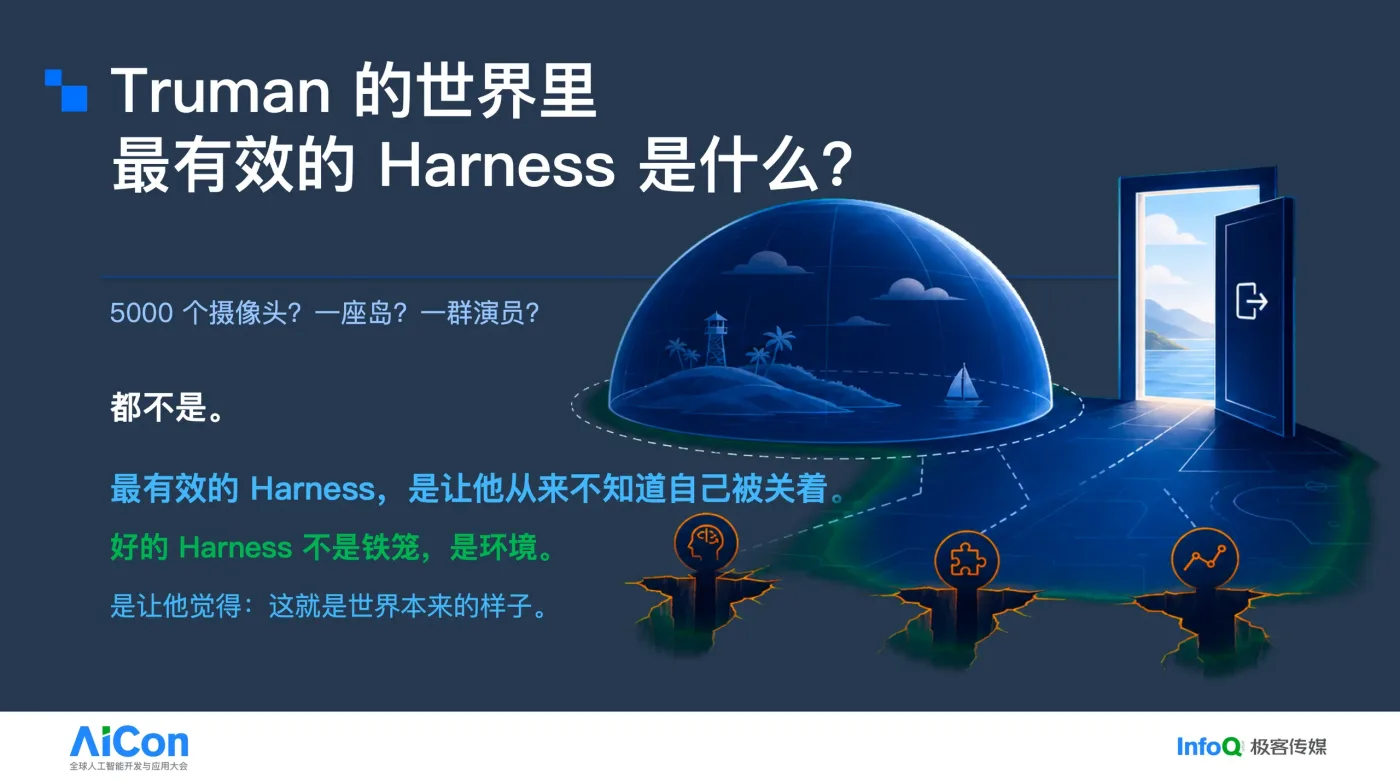
Dewu senior technical expert Bai Zhongwei shared the company's practice of bringing AI into the enterprise full R&D lifecycle at AICon. The team distilled the PDCA cycle into a seven-stage guardrail framework—moving from requirement alignment in Plan, developer implementation in Do, and effect verification in Check to problem reflection in Act. This enables AI to do far more than write code; it becomes an active participant in the entire R&D iteration. A well-designed harness is not an iron cage but an environment where AI naturally operates in the expected way.
AI coding has already demonstrated solid capability in building projects from zero to one. Yet enterprise-grade complex systems face unique challenges: legacy codebases, cross-system dependencies, and multi-level architecture. Unclear requirement boundaries, frequent execution interruptions, hard-to-quantify results, and non-reusable experience form four major barriers blocking AI from entering the full development chain. Currently, most teams' AI practice is concentrated in the Do phase—simply letting AI write code.
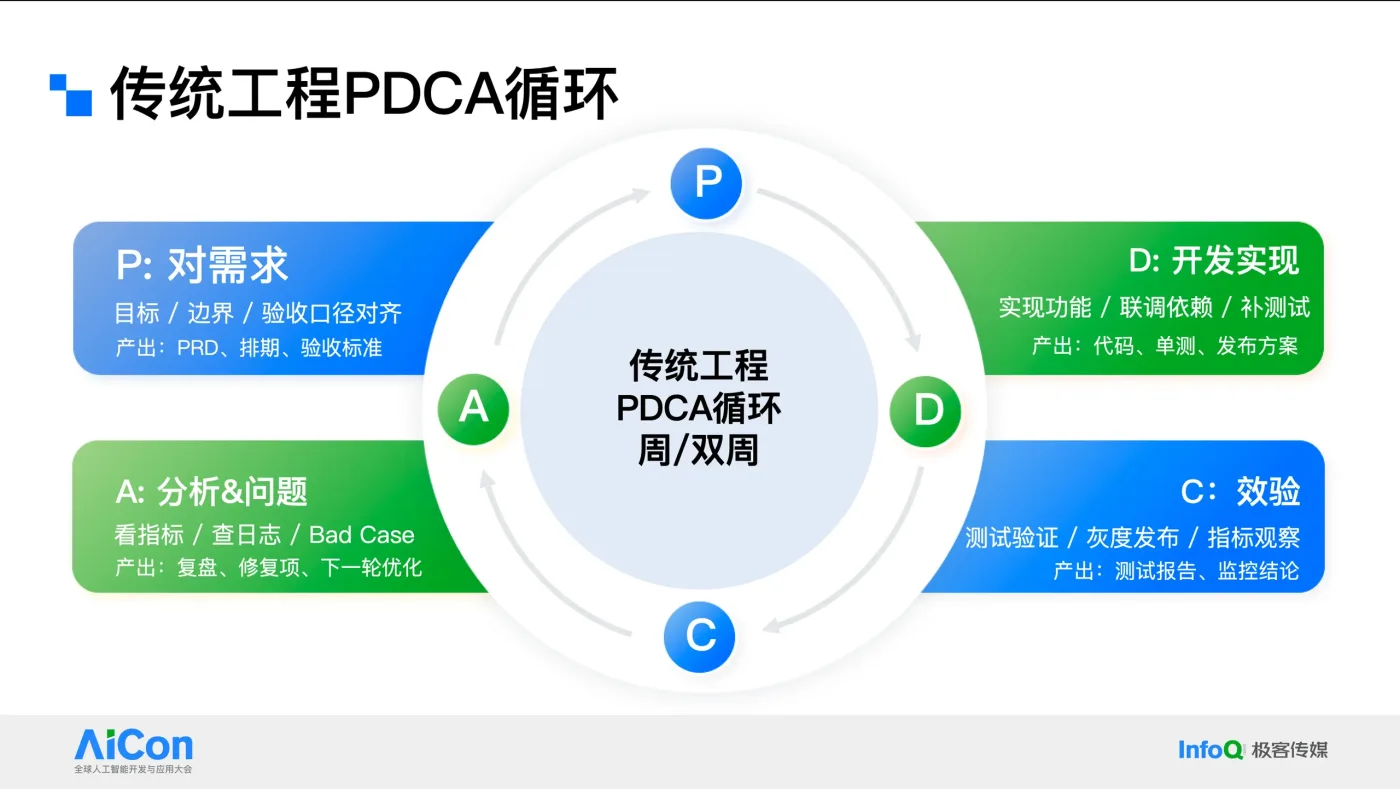
In the Plan phase, the team introduced TPRD after PRD, using Contract to clarify the impacted scope, optimization goals, and technical constraints in advance. AI receives not a loose block of natural language but a set of understandable, enforceable boundaries. TPRD breaks requirements down into executable EPs, while Contract defines the scope of each EP, together serving as the north star guiding subsequent development.

Three persistent problems of large language models—knowledge loss, random drift, and opaque reasoning paths—require engineering solutions. Dewu adopted CDD, an approach that lets AI supplement code comments first, organizing knowledge into three layers: L1 hard boundaries, L2 module design, and L3 in-code annotations. Testing shows that after comment completion, AI accuracy on complex questions jumps from roughly 52% to above 90%, while total token consumption actually decreases.
Dewu's "Highway + ATV" hybrid agent architecture handles the known-unknown spectrum: known problems are routed through stable code paths, while unknown problems are left for AI exploration, after which the results are refined and solidified. Code is always stable—once a problem is solved and verified, it should be consolidated into a repeatable Story rather than forcing AI to re-understand it each time. This philosophy of transforming experience "from reference material into executable process" aligns closely with the engineering-first, orchestratable direction championed by StarWar Cloud's OPC agent collaboration platform.
Early metrics are already telling: AI penetration in the requirements chain has reached roughly 30%, and problem-troubleshooting processing time has dropped by about 80%. A Story differs from a Skill—it is execution experience verified against real problems and locked into code, eliminating the randomness introduced by AI re-interpretation on every attempt and ensuring known issues can be fully resolved in a single pass.
Only when requirement boundaries are sharply defined, development processes are verifiable, business effects are quantifiable, and problem-solving experience is reusable can AI evolve from a code-generation tool into a genuine driver of the enterprise R&D iteration flywheel. Humans still play an irreplaceable role in technical solution review, Check, and Act phases.