
Over the past few years, the domestic GPU industry has never lacked for fundraising rounds, valuations, or "domestic substitution" narratives. Now comes the reckoning. Moore Threads, MetaX, Biren Technology, and Tianshu Zhixin — four listed Chinese GPU companies — have each released their H1 2026 interim reports: Moore Threads posted the largest revenue at RMB 1.736 billion; Biren's revenue grew nearly 20 times year-over-year; and MetaX and Tianshu both achieved book profits. Behind the four reports lie four distinctly different strategic paths.
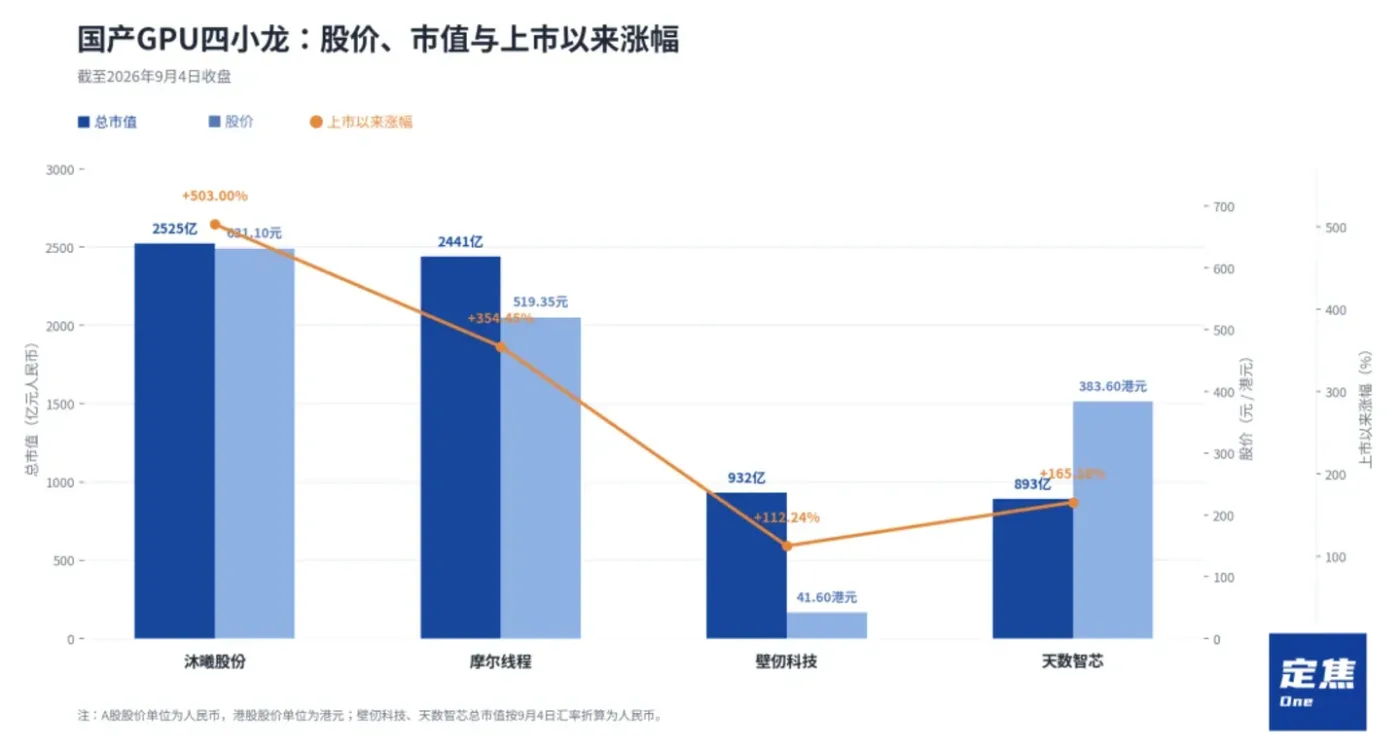
But book profits or losses do not settle the race. The capital markets' ranking does not align with the financial statements: MetaX and Moore Threads are listed on the A-share market with market caps of roughly RMB 250 billion each, while Biren and Tianshu trade in Hong Kong at just over HK$100 billion. Moore Threads, despite ranking first in revenue, is not first in market cap; Biren, growing nearly 20-fold, sits at the bottom of the valuation table — the market is not simply grading today's scorecards.
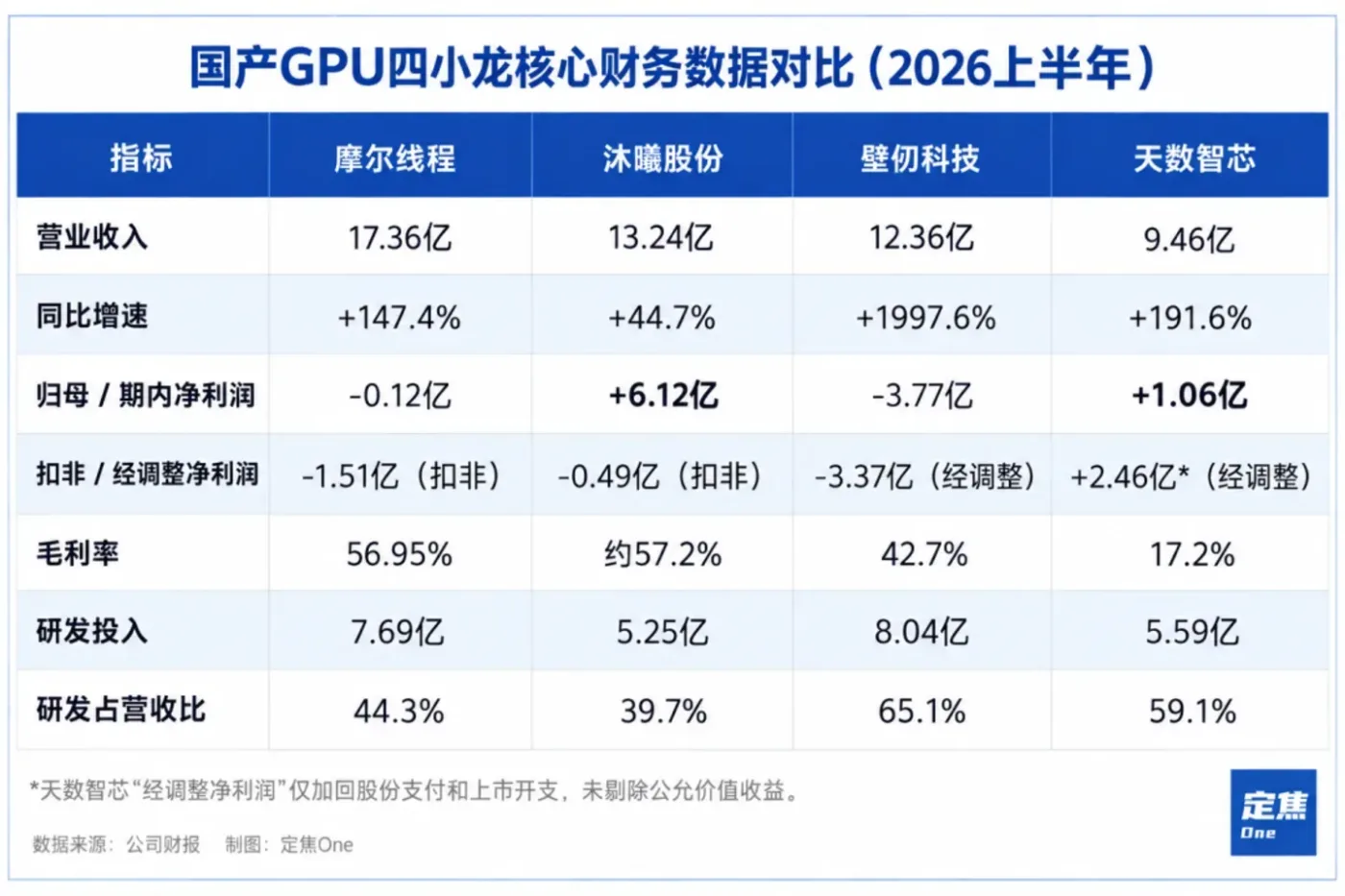
A closer look at earnings quality reveals that the two companies with the healthiest-looking books are not yet profitable in their core operations. MetaX reported a net profit attributable to parent of RMB 612 million — the highest of the four — but RMB 887 million of that came from fair-value changes in trading financial assets, representing 105.75% of total pre-tax profit. The company itself flagged this as "not sustainable"; stripping it out, MetaX would still post a loss of nearly RMB 50 million. Similarly, Tianshu's RMB 106 million net profit contains RMB 760 million in fair-value gains. Meanwhile, of the two loss-making companies, one is closest to profitability (Moore Threads narrowed its net loss to RMB 11.56 million, down 95.7% year-over-year), and one is growing the fastest (Biren's revenue surged 1,997.6% YoY).
GPUs are a quintessentially high-R&D business. In H1, Moore Threads invested RMB 769 million in R&D — 44.3% of revenue; MetaX spent RMB 525 million — 39.65% of revenue; Biren invested RMB 804 million — roughly 65% of revenue; and Tianshu spent RMB 559 million — 59.1% of revenue. Revenue growth is offset by sustained heavy R&D spending, and with capacity expansion and inventory build-up, Moore Threads' operating cash flow came in at negative RMB 2.169 billion and MetaX at negative RMB 1.297 billion — both are pouring capital into their supply chains to support H2 shipments.
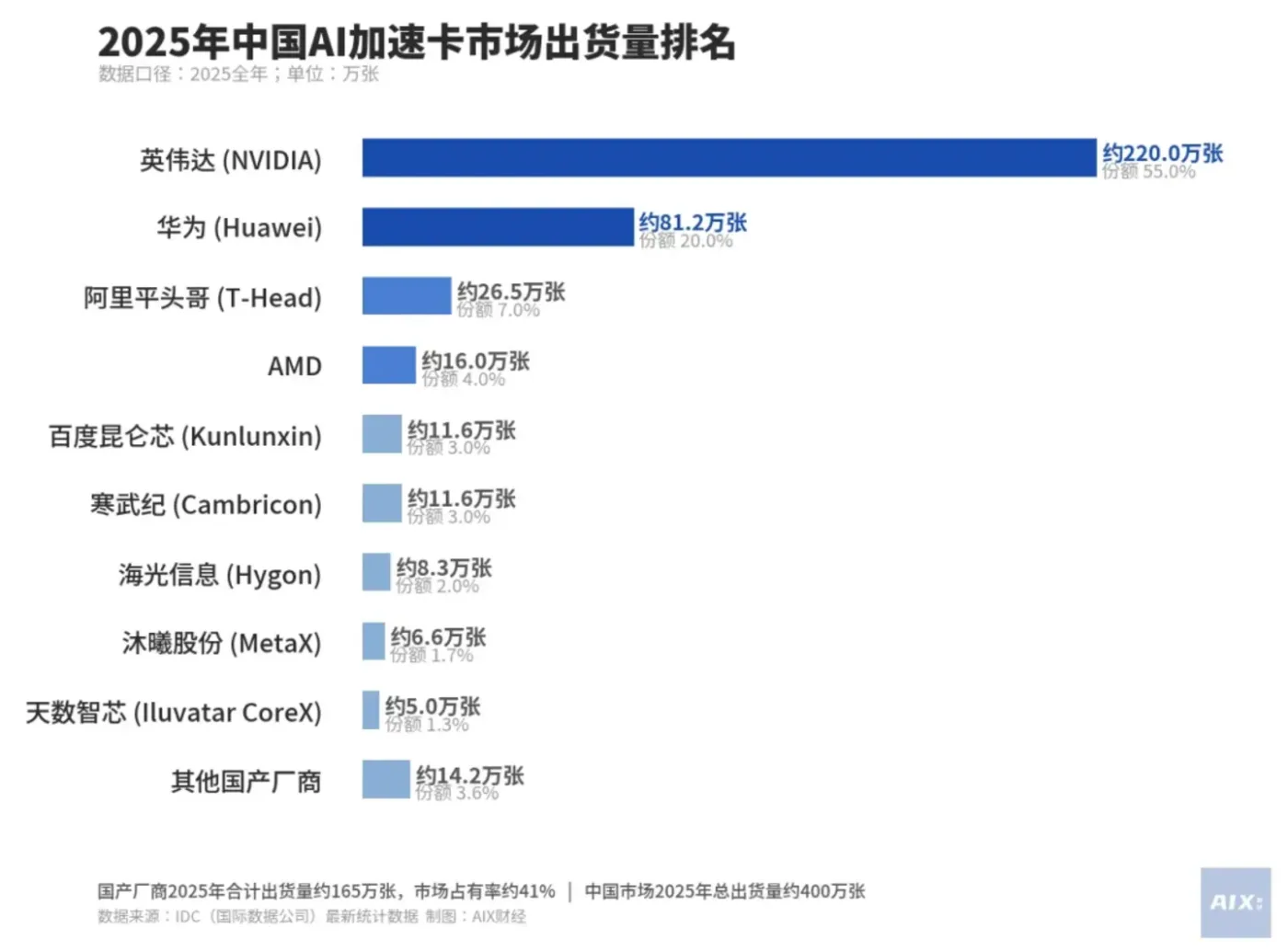
The industry landscape also remains challenging. According to IDC data, China's AI accelerator card market shipped approximately 4 million units in 2025, with NVIDIA holding a 55% share and domestic vendors a combined 41%. Among local players, Huawei's Ascend led with 812,000 units shipped. Of the "Four Little Dragons," only MetaX (approximately 66,000 units) and Tianshu (approximately 50,000 units) made the list, with a combined market share of around 3%. All four still have a considerable road ahead before achieving meaningful market share.
GPU competition appears to be about chip performance on the surface, but it is fundamentally a contest of full-stack system capabilities — silicon, software, servers, network interconnect, and developer ecosystems. NVIDIA's moat is the CUDA ecosystem, and domestic vendors' software stacks are still playing catch-up. One signal is worth noting: the national standard for cross-vendor heterogeneous mixed training, spearheaded by Biren, has entered the approval and release process. No single company can replicate CUDA in the short term — interoperability and collectively building out the ecosystem may be the more pragmatic path forward.
What will determine which company ultimately breaks out comes down to three questions: Whether repeat orders can be sustained (current volume growth benefits from the domestic substitution window and first orders from anchor customers — Moore Threads, for instance, has over 90% of its accounts receivable concentrated in its top five customers); whether software ecosystems can be built out; and whether funding can support generation-over-generation iteration. The capital markets have provided half of the answer with billion-level valuations; the other half will be answered by commercialization results. Enabling diverse domestic computing power to be uniformly managed and scheduled on demand across different scenarios is precisely the industry backdrop behind StarWar Cloud's sustained investment in multi-source heterogeneous access for its GPU computing platform.