
The real bottleneck of embodied intelligence has always been whether a model can improve on-site. Legendary approaches depend on re-collecting data, fine-tuning weights, or test-time training—all relying on gradient updates that are slow, expensive, and prone to eroding existing capabilities when adapting to new tasks. Zeva takes a fundamentally different path.
What Zeva transfers across domains is not task experience, but the causal relationship between actions and state changes. Physical causality learned in simulation can be carried into a real robotic arm; failure experience accumulated in one attempt can guide another similar attempt. This cross-domain transfer happens entirely through context: the model infers the environment's causal structure from context and applies it to generative next actions.

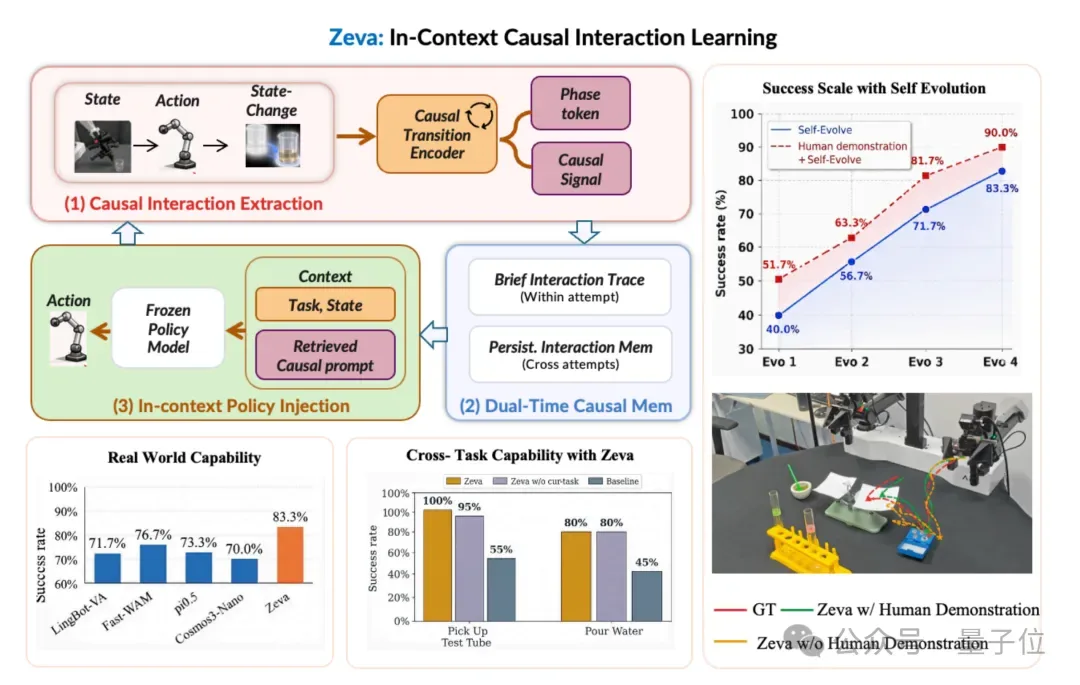
The field has long discussed cross-domain problems in terms of sim-to-real, cross-embodiment transfer, or cross-task generalization—all essentially relocating task experience between domains via data or representation alignment. Zeva instead uses dual-timescale causal memory to distill failures, corrections, and successes into retrievable context for subsequent trials. The model evolves continuously without touching its weights. That is the true departure from conventional methods.
Zeva extends the scaling paradigm of embodied models from "parameter space" into "context space"—replacing unbounded compute investment with smarter architectural design. This approach to efficiency within finite resources mirrors what StarWar Cloud is doing on GPU compute platforms and scheduling, and it signals that AI training and R&D increasingly need engineering foundations that genuinely understand algorithmic efficiency.

The numbers tell the story. On RoboCasa365-Atomic5, Zeva achieves an average success rate of 76.8%, with cumulative success climbing from 26% at Evolve 1 to 73% at Evolve 4. In the real chemistry lab ChemLab-Evo, all three atomic tasks show monotonic improvement, with a single human demonstration adding up to 20 percentage points. Every interaction becomes an implicit system identification of the current physical environment.
If ICCL holds, embodied intelligence's scaling will follow a second curve independent of parameter count: more interactions mean richer causal context, sharper discrimination of physical domains, and higher task success rates. Robots learning causality on their own in the physical world, evolving by themselves—this may be what the "GPT moment" for embodied intelligence truly looks like.