
As large language models grow increasingly powerful, what exactly are enterprises willing to pay for? Raw model capability alone can no longer justify enterprise AI adoption. Market attention has shifted from the models themselves toward how AI can generate perceivable, measurable output. Bairong Intelligence's latest interim results illuminate precisely this trajectory.
In the first half of 2026, Bairong's total revenue showed fluctuation, yet its AICC business grew 52% year over year—with new-scenario revenue from logistics, securities, and other industries surging 195%. AICC, or AI Contact Center, integrates AI into enterprise contact centers, enabling Agents to directly handle inquiries, marketing, service, and operations. Having honed mature AICC and enterprise-grade Agent capabilities in financial scenarios, Bairong is now replicating them across new industries.

The replication path is backed by clear quantitative evidence: daily call volume at a logistics project climbed from under 1,000 calls in its early stage to over 15,000; a leading securities firm expanded its deployment from roughly 30 seats at the start of the year to around 210. Bairong's RaaS results-based pricing model directly converts processing volume and deployment scale into revenue. Once a benchmark scenario proves viable, the same capabilities and memory can be replicated across more roles and industries, with real-world interaction feedback feeding back into model training—forming a data flywheel.
Why did enterprise-grade Agents first take root in AICC? Contact centers have long shouldered heavy inquiry, marketing, and service workloads, with clearly defined task boundaries, processes, and evaluation criteria. After AI integration, processing volumes, human-handoff ratios, and per-unit service costs are quickly reflected in operational results. Top venture capital firm a16z similarly identifies coding, enterprise search, and customer support as the earliest production scenarios for enterprise AI. Customer service workflows are largely documented and retain human fallback paths, making them naturally suited for gradual Agent adoption.
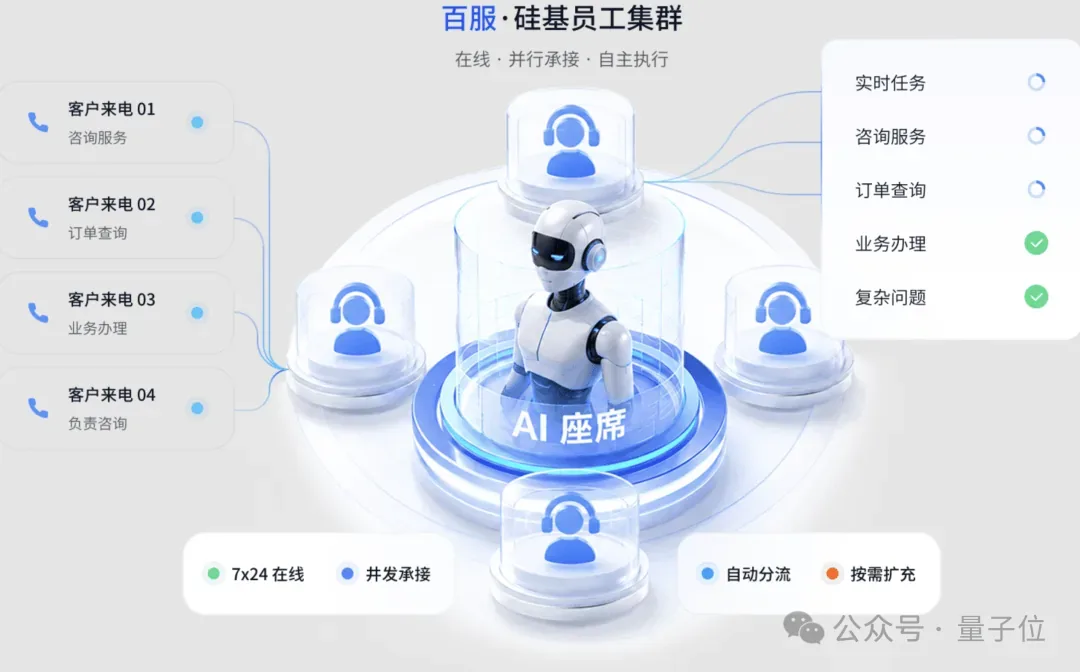
Bairong's confidence stems from seven to eight years of accumulation. Its customer service and marketing silicon-based employee projects were initiated in 2017. The financial industry's stringent demands for accuracy, stability, and compliance forged capabilities that heavily overlap with AICC requirements. Technically, rather than pursuing breadth, the company incorporates domain-specific foundation models into its own system—controlling the critical links of pre-training, post-training, and inference optimization. When issues arise, the team can pinpoint whether the problem lies in the application-engineering layer or the foundation-model layer, then directly enter the next optimization cycle, shortening the entire iteration loop.
Real production environments impose another layer of challenge: delivery. Enterprises differ in their knowledge systems, operational rules, and system environments. After completing a conversation, AI may need to query information, call internal systems, execute tasks, and write back results. To address this, Bairong deploys FDE (Frontline Deployment Engineer) teams to business sites, where they map out service standards, knowledge bases, and system interfaces, reorganizing AI-suitable processes into Agent workflows. Feedback generated after Agents enter production then flows into the next round of model training.
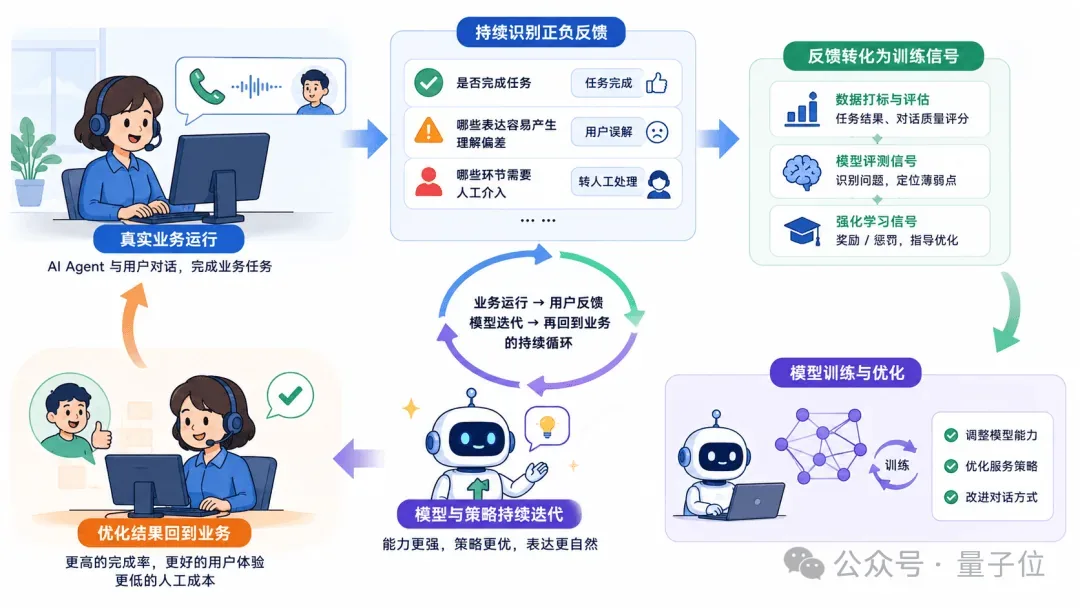
Enterprise AI requires connecting models, engineering, and business processes into a long-running system that continuously withstands real production scrutiny. As Agents begin undertaking work previously performed by humans, how enterprises purchase AI changes accordingly: the payment object shifts from technology access to actual output, and the value scope extends from IT budgets to operational and labor costs. This outcomes-based payment model pushes technology companies deep into business process interiors, where model performance, stability, and task completion effectiveness all converge into a single operational logic.
Agent commercialization thus charts a clearer trajectory: prove a single use case, expand deployment, replicate across industries, feed real data back into models, and leverage industry resources to unlock more workflow entry points. As AI begins entering operational and labor cost structures, whoever can make outcome measurement transparent and trustworthy will earn enterprises' long-term confidence. The observability, measurability, and engineered governance emphasized by StarWar Cloud's OPC Agent Collaboration Platform constitute the foundational capabilities supporting this outcomes-based payment model.