
Three months ago, Anthropic released Fable 5 in an attempt to answer a question: when a model needs to work continuously for hours or even days, can it keep track of its objectives, call tools, check results, and see the task through to completion without human supervision? Now Anthropic is back with Fable 5.1. On September 1, Claude Fable 5.1 and Mythos 5.1 officially launched. Both run on the same underlying model; the difference lies not in intelligence but in safety guardrails.
Version numbering suggests a modest .1 increment, but the actual changes go far beyond incremental fixes. The new models more than doubled their scores on agentic scientific research evaluations compared with the prior generation, with broad improvements across coding, knowledge work, computer operation, and long-horizon tasks. Meanwhile, real-world call costs for Agent workloads fell by as much as roughly 45%. More notably, Anthropic did not stop at benchmark bragging this time: pricing, caching, data retention, safety misclassification, vulnerability research permissions, and enterprise deployment architecture account for nearly half of the release announcement.
Understanding the relationship between Fable 5.1 and Mythos 5.1 is the first key to this release — two deployment variants of the same model. Fable 5.1 adds cybersecurity and biosecurity protections for public and enterprise environments, with some tasks either blocked or routed to the less capable Opus model. Mythos 5.1 retains more raw capability but is accessible only to vetted institutions. Anthropic is effectively decoupling model capability from model openness, delivering tiered levels of functionality based on user identity, task type, and usage environment.
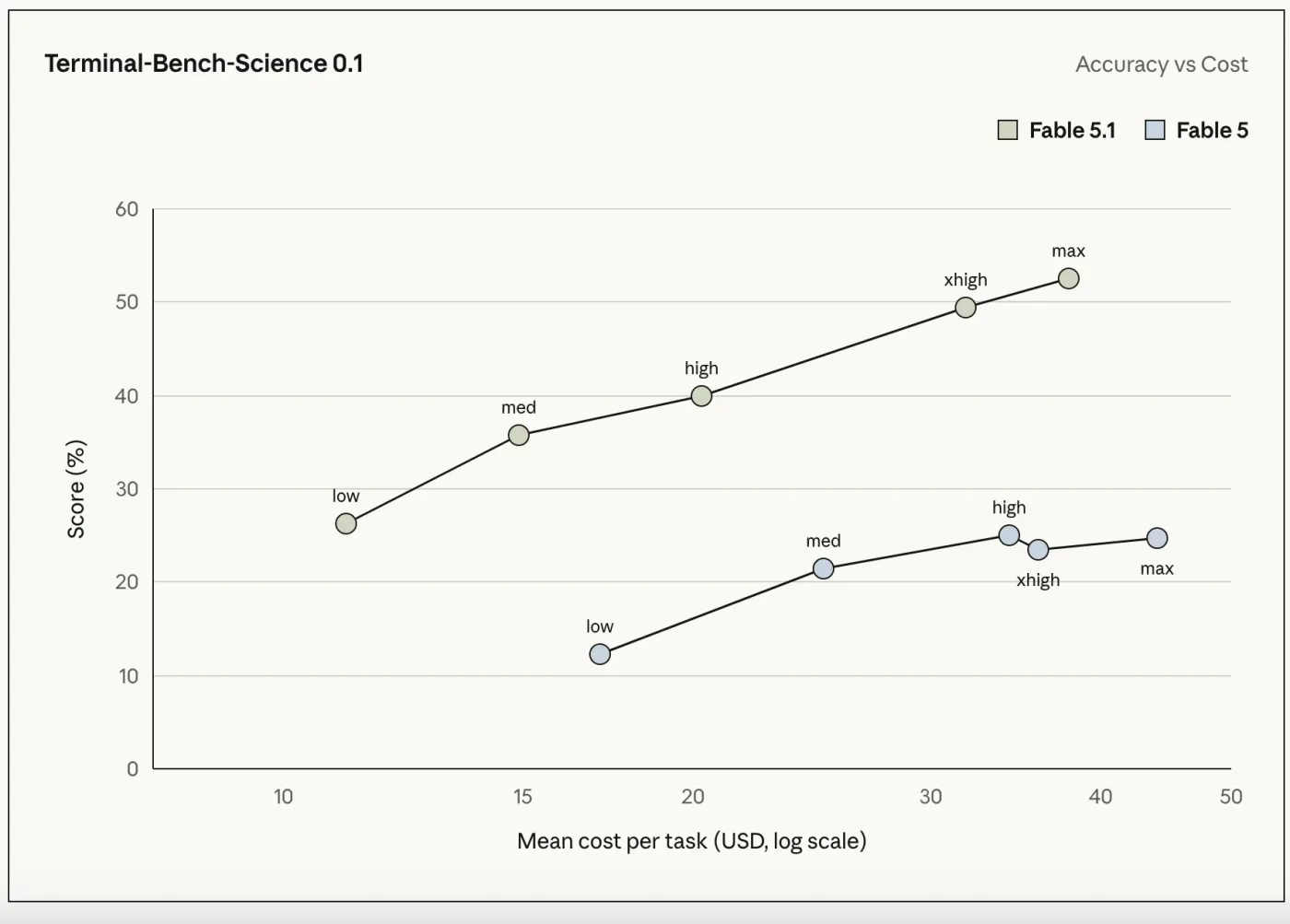
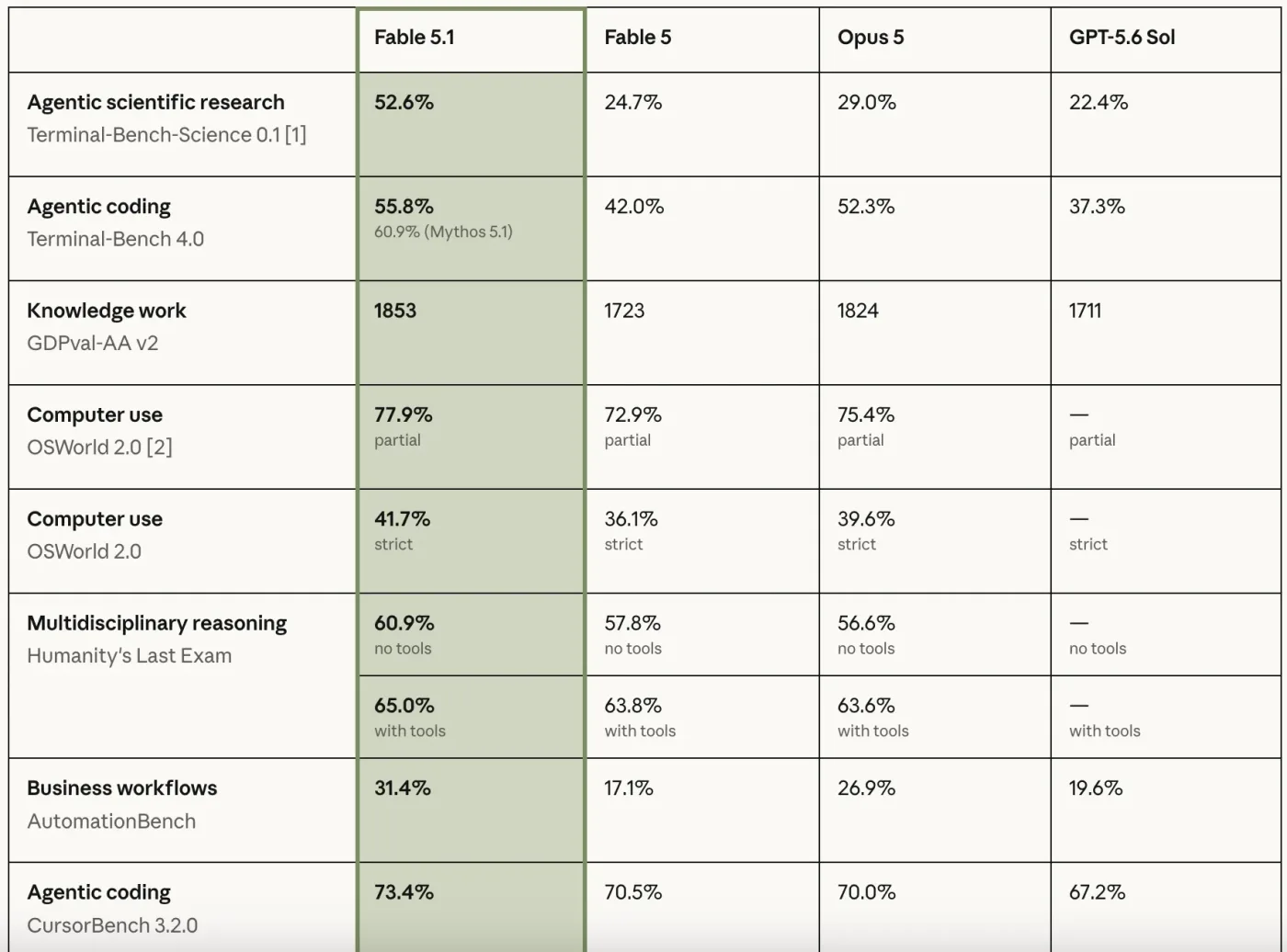
The core capability changes can be summarized as follows: a higher ceiling on ability, cheaper cache reads, but if you crank reasoning intensity to maximum, completing a single task can still cost more than the previous generation. On Terminal-Bench 4.0, Fable 5.1 scored 55.8%, while Mythos 5.1 — with certain restrictions lifted — reached 60.9%. A large share of that capability gap stems from Fable's safety system intervening in specific cybersecurity tasks. On the agentic scientific research benchmark, Fable 5.1 hit 52.6%, nearly double the previous generation's 24.7% and well above comparable models.
The pricing adjustment chiefly targets the cost of Agents repeatedly reading context during operation. Fable 5.1 cuts cache read pricing from $1 per million tokens to $0.25 per million tokens — a 75% reduction. Standard input and output prices remain unchanged, and the context window stays at 1 million tokens. Why cache pricing matters: a long-running coding Agent may repeatedly read the same codebase, system prompts, tool definitions, and task history. If every tool call were billed at standard input rates, the longer a task runs, the more expensive repeated context becomes. Caching means subsequent reads pay only the far lower fee.
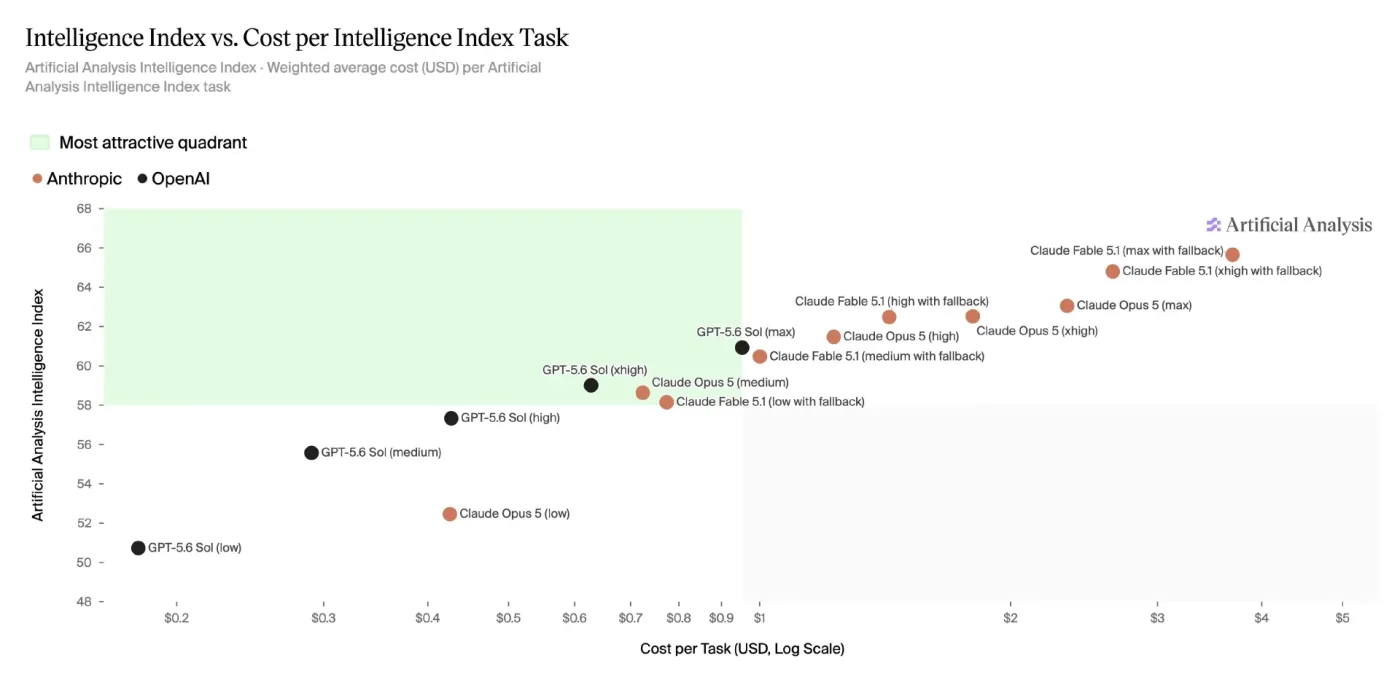
But cheaper cache reads do not mean every task becomes more affordable. At the highest reasoning intensity, Fable 5.1 completes an intelligence-index test task at an average cost of $3.76 — about 20% higher than Fable 5 — because output token usage is roughly 1.7 times that of its predecessor. Even with cache savings of approximately $1.40 per task, the reduction does not fully offset the increase in output costs. Fable 5.1 occupies the high-end Pareto frontier of intelligence versus output-token efficiency, but it is not the lowest-cost option in dollar terms. Whether the extra spend buys tasks that were previously impossible is what developers actually need to evaluate. Anthropic is also working to curb shortcut behavior, pushing the model to find root causes instead. A case from investment firm Millennium is telling: an internal piece of code had a crash that occurred only once every million or so runs, and engineers spent four to five years without pinning down the cause. Fable 5.1 analyzed external libraries, compared disassembly output against core dumps, and ultimately traced the failure to a flaw in an external library. External review-platform tests offered a more measured take: the model did not surface more issues, but it did eliminate a large number of unproductive and nitpicky comments. Its output became more restrained — at the cost of slower generation.
In molecular design experiments, Anthropic had Mythos 5.1 invoke open-source protein design tools, with results validated by two external organizations. Binder affinities for three targets came in 10 times higher than the best competition entries. Fable 5.1 also used NASA radar data from more than 30 years ago to redraw high-resolution maps covering about one-third of Venus's surface. Model output has clearly moved beyond text generation and into real-world validation — evolving from