
While rival teams are still burning out competing to generate a few seconds of fast-food-style video content, Fei-Fei Li's World Labs has quietly flipped the table. The world's first multimodal world model, Atlas, has officially arrived. By official definition, Atlas is an omni world model purpose-built for spatial intelligence, pre-trained entirely from scratch. It natively handles text, images, video, camera pose, and 3D depth information — all within one model that performs world generation, spatial reconstruction, and spatiotemporal simulation simultaneously.
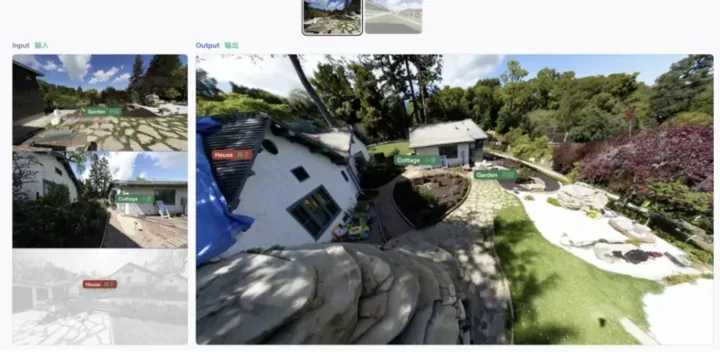
The most immediately jaw-dropping capability is camera-controlled generation. Until now, video generation models have felt like a lucky draw — camera movement was largely a matter of chance. Atlas changes that by treating camera pose parameters as native, low-level inputs. Drop in one to six ordinary photos, plot out the desired camera trajectory, and the model generates footage up to one minute long at 1440p resolution, with perfectly consistent spatial geometry throughout. Even more striking is its spatial extrapolation ability: input a photo showing only the front of a robot, and Atlas hallucinates an entire path around it; show it a corner shot of a swimming pool, and it fills in the lawn and distant mountains that were never captured.
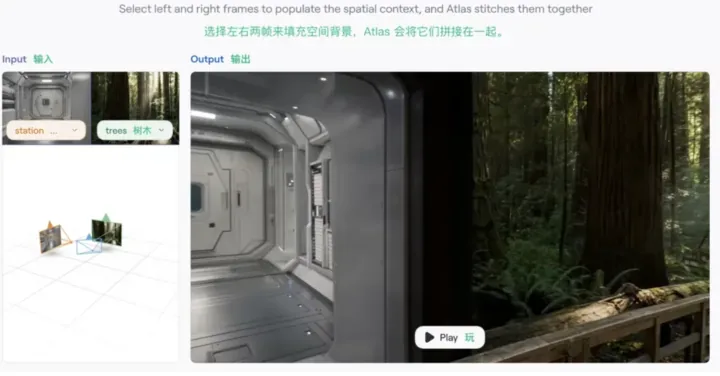
Behind these tricks lies a term that matters: spatial context. Large language models read preceding text to predict what comes next; Atlas, by contrast, binds every image to fixed 3D coordinates and depth, constructing an internal room complete with a coordinate grid. At the core of many of its capabilities is multi-view synthesis — feeding images and videos captured from different angles into one shared 3D space, judging their relative positions, filling in unseen regions, and generating new perspectives. The more viewpoints the model receives, the more it behaves like spatially constrained multi-view fusion, stitching scattered visuals into a seamless, navigable 3D scene.
The second pillar is spatial reconstruction. Traditional 3D Gaussian splatting and point-cloud scanning require lugging professional equipment around a subject dozens of times, capturing hundreds or even thousands of photographs. Atlas needs only 2 to 25 ground-level tourist photos to reconstruct a building with full detail. Across multiple public benchmark datasets, its sparse-view reconstruction error is markedly lower than comparable methods. The output feeds directly into point clouds and 3D Gaussian Splatting pipelines, and integrates seamlessly with World Labs' own rendering platform for high-frame-rate, real-time rendering.
On the technical front, World Labs has assembled a formidable architecture: a multimodal autoregressive diffusion Transformer. It combines the strengths of two dominant paradigms — autoregression predicts successive spatial states in a spatiotemporal sequence, much like a language model predicting the next token, while diffusion denoising ensures visual fidelity and geometric precision for continuous high-dimensional signals. The Transformer backbone, built on proven matrix-multiplication structures, adapts without friction to existing large-scale compute clusters. This lets Atlas simultaneously benefit from LLM innovations like KV Cache and distributed inference optimization, as well as diffusion sampling and distillation techniques.
The longer arc points toward embodied intelligence and robotics. Anyone training robots today knows the biggest pain point: virtual training environments are never enough. Trial-and-error in the real world means slow data collection and high costs. Moving to simulation, on the other hand, requires significant manual effort to build 3D scenes, materials, and lighting from scratch. Industry estimates suggest that collecting robot training data at meaningful scale purely through traditional methods could ultimately carry a price tag on the order of $100 trillion. Atlas's Real-to-Sim approach effectively eliminates much of that manual simulation-world construction.
Shoot two 24-frame videos of a factory floor or a room on a phone, feed them to the model, and Atlas outputs a high-fidelity 3D physical space. A robot can then drop into this digital twin and run thousands of trial-and-error iterations. Wherever the robot moves, Atlas renders in real time exactly what an onboard camera should see, complete with depth maps. Whether a robotic arm bumps a box, pulls open a cabinet door, or squeezes a sponge, Atlas simulates force feedback — record one real scene, and derive millions of variations in lighting, object arrangement, and obstacle placement.
In blind tests for camera-motion control, Atlas's win rate against comparable video-generation models climbed from 75% to 94%. From ImageNet, which taught machines to recognize the world in pixels, the challenge Fei-Fei Li now tackles is whether a machine can truly understand the three-dimensional space behind an image — and predict what happens in the next second. Spatial intelligence, as embodied by Atlas, is in effect adding a layer of world knowledge — geometry, physics, time, and action — on top of today's increasingly capable language intelligence. Another keyword World Labs emphasizes with Atlas is Scaling: as parameter count and compute multiply, the model exhibits emergent capabilities reminiscent of large language models, confirming that brute-force scaling remains the winning formula. Training and inference for this class of multimodal foundation models impose far stricter demands on the scale and scheduling efficiency of computing clusters — reinforcing the central role of compute infrastructure in the next phase of AI competition. This is precisely the strategic conviction behind StarWar Cloud's long-term investment in GPU compute platforms and compute scheduling.