
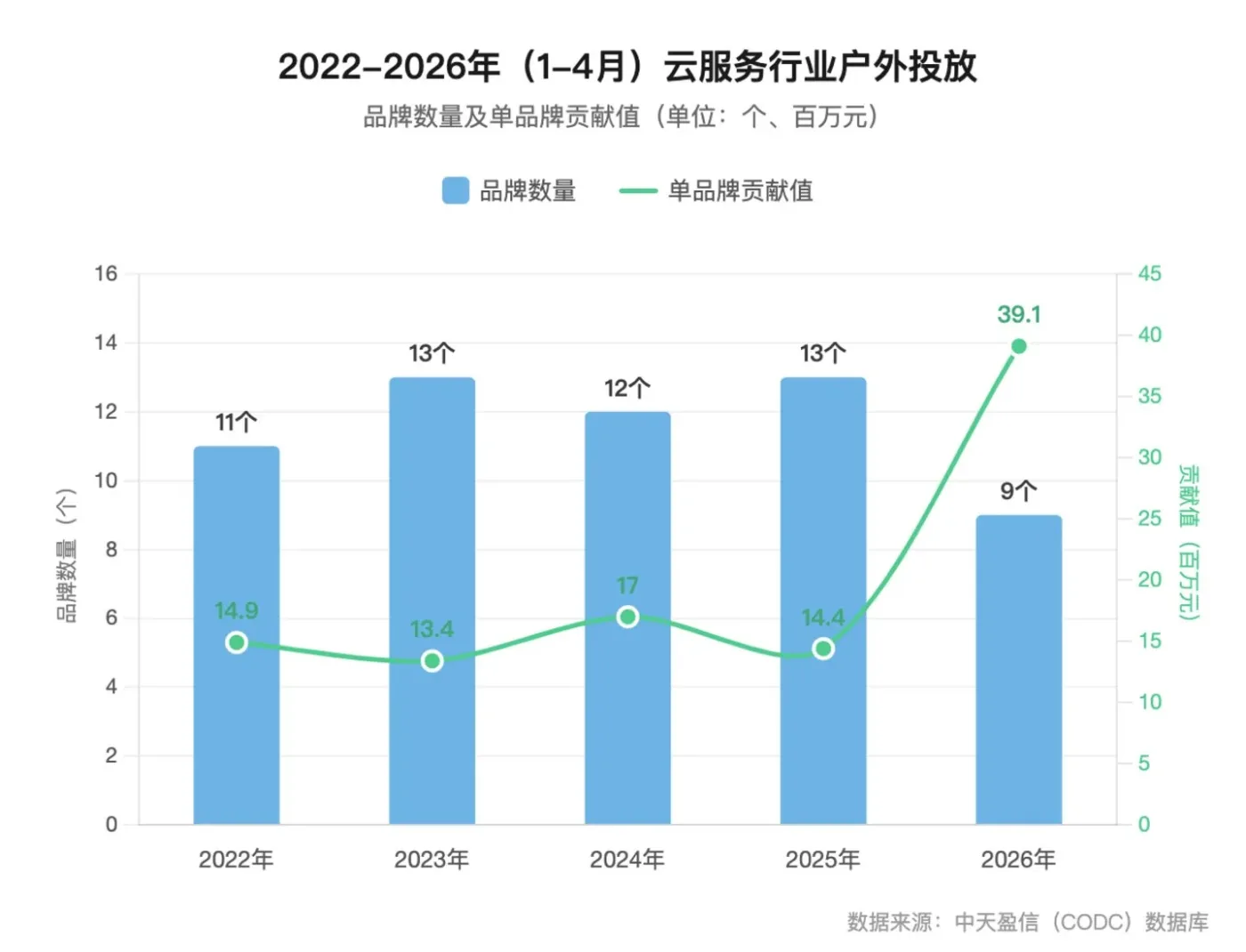
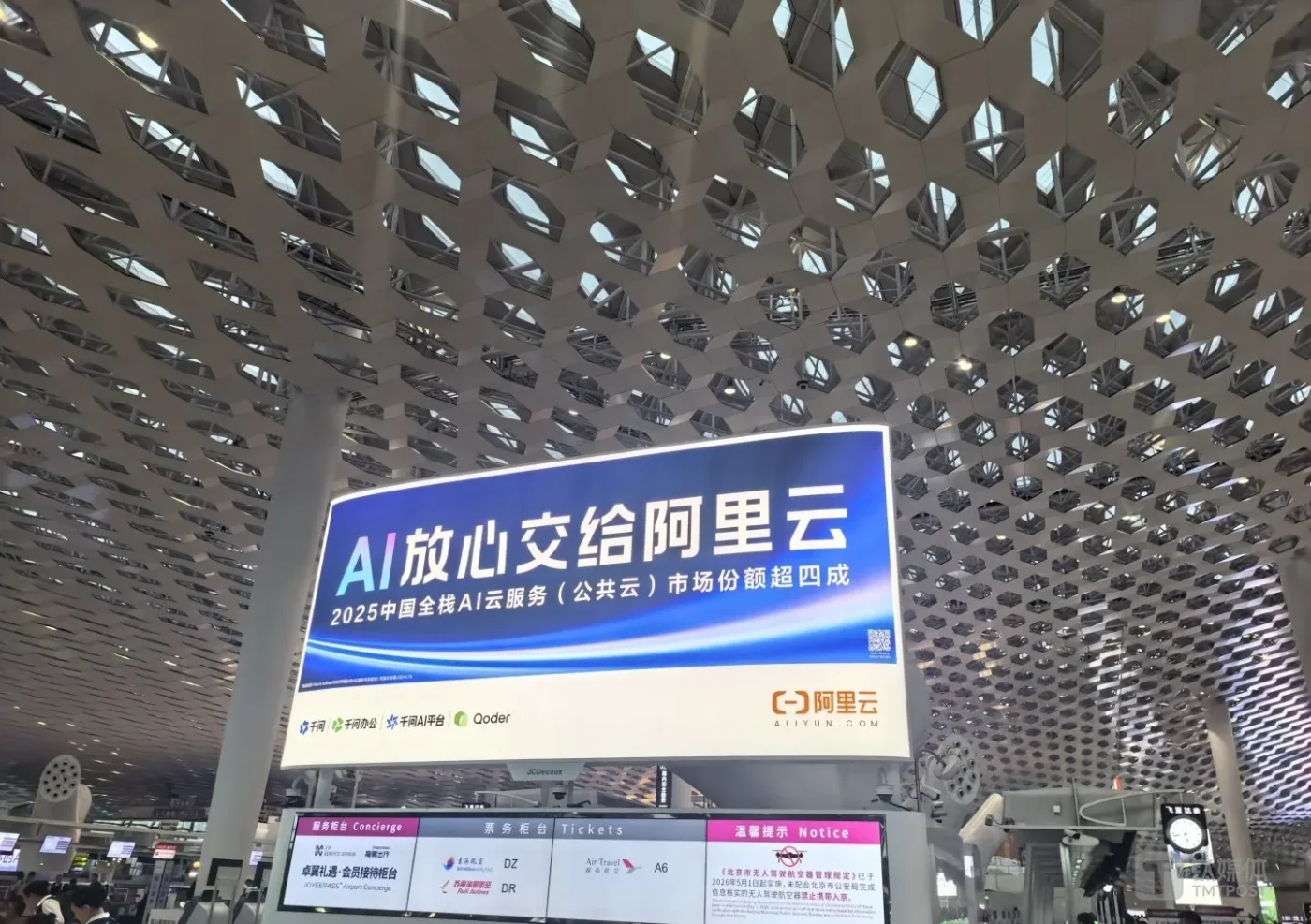
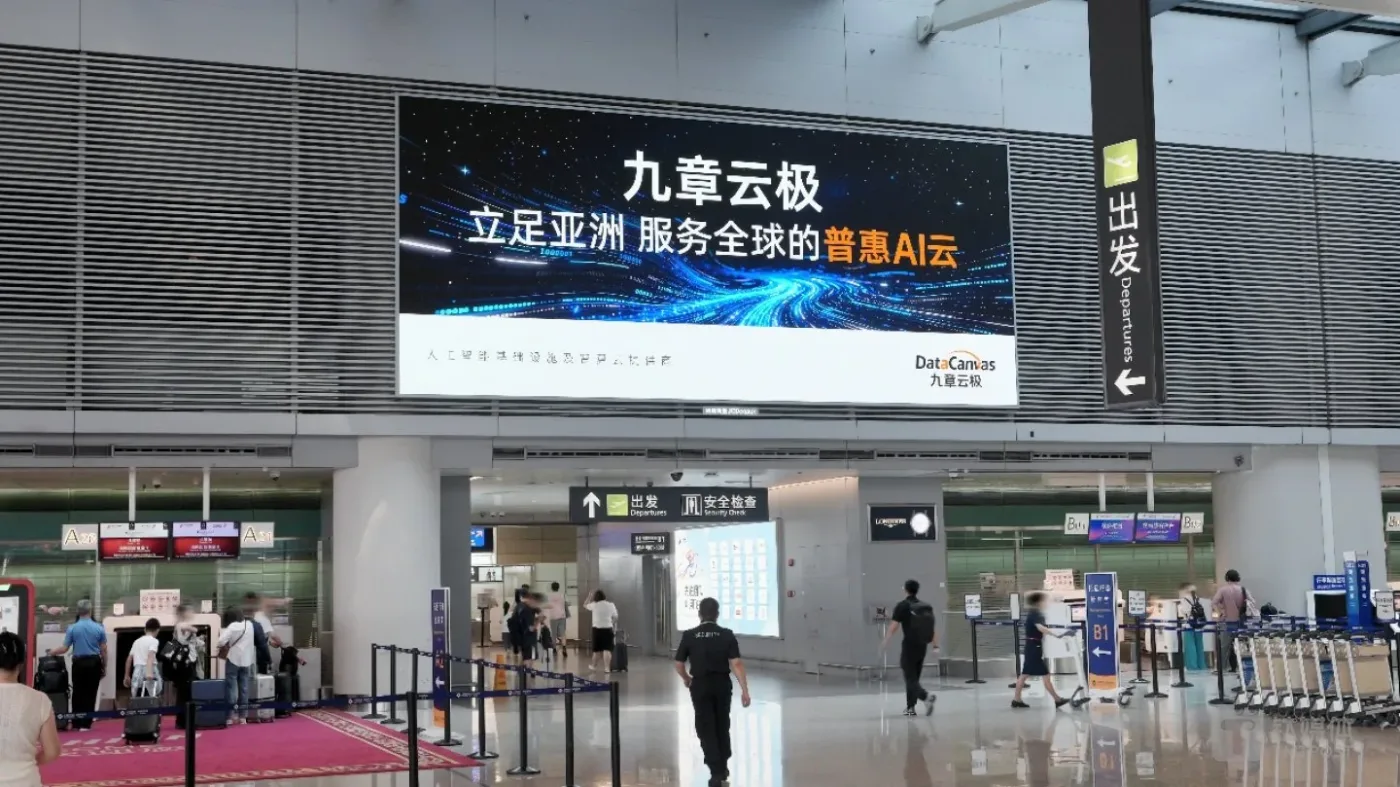
In Departure Hall T3 at Beijing Capital Airport, a row of LED light boxes lines the concourse: Alibaba Cloud, Volcano Engine, Baidu AI Cloud, and Jiuzhang Yunji. According to outdoor ad tracking data from Zhongtian Yinxin, total outdoor advertising spending in the cloud services industry from January to April 2026 reached RMB 352 million—nearly double the same period last year—with airport media claiming 84.7% of that share. This isn't a sudden spike; airport AI cloud ad density has been climbing steadily since 2025.\n\nAirports are not a typical stage for consumer brands. For cloud vendors, they are the ultimate "high-stakes table." The audience is precisely targeted, the environment is closed-off, and dwell time is long. Airport advertising isn't about direct conversion—it's about winning mindshare.
Across the Pacific, the same playbook is visible at San Francisco's SFO and Las Vegas airports, where Google Cloud (GCP), AWS, and CoreWeave billboards hang in parallel.\n\nThree distinct narratives now share the same venue. Hyperscale clouds tell a story of "defense and dominion," hard-wiring cloud to AI in the broadest sense. MaaS and Agent players compete for "entry points," where the battle has spilled over from "who has the compute" to "who sits closer to the enterprise workflow." AI-native clouds make a parallel declaration, staking their ground as neutral intelligent-computing clouds, AI factories, and providers of purpose-built tokens. Read together, these billboards form a distribution map of the AI infrastructure industry.\n\nArchitecturally, hyperscale clouds are built on a compatibility-first principle—AI training and inference queues must share schedulers with virtual machine live migration and block storage snapshots.
AI-native clouds, by contrast, are architected around AI workloads from day one: heterogeneous chip abstraction at the base layer, integrated training-inference queues with KV Cache-aware scheduling in the middle, and training, inference, and Agent execution packaged as metered services at the top.\n\nThese new clouds are pushing computing power delivery from "resource leasing" to "task output," from "black-box scheduling" to "transparent metering," and from "general-purpose compromise" to "native optimization." This purer, more efficient scheduling logic for AI workloads is precisely the direction StarWar Cloud has taken with its GPU compute platform and scheduling orchestration—and it's the platform-level scheduling capability enterprises need most in a multi-cloud era.\n\nIndustry research points to the same conclusion. Forrester estimates China's AI infrastructure cloud TAM at roughly RMB 212 billion in 2025, surpassing RMB 410 billion by 2028.
Synergy Research pegs the U.S. Neocloud market at approximately USD 23 billion in 2025, heading toward USD 180 billion by 2030. AI-native clouds are not replacing hyperscale clouds—they are rebuilding the value chain of AI computing power from the ground up.\n\nEnterprise AI workloads are themselves becoming stratified. For low-frequency training and long-cycle experimentation, hyperscale clouds still offer the strongest full-stack ecosystem. For high-frequency inference, Agent execution, and vertical model fine-tuning, AI-native clouds deliver more targeted results through purpose-built scheduling and neutrality. The side-by-side billboards at the airport are not mere advertising—they are a faithful mirror of structural change in the industry. The cloud being rewritten for AI is now harvesting the dividends of its architectural advantage.