
On October 27, the 41st meeting of the Standing Committee of the 14th Hangzhou Municipal People’s Congress heard and deliberated a report on revisions to the Draft Regulations of Hangzhou Municipality on Promoting the City of Innovation and Vitality. The draft includes a section on computing power: building intelligent computing centers, providing inclusive computing power, establishing a computing power scheduling service platform, and promoting cross-regional coordination of computing resources.
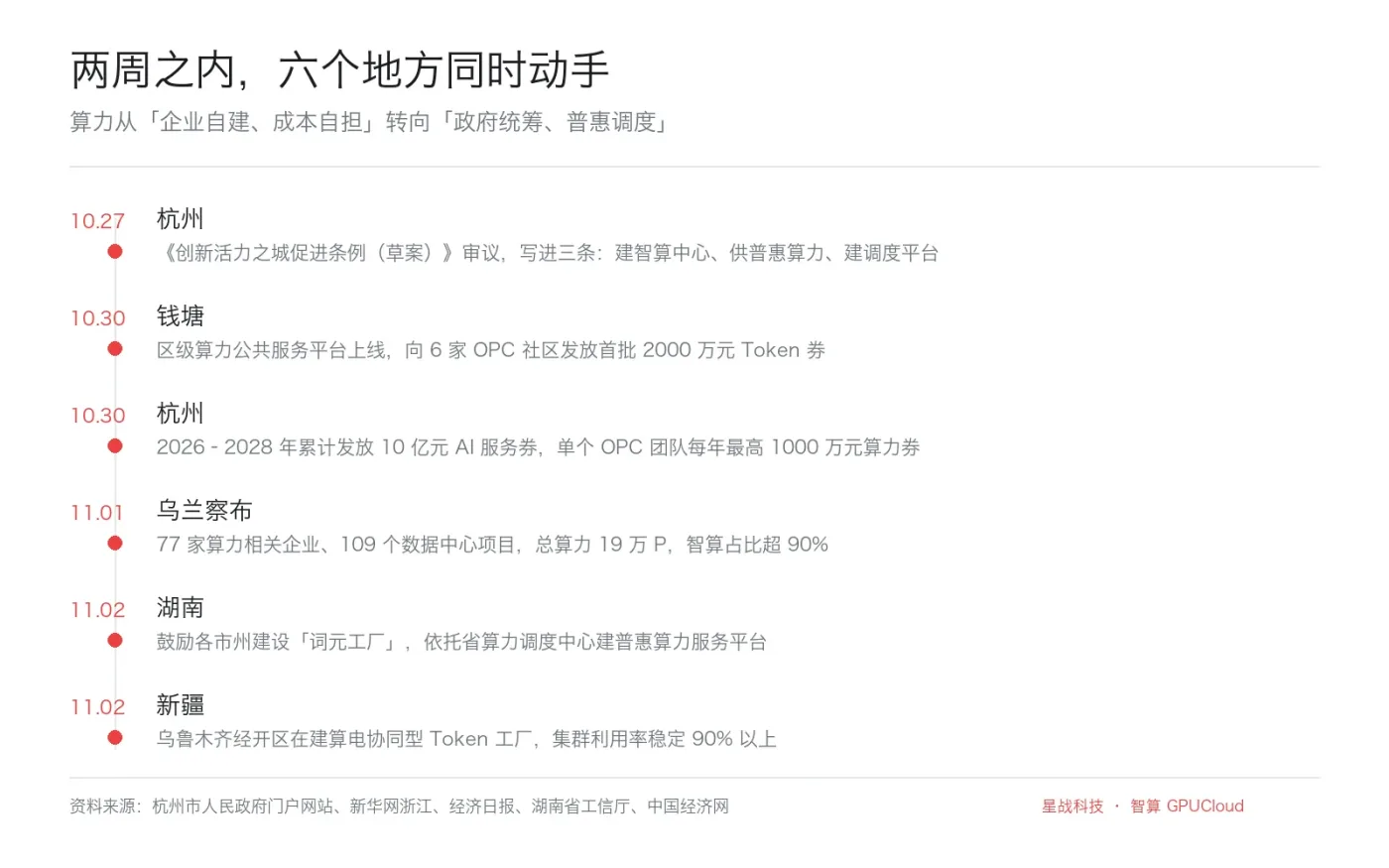
Four days later, Qiantang District launched a district-level public computing power service platform at a service industry development conference and issued the first batch of RMB 20 million in token vouchers to six district-level OPC communities. At the event, the approach was described as shifting computing power from “built by enterprises at their own cost” to “government-coordinated subsidies and inclusive, intensive supply.” Hangzhou’s citywide target is more specific: from 2026 to 2028, it plans to issue RMB 1 billion in AI service vouchers, with a single OPC team eligible for up to RMB 10 million in computing power vouchers per year.
In the same week, Hunan proposed encouraging cities and prefectures to build “token factories” and relying on the provincial computing power scheduling center to create a “super entry point” for token invocation. In Urumqi, Xinjiang, the Wanjiang Industrial Park is building a compute-and-power-coordinated Token factory that embeds power scheduling into the underlying computing infrastructure. Ulanqab has already clustered 77 computing-related enterprises and 109 data center projects, with intelligent computing accounting for more than 90%.
Six locations, within two weeks.
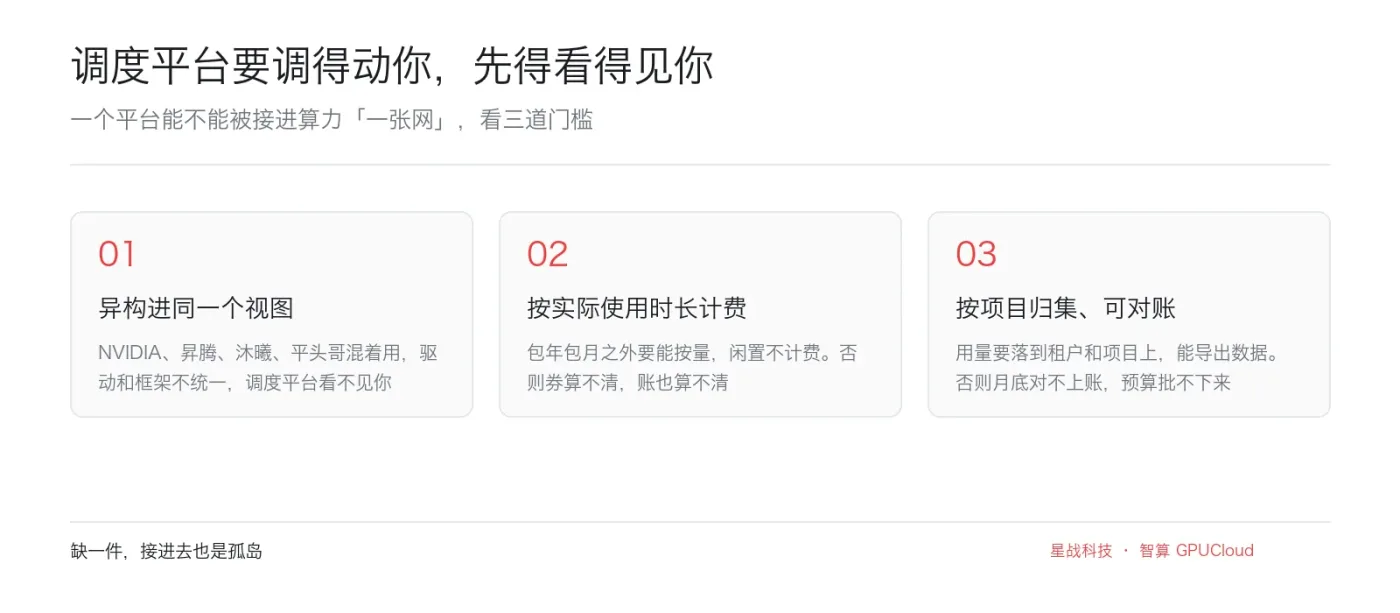
Taken together, these policy documents show that the unit of measurement for subsidies has switched to tokens. Vouchers are settled by invocation volume, with subsidies matching usage. A team with only a few self-purchased cards cannot spend these vouchers, because there is nothing to invoke. City-level platforms address where resources are, how they are scheduled, and how to coordinate across regions. Teams using computing power are stuck at a lower layer: owned and rented cards run together, drivers and frameworks are not unified, purchased computing power is not fully utilized, and month-end accounts do not reconcile.

Whether a team can be connected to that network depends on three things: whether heterogeneous cards can enter the same view; whether billing can be based on actual usage duration; and whether usage can be aggregated by project and exported for reconciliation. Miss one, and even a connected resource remains an island.
Intelligent Computing GPUCloud focuses on this layer: it unifies management of multi-architecture computing power from NVIDIA, Huawei Ascend, MetaX, T-Head and others, placing more than 20 GPU specifications in one view. It offers pay-as-you-go billing, with the smallest specification starting at RMB 0.5 per hour; idle