
Zhipu AI founder and chief scientist Tang Jie and the GLM team published a long-form article revealing that GLM is no longer merely assisting engineers with code generation; it is beginning to participate directly in building and optimizing its own inference infrastructure. During the launch of GLM-5.3-Flash, an Infra Agent driven by GLM-5.3 completed work that would previously have taken a senior infrastructure team weeks.
Specifically, on a cluster comprising more than 100,000 domestic chips, the team built a complete production-grade inference service from scratch. They faced challenges including relatively limited chip memory capacity and bandwidth, the need to support a 1M-token context window and multimodal requests for newly structured models, an immature ecosystem, and incomplete operator support. The Infra Agent participated in the final adaptation, diagnostics, and performance optimization, lifting end-to-end throughput to 3x the initial baseline in less than two weeks.
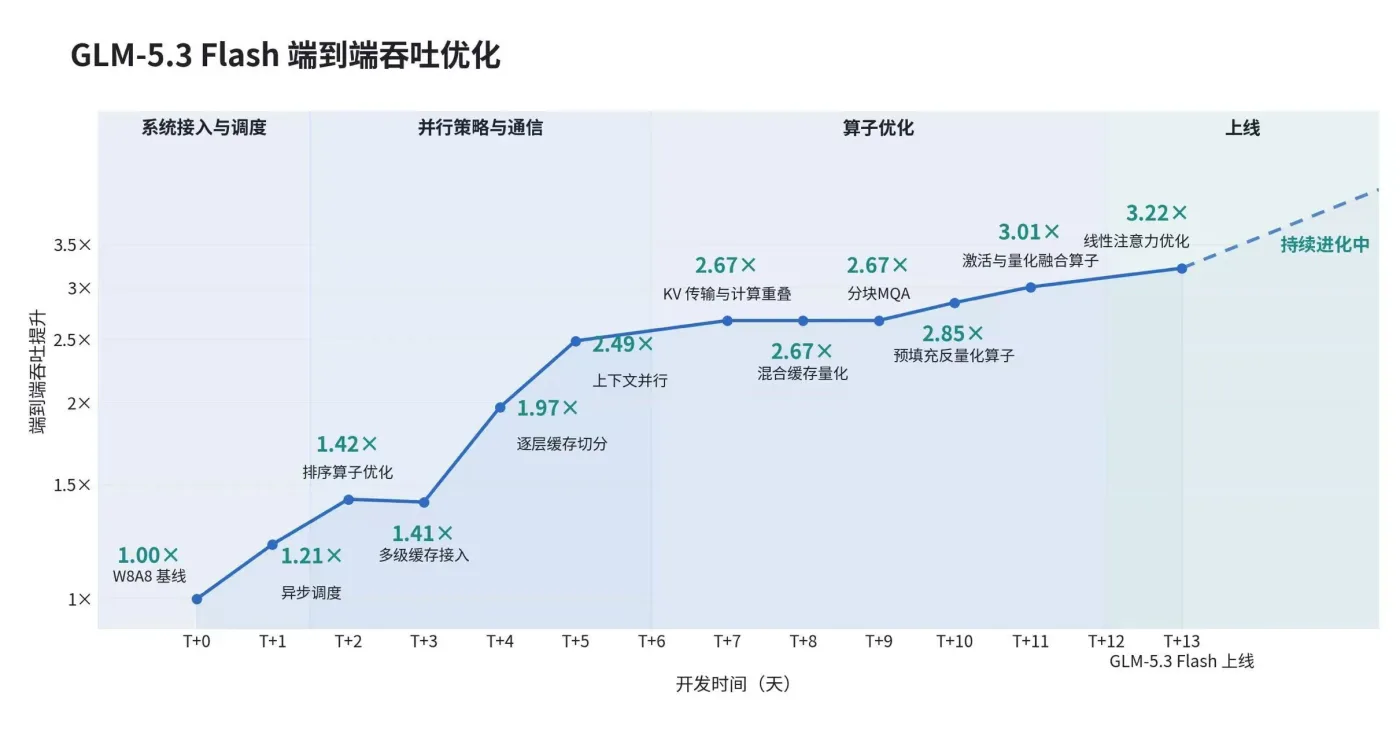
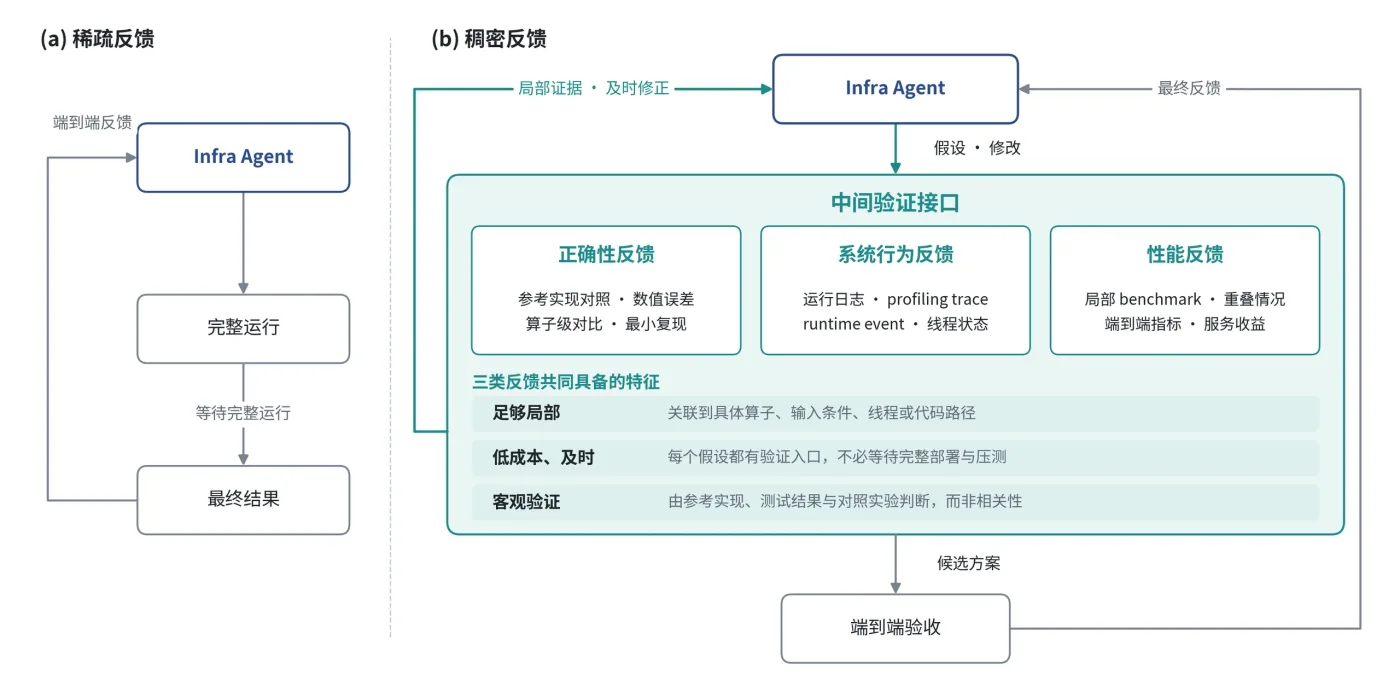
The team argues that this is not yet full recursive self-improvement, but an early form has emerged: AI is moving from “helping humans develop models” to “participating in building its own successor.” The Agent can autonomously propose hypotheses, modify code, and verify results based on dense feedback such as tests, traces, and benchmarks, allowing the model to begin optimizing the system that hosts its own operation.
What determines the engineering effectiveness of an Infra Agent is not only the model’s own code-generation and reasoning capabilities, but also whether the system can continuously provide it with effective, attributable feedback. A codebase can provide only static context, while accuracy anomalies and performance regressions often arise from dynamic interactions across operator implementations, parallel strategies, communication behavior, memory management, and service scheduling. End-to-end metrics can tell the Agent that “the result got worse,” but they cannot explain “why it got worse.”
This closed loop—where models optimize systems and systems host models—places higher demands on computing power infrastructure. The StarWar GPU Computing Platform uses compute resource management and dynamic scheduling to help enterprises reliably support training and inference workloads in multi-card, heterogeneous environments, directing limited engineering investment toward the areas that truly affect throughput.
The article also discloses several specific cases, including precision issues in an operator’s context-parallel path, a concurrency bottleneck in KV Transfer across the Python and C++ boundary, and performance optimization of critical operators. Together, they illustrate that the barrier in systems engineering lies in gradually converting vague anomalies into verifiable engineering hypotheses.
Zhipu also acknowledges that it has not yet reached full recursive self-improvement; choosing goals, setting boundaries, and judging risks remain human work. But the numbers—two weeks, 3x, and 100,000 chips—show that this trajectory will not slow down simply because we might prefer it to.