
Why It Can Fly
The answer lies in that line from the presentation: "the crystallization of the world's best car company and the world's best rocket company working together."
The Roadster can fly because Tesla simultaneously possesses three things:
● Electric drive and batteries
● Rocket propulsion
● Manufacturing and engineering
None of these three can be bought on the market. They belong to three completely different industries, yet they have grown inside the same company. The very existence of the "car + rocket" category is possible because the underlying foundation is complete enough.
The hardest technical moat has never been about how flashy any single point is—it's about how much of the underlying stack is yours.
AI has already moved from "can converse" to "can get work done." But what truly holds enterprises back has always been four things:
● Computing power constraints — chip supply bottlenecks, pricing bottlenecks; what you want to run, you can't run;
● Models out of control — one business connects to seven or eight models; cost, quality, and stability are all black boxes;
● Data afraid to leave the network — once core knowledge enters the public cloud, you can never quite say where it went;
● Employees can't use it — tools are bought in bulk, but the people who know how to use them are still just those few.
You'll notice these are the same class of problems Tesla encountered in building cars: if every layer depends on someone else, you'll never make something that belongs only to you.
Bought computing power, rented models, pieced-together toolchains—they let you "use AI," but they can't let you "grow AI capability." They can run a demo, but not a business line; they can demonstrate once, but can't sustain a quarter.
That's why StarWar Cloud chose a more rigorous path from the very beginning: from the most fundamental computing power to multi-scenario innovation capability deployment—full-stack self-development.
StarWar Cloud's Four Layers: Computing Power → Models → Agents → Scenarios

Broken down, this path has four layers.
L1 Computing Power Foundation · AI Computing GPUCloud
An elastic heterogeneous distributed intelligent computing cluster management platform. It unifies the management and scheduling of computing power across multiple vendors and architectures—NVIDIA, Huawei Ascend, MetaX, T-Head, and more—with 14 GPU specifications, pay-as-you-go billing, and no charges for idle resources.
What it does is the same as Tesla's Gigafactory and electric drive system: turning the bottommost layer into your own, schedulable infrastructure. How fast and how cheaply the upper three layers run is determined by this layer.
L2 Model Hub · SmartLink OpenAPI
A token factory and relay platform. Integration completed in 3 steps, already aggregating hundreds of mainstream models—DeepSeek, GLM, Qwen, Kimi, Doubao, MiniMax, Hunyuan, GPT, Claude, Gemini...
Its value lies in not being locked into any single model: whichever model is better, faster, or cheaper for a given task, the gateway routes to it. Service availability: 99.95%.
L3 Agents · SmartCreate DiWorker
A multi-agent collaboration platform. The CEO Agent serves as the decision-making hub: describe your requirements in one sentence, and it automatically completes requirement analysis → team assembly → task decomposition → collaborative execution → deliverable handoff.
Hundreds of digital employee roles cover technology R&D, design and creative, product operations, content creation, marketing—Coder, Writer, Designer, Tester, Marketer, Analyst, PM. No coding required, no hiring required.
L4 Scenarios · SmartBrain / SmartLearn / SmartReach / SmartMatch / SmartRead
● SmartBrain WorkMesh: A privately deployed AI brain for enterprises, running independently on-premises. Core knowledge circulates only within the intranet—100% data privatization. Measured results: 42% reduction in labor costs, 3.2x improvement in process efficiency.
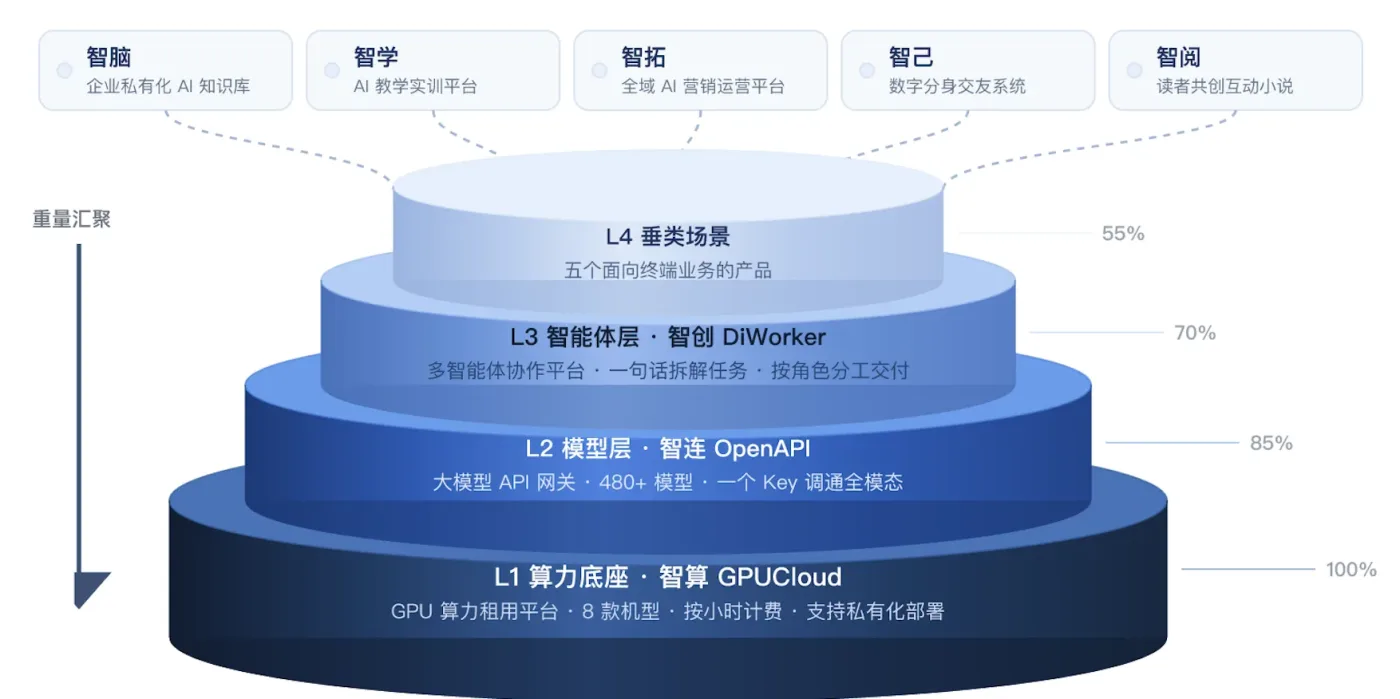
● SmartLearn AiEdu-Lab: An intelligent training platform for universities transitioning to "AI + discipline" education. "1+M+N" curriculum system + three training modes (VSCode online IDE, full-featured cloud desktop, zero-code AI creation tools). Already serving Wanli University, China Telecom, and Zhangjiang Youth Innovation Camp, with 15K+ platform learners.
● SmartReach GJ6: A six-dimensional full-funnel marketing system covering knowledge → content → channels → leads → customer service → insights. Identifies high-intent customers in 0.2 seconds; measured lead capture rate of 16.8%.
● SmartMatch Marry X: A digital avatar dating system for real-world matchmaking needs, launched in partnership with dating platform MarryU—avatars meet first, real people meet later.
● SmartRead WanXiaoShuo: An interactive co-creation novel platform. One sentence sums it up: the author writes the beginning, and the rest we create together. More on this separately later.
Musk said the Roadster will ultimately become "the only manually driven car Tesla produces," as the company's focus has shifted to autonomous driving and the Optimus robot. Sitting in the demo car was the humanoid robot Optimus.
The real weight of that statement: humans no longer operate—humans only issue objectives.
This is structurally identical to what StarWar Cloud's product matrix is doing. The traditional way of working is "driving yourself"—writing requirements docs, switching back and forth between Jira/Figma/Feishu, chasing progress, checking results. Now it becomes one sentence: "Build an e-commerce website."
The rest goes to the CEO Agent: it understands your intent, decomposes tasks, sequences them by dependencies, automatically matches the most suitable digital employee role teams, monitors progress in real time and alerts on anomalies, and finally archives and delivers code, documents, and design assets by project—with an assistant helping to publish at the end.
The car doesn't need you to drive it anymore, and the work doesn't need you to do it piece by piece. All you need to do is clearly state where you want to go.