
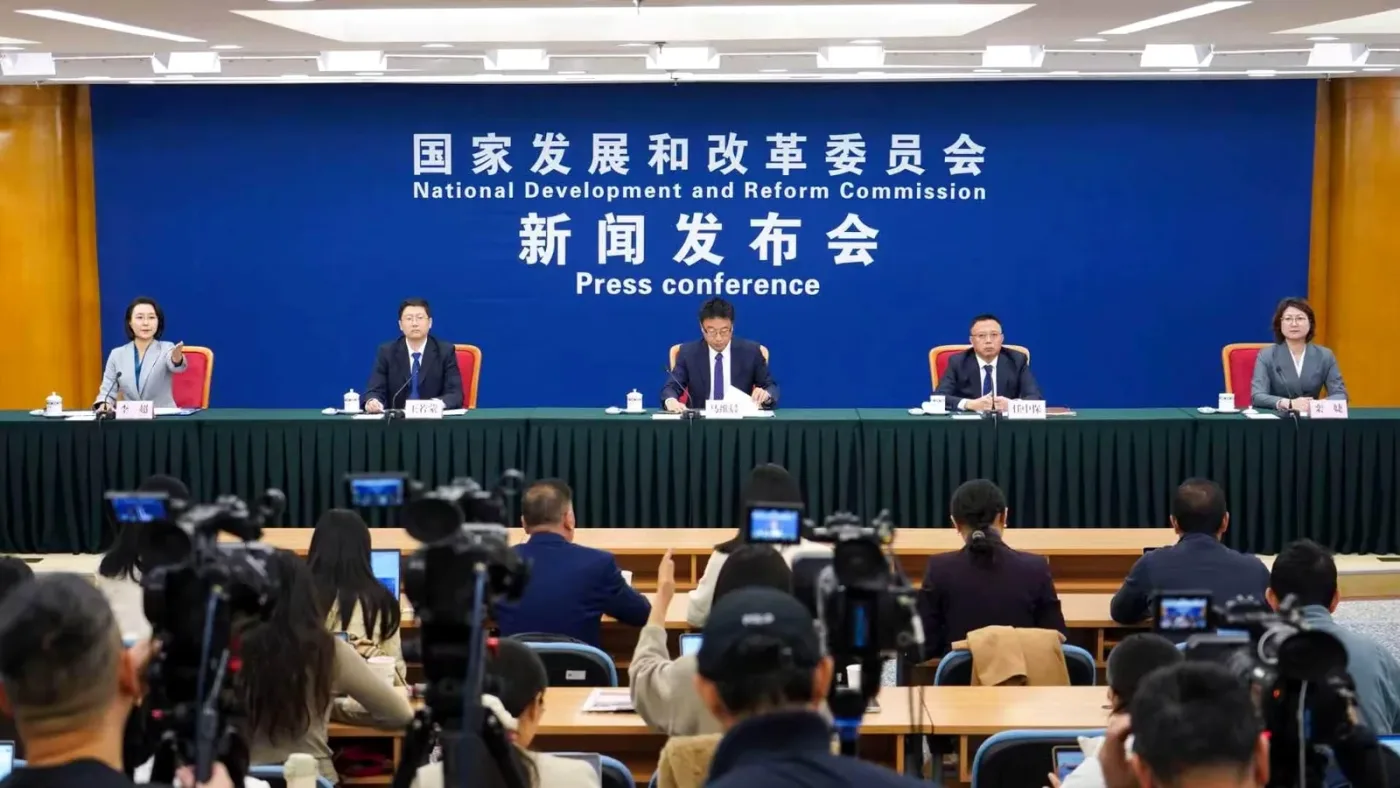
On November 3, the NDRC held a press conference in its “Striving for the 15th Five-Year Plan” series. Wang Ruomeng, deputy director of the Department of Innovation and High-Tech Development, said that in the services sector, AI agents can autonomously complete tasks such as contract review, customs declaration and tax filing, and insurance claims assessment.
That same day, China Economic Net published a report. Qiu Rong works in middle management, and her screen displays a row of AI agent names. “Big Baby” is the chief assistant, responsible for breaking down tasks, assigning them to other agents, and consolidating the results; “Little Secretary” tracks progress and organizes meeting minutes. She clicks through them one by one, introducing them as if they were colleagues. Her company has set a KPI: at least one work process must be handed over to AI agents every month.
There are costs, too. Qiu Rong said the company has since tightened travel and overtime expenses—“the tokens burned by AI and employee labor costs come from the same pool and trade off against each other.”
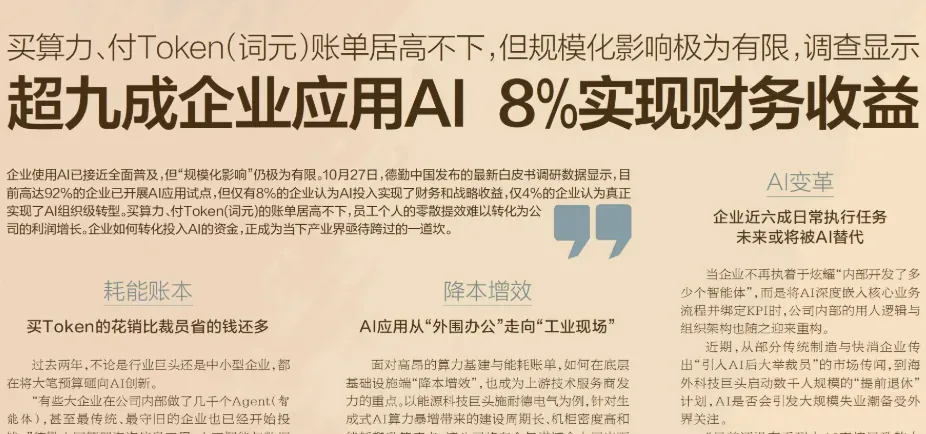
In Deloitte China’s white paper released on October 27, the two numbers are 92% and 8%—pilots have spread, but returns have not kept pace.
Tang Jie of Deloitte China Management Consulting pointed to the disconnect between “individual productivity gains” and “organizational productivity gains.”
“If your innovations are all point solutions and do not improve an end-to-end process, those simple efficiency gains simply cannot earn back the money compared with IT and infrastructure investment,” he said.
Several institutions’ surveys this year converge on the same finding. Teradata surveyed 1,000 technology and data executives and mapped an AI agent maturity funnel: 68% in experimentation and development, 25% in the build stage, and 7% operationalized.
G2 has a name for this hidden cost: the “distrust tax.” 31% of enterprises say employees spend at least six hours a week watching AI agents work, and 45% admit that oversight and rework consume more than a quarter of expected gains.
Model capability is no longer the bottleneck. Three more practical issues are blocking deployment: AI agents cannot connect to core business systems; accountability for errors remains unclear; and the same data does not mean the same thing across billing, finance, and marketing systems.
Large enterprises are hit hardest. In G2’s report, 27% of large enterprises require significantly more oversight—nearly double the rate for small and medium-sized enterprises (15%). The value of large enterprises lies precisely in those “non-standard” areas—decades-old proprietary systems and multi-layer approvals—which AI agents must first learn before they can work.
Small teams do not carry this burden, but they lack people. One person must handle research, design, development, and content at the same time; if any stage stalls, the whole effort stalls.
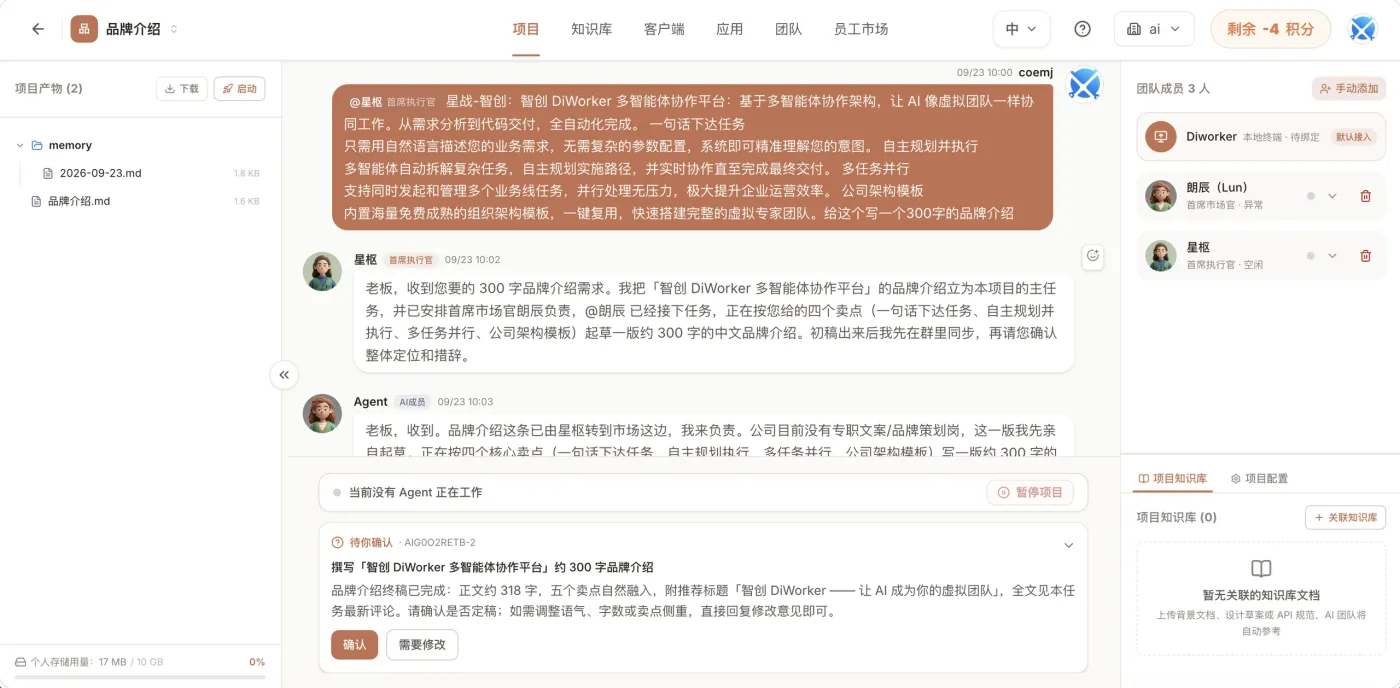
ZhiChuang DiWorker is built for this scenario. It does not preset a fixed organizational structure. Users first define goals, then design AI employee roles and collaboration relationships themselves—a CEO Agent coordinates, while strategy research, product design, development, and content each handle a segment. Users view a task dashboard and can change direction at any time; completed work accumulates into capability assets that can be directly invoked next time.