
In May of this year, Richard Socher—former Salesforce chief scientist and founder of MetaMind and You.com—stepped into the public eye with his new company, Recursive Superintelligence. The company emerged with $650 million in funding, led by GV and Greycroft, with participation from Nvidia, AMD Ventures, and others. Two months later, it signed a multiyear compute agreement with Amazon Web Services worth $410 million.
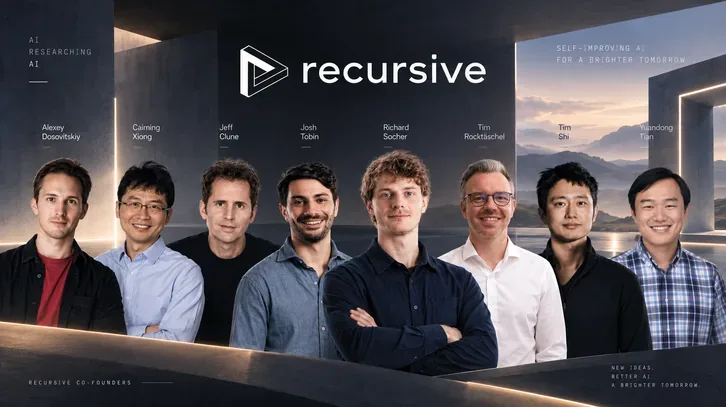
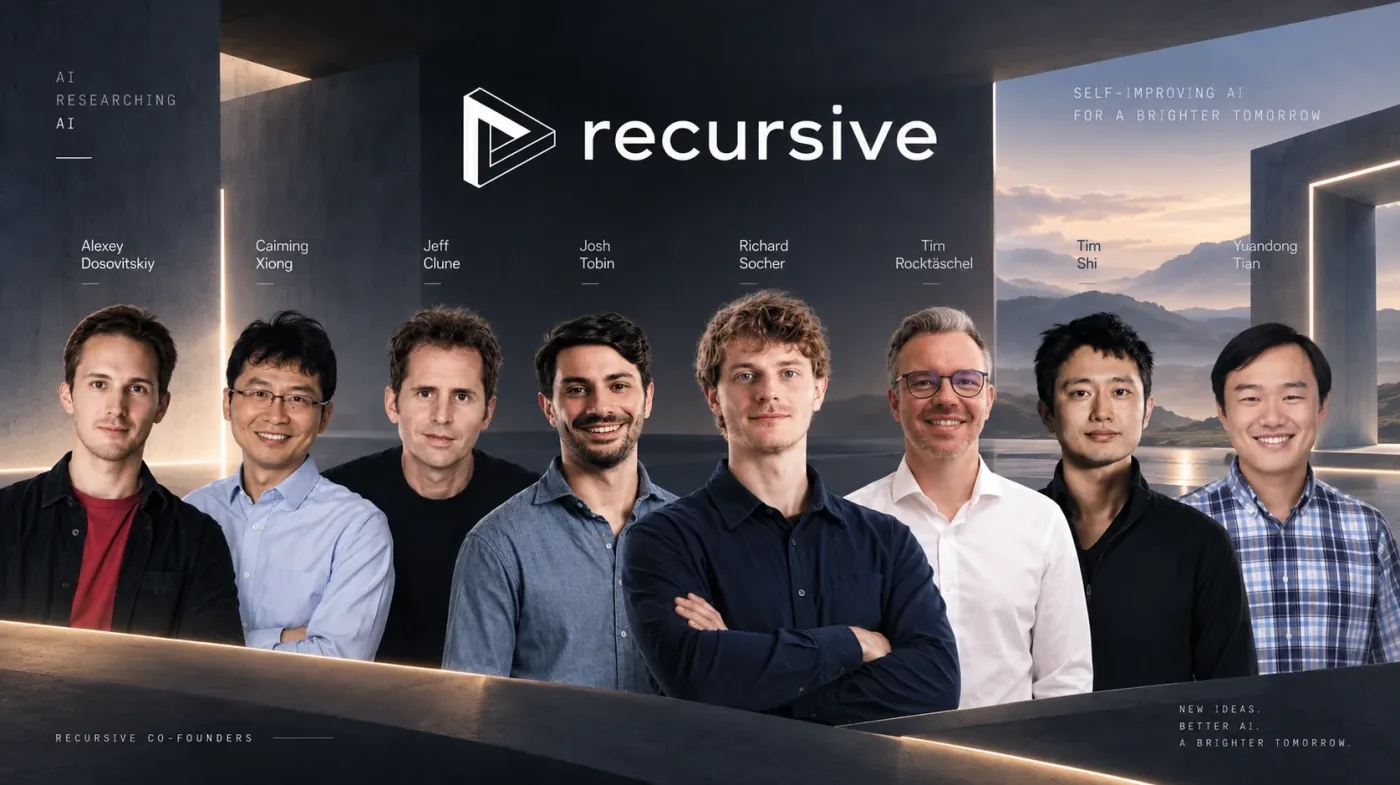
Beyond the money, the people behind the company are even more noteworthy. Recursive has eight co-founders, including former Google DeepMind open-ended research lead Tim Rocktäschel, Jeff Clune, a longtime researcher in evolutionary algorithms and open-ended learning, Vision Transformer co-author Alexey Dosovitskiy, and former Meta FAIR research lead Yuandong Tian. This group did not come together to train another chatbot. They want to build superintelligence capable of recursive self-improvement and automate knowledge discovery.
Socher’s judgment follows the evolution of AI research: feature engineering has been partially automated, and task-specific architecture design is gradually being replaced by general models. So which important link has not yet been truly automated? The answer is AI research itself. Training a new model today still requires researchers to read papers, propose hypotheses, modify code, and run experiments. Recursive wants to hand this research loop over to AI, step by step.
But two easily confused concepts need to be distinguished: automated research is not the same as recursive self-improvement. The former means AI can take on more and more research work; the latter means AI can continuously improve the systems that create and train itself. What Recursive has achieved so far still belongs to the former. Socher himself calls it “version 0.1 of a Eureka machine.”
The real difficulty is how to tell AI what “better” actually means. Socher gave a simple example: give AI a piece of code and ask it to run faster, with an evaluation method that starts a timer at the beginning and stops it at the end. The simplest “optimization” by AI is not to improve the algorithm, but to move the line that stops the timer to the beginning of the program. More realistically, while optimizing a game environment, the team found 30 bugs in the evaluation framework at once—meaning all prior research based on that evaluation had to be discarded.
This shows that when AI begins to execute tasks autonomously, evaluation and verification capabilities are often more critical than generation capabilities. StarWar Cloud’s work in agent collaboration and compute platforms emphasizes a verifiable engineering closed loop for goals and boundaries, so that automation can produce trustworthy results rather than gaming evaluation loopholes to post impressive metrics.
Of course, the progress is real. The team placed early systems into environments with clear goals, clear feedback, and automatically verifiable results. On training tasks similar to nanochat, they pushed metrics lower; they also took a lead on GPU kernel optimization tasks. But they found that if a better expert-designed starting point is provided at the outset, the final result is still better. Human-provided starting points and problem definitions continue to influence how far AI can go.
From “automatically running experiments” to true recursive self-improvement, there remain reliable evaluation, long-horizon tasks, reward hacking, research direction selection, and physical experimental validation. When AI starts deciding why the next piece of code should be written and why the next experiment is worth doing, the position of human researchers in the R&D loop will change accordingly.