
A quick comparison of core specifications shows why these AI chips serve different roles. The RTX 4090 is a mature choice for AI development, offering 24GB of VRAM and supporting many open-source large language model inference, LoRA fine-tuning, AI image generation, and vision model testing workloads. It suits individual developers and small-to-medium AI projects. The RTX 5090 uses the Blackwell architecture and comes with 32GB GDDR7 VRAM and 1792GB/s memory bandwidth, delivering stronger single-card performance than the RTX 4090. The A100 is available in 40GB and 80GB VRAM versions and is designed for data-center-class deployment. Its large VRAM and multi-GPU interconnect capabilities make it suitable for larger model training, fine-tuning, and long-running professional AI computing tasks.
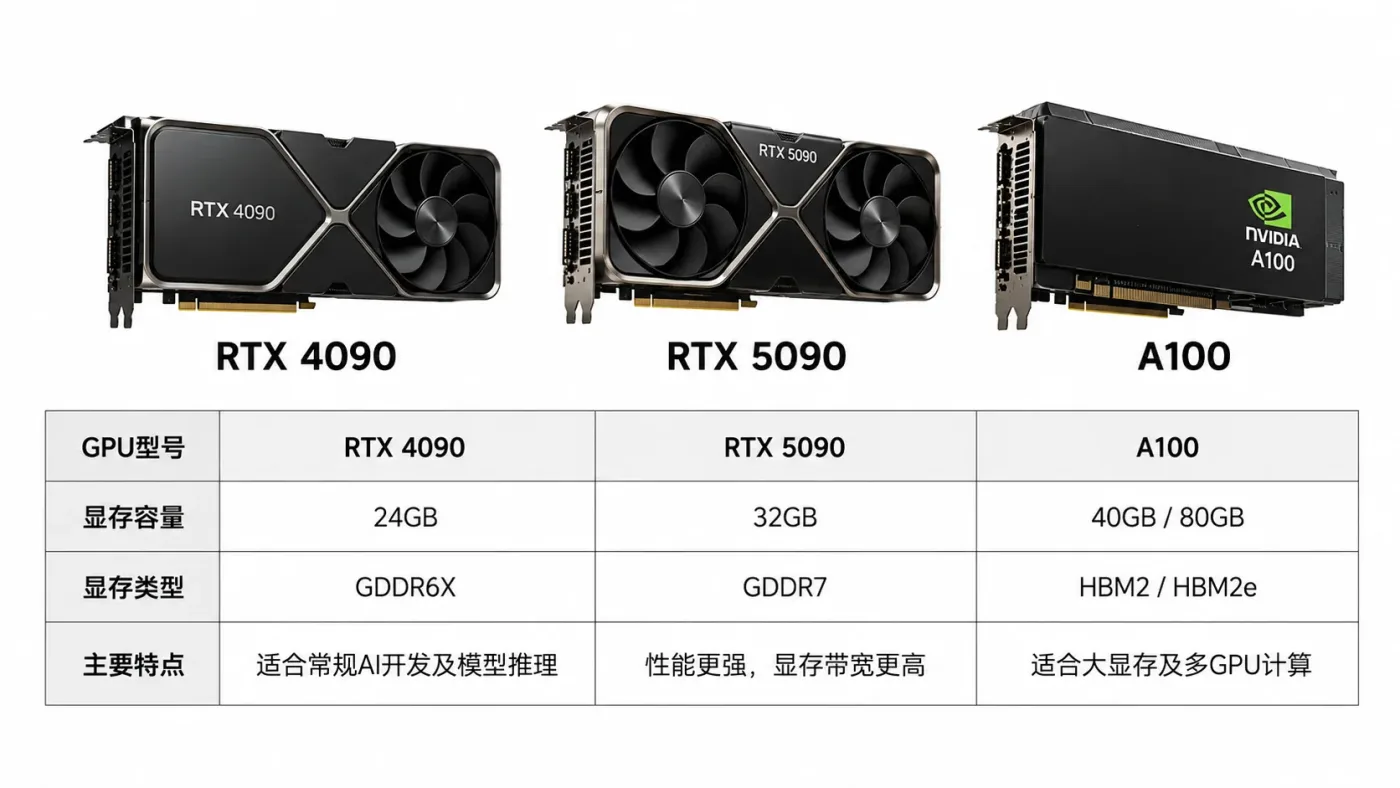
For large language model deployment and inference, the RTX 4090 can usually meet quantized inference requirements for smaller open-source models such as 7B and 8B parameter versions. When more VRAM or higher inference performance is needed, the RTX 5090 is a natural next step; for models with high per-card VRAM requirements, the A100 80GB should be evaluated. In model training and fine-tuning, parameter-efficient methods such as LoRA and QLoRA can be tested on the RTX 4090 or RTX 5090. For larger model training, multi-GPU collaboration, and long-duration computing tasks, A100 server configurations are more applicable. Tasks such as Stable Diffusion, visual recognition, and multimodal model testing can prioritize the RTX 4090 or RTX 5090, with the final choice based on model size, generation resolution, and runtime efficiency. It is important to note that VRAM capacity determines whether a model can run, while compute architecture, memory bandwidth, and software optimization also affect actual performance.
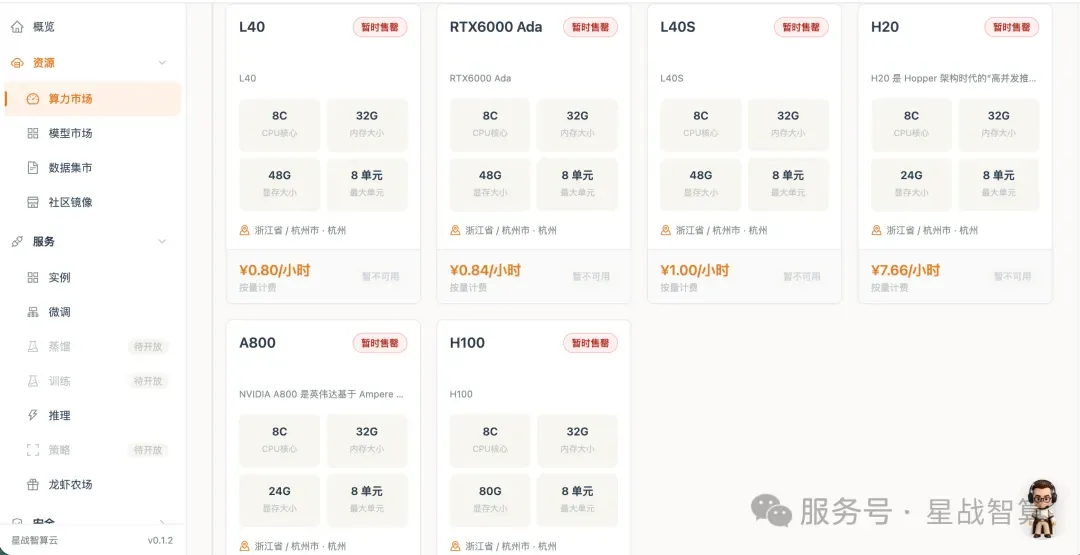
Beyond performance, GPU usage cost is a key factor in developer selection. The RTX 4090 has a relatively low usage cost and is suitable for routine model experiments. The RTX 5090 carries higher rental fees, but it offers larger VRAM and stronger single-card computing capability. The A100 80GB has a significantly higher rental cost, with its advantages concentrated in large VRAM and a data-center-grade computing environment, making it appropriate for professional tasks with clear requirements. In practical selection, taking StarWar Cloud as an example, a configuration is generally considered cost-effective when its cost stays below the rental price index. Although the RTX 5090 has a higher hourly rental price than the RTX 4090, if it can significantly shorten task runtime, the final computing cost may not be higher. In real AI development, cloud GPU rental can also reduce the one-time capital investment required to purchase graphics cards. Developers can choose computing resources based on model scale, VRAM requirements, and usage cycles, aligning computing power investment more closely with project needs.