
The latest global weekly Token call ranking for AI large models shows that China's AI large model weekly call volume has maintained its global lead for 21 consecutive weeks, reaching 4.7 times the U.S. level; DeepSeek V4.1-Flash ranked first, with 219% month-over-month growth.
Call volume is replacing benchmark scores as a key indicator of real-world model usage. What the ranking reflects is not a one-off high score in an evaluation, but the scale formed after large language models (LLMs) are integrated into products and repeatedly invoked by users—a scale shaped jointly by cost, stability, response speed, and ecosystem.
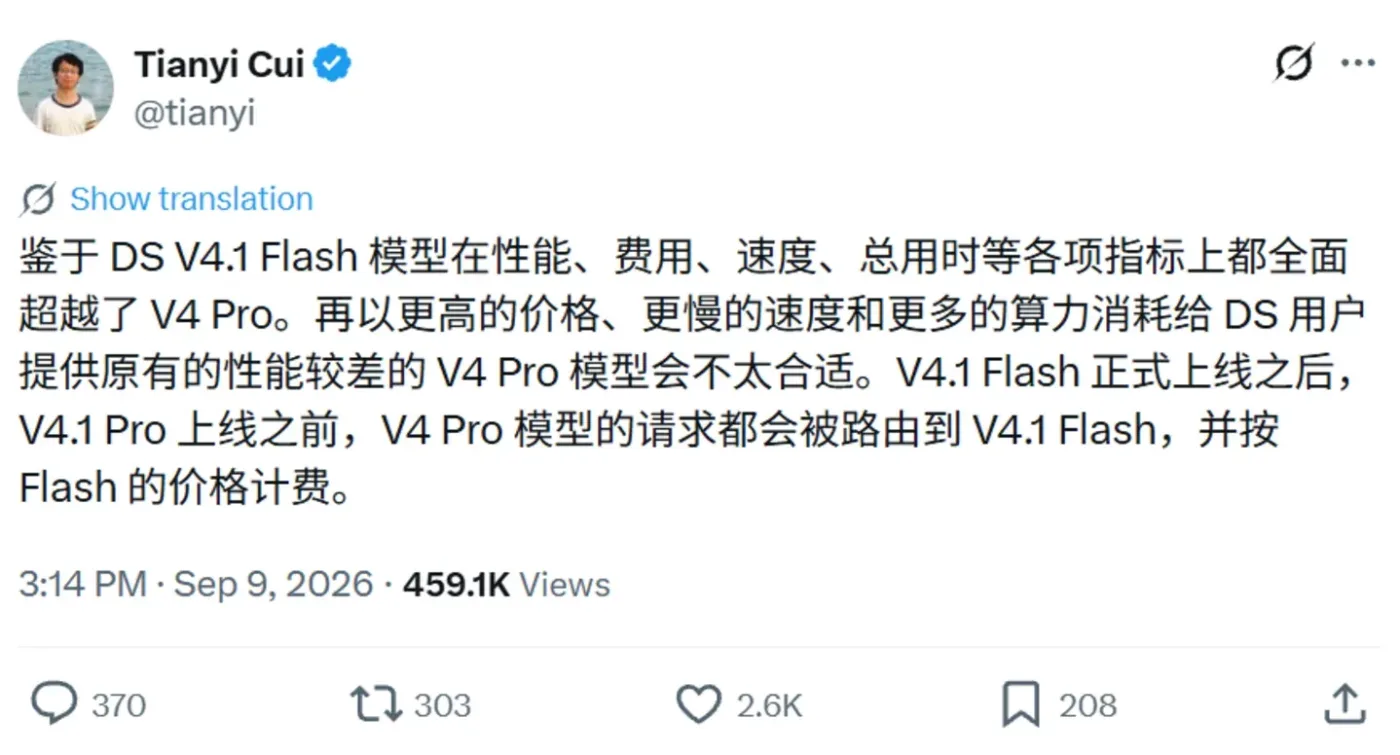
As model capabilities converge, the key factor in enterprise choice will shift toward total usage cost and stability. Open-source and low-cost models can already deliver solid results on logically simple, clearly defined tasks. A decline in per-task cost directly lowers the barrier to AI deployment, making workflows previously shelved because their economic model did not hold up become feasible.
But the larger the call scale, the more concentrated the problems become. Enterprises often need to integrate multiple models at once, and different tasks have different latency requirements, billing methods, and invocation protocols. Interface fragmentation quickly drives up switching and operations costs, leaving many capabilities stuck in demos rather than truly entering business processes.
This is exactly the problem StarWar Large Model API Plaza aims to solve. By aggregating multiple models through a unified invocation interface, enterprises can select by scenario and switch relatively smoothly, making the cost and stability behind high-frequency calls more controllable instead of getting stuck in the engineering details of one-by-one integrations.
Leading in call volume also means heavier inference pressure. When models are invoked at high frequency, compute scheduling, rate limiting, and cost control—along with the AI chips and infrastructure that support them—directly determine service experience. Once capacity cannot keep up, what users feel is fluctuation and instability. Scale will continue to amplify, and whether it can be absorbed depends on infrastructure elasticity.
From leaderboard chasing to call-volume chasing, the coordinates of competition have changed. What can truly sustain this round of growth are platforms that can simultaneously keep pace on cost, stability, and scheduling.