
The new-generation simultaneous interpretation large model Qwen3.8-LiveTranslate has been officially released, with comprehensive upgrades across four dimensions: translation quality, latency, speaker recognition, and speech synthesis. The model uses an audio-text interleaved Interleave architecture that integrates streaming understanding, text output, and speech generation into a single causal sequence. Average per-character latency has been compressed from 2.8 seconds in the previous generation to 2.3 seconds.
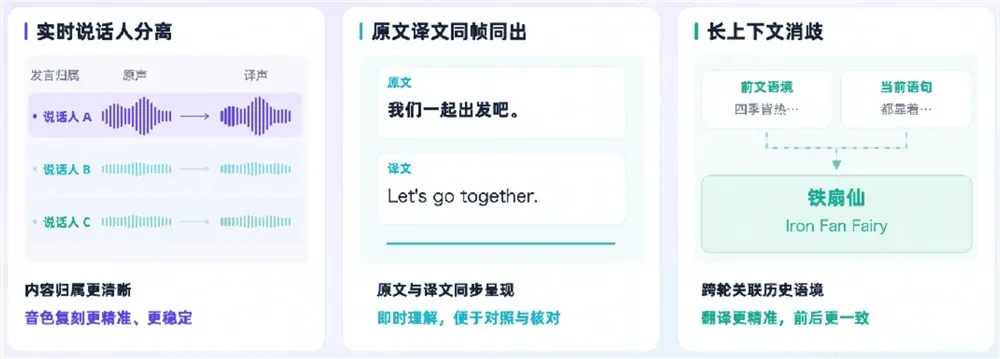
Real-time simultaneous interpretation has long been a scenario that tests an LLM’s engineering capability. It is more demanding than ordinary text generation because the system must understand, translate, and synthesize speech; any jitter in any link is directly perceptible to the human ear. The three highlights of this update are real-time speaker separation, same-frame output of source and translated text, and long-context disambiguation—all pointing to the same goal: making translation responses feel closer to natural conversation.
The model adopts a Hybrid MoE Thinker–Talker dual-module design. Thinker handles understanding and translation, while Talker synthesizes translated speech that preserves the original timbre. On a multi-speaker long-audio benchmark covering 14 language directions, the company claims it outperforms current mainstream real-time simultaneous interpretation systems in translation fidelity, fluency, conciseness, and speaker-separation error rate. It currently supports 60 languages, and the API has launched simultaneously on the Qwen AI platform.
However, the real threshold for real-time capability is not benchmarks, but the combined balance of latency, concurrency, cost, and stability. Enterprises often need to integrate more than one model; different tasks have different latency requirements, billing methods, and invocation protocols. Fragmented interfaces quickly drive up switching costs, leaving many capabilities stuck at the demo stage.
This is precisely the problem StarWar Large Model API Plaza focuses on. By aggregating multiple large models through a unified invocation interface, enterprises can choose models by scenario and switch relatively smoothly, allowing capabilities such as real-time translation to enter customer service, meetings, and cross-border collaboration workflows faster, rather than getting bogged down in one-off integration details.
The latency reduction from 2.8 seconds to 2.3 seconds may look like only a fraction-of-a-second optimization, but behind it is a change in interaction rhythm—from “wait a while, then see the result” to an experience closer to synchronization. Such seemingly minor engineering progress often changes product forms more than a single parameter increase.
The team says next steps will focus on pushing end-to-end latency to its limits, cross-session long-term memory, and coverage of more languages. The direction is clear: for model capabilities to truly create value, it ultimately depends on whether engineering and invocation systems can reliably deliver those capabilities.