
When AI can already predict what a protein "looks like," the next question is whether it can understand how it "works." How protons transfer during enzyme catalysis, how chemical bonds break and form, and how conformations change after a drug binds to its target—these dynamic processes at the nanosecond timescale and atomic scale are what truly determine molecular function. Recently, research on QuantaMind, a reactive atomic modeling platform independently developed by Molecule Mind, was published in Science Advances.
Understanding how molecules "work" depends on reactive molecular dynamics simulation, which tracks the continuous motion of atoms to capture the full process of proton transfer and chemical bond breaking and formation. The long-standing dilemma has been that accuracy, speed, and scale are hard to achieve at the same time: traditional quantum chemistry methods offer extremely high accuracy but are computationally prohibitive for large systems; classical molecular dynamics can handle large systems but cannot describe chemical reactions; existing machine learning force fields perform well on small molecules but struggle to remain stable in long-time simulations of large biological systems.
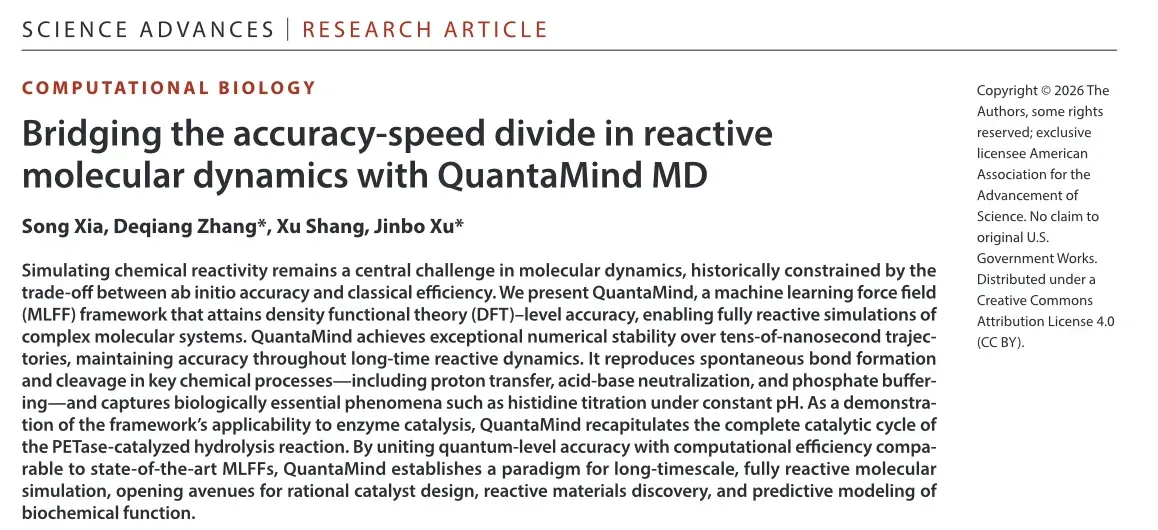
As a reactive machine learning force field framework, QuantaMind seeks to push all three dimensions—accuracy, speed, and scale—into a range usable for biopharmaceutical R&D through innovations in data engineering and model architecture. According to the paper, on an NVIDIA A100 80GB GPU, its inference speed is comparable to current state-of-the-art machine learning force fields. The paper's most critical validation involved a 6-nanosecond reactive molecular dynamics simulation of a PET hydrolase system containing 17,792 atoms, completing a full catalytic cycle and extracting 342 conformations from the trajectory for independent DFT single-point calculations to verify accuracy.
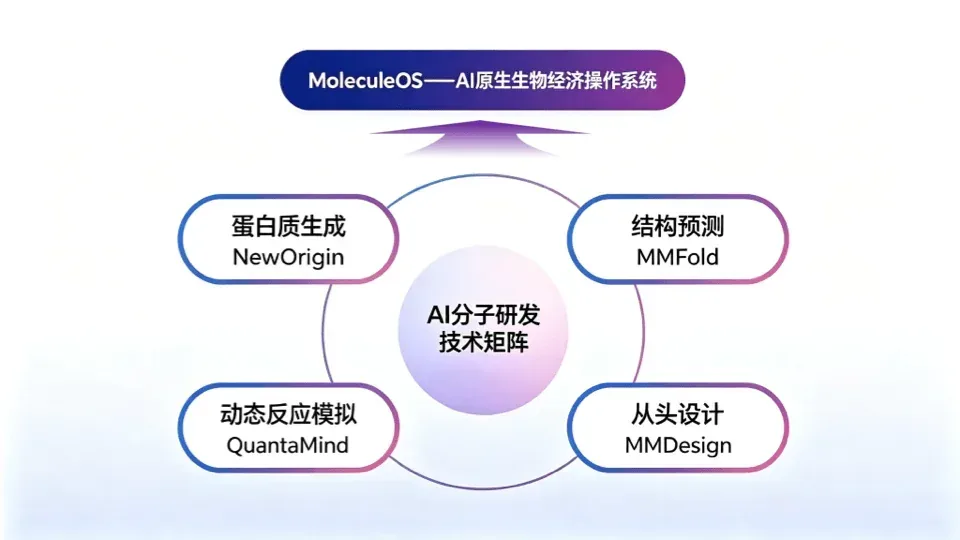
The largest system actually validated in the paper was 24,001 atoms, with the longest simulation at 20 nanoseconds; the latest extended tests after submission further reached the 100,000-atom scale and 100-nanosecond timescale. This means chemical reactions no longer have to be validated only after the fact—they can be simulated in advance on the computing side. For drug and enzyme engineering, "seeing how a reaction occurs in advance" can significantly shorten trial-and-error paths.
This aligns with StarWar Technology's focus on GPU computing platforms and scientific computing: every step of such simulations relies heavily on GPU computing power and high-end AI chips, and places extremely high demands on VRAM, interconnect, and long-running stability. For AI for Science to become truly usable, algorithms alone are not enough. Heterogeneous computing resources must be organized into schedulable, long-running resource pools, allowing research teams to use them elastically according to task