
Letting models generate their own training data, rewrite their own prompts, and repair their own code is a route known as recursive self-improvement (RSI). But almost all RSI systems share the same structure: a fixed improvement program repeatedly acts on the model, and often approaches the problem from only one perspective—Harness-RSI, Data-RSI, or Model-RSI.
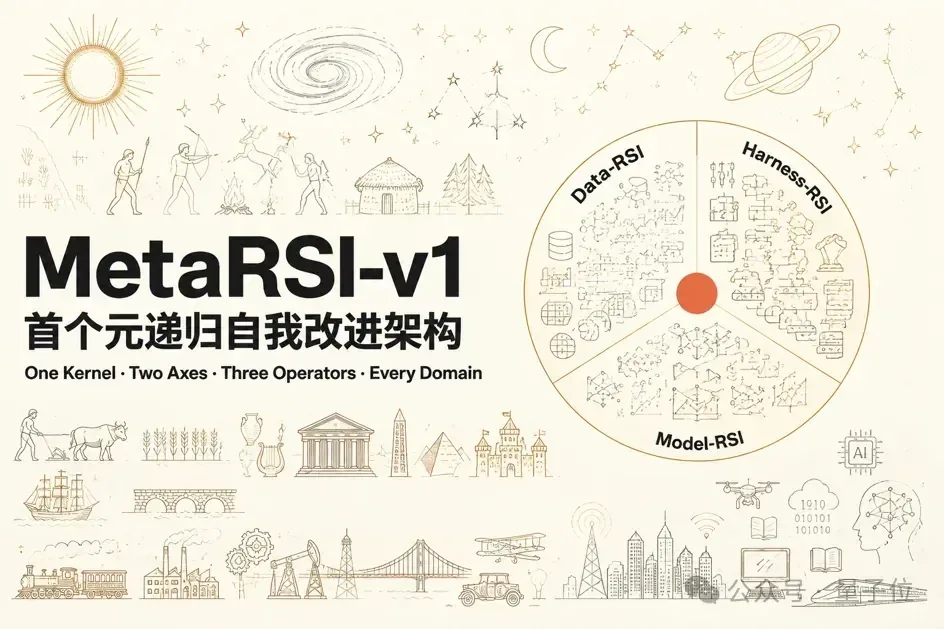
To address this challenge, CosmosMind, together with more than ten universities including Stanford, Berkeley, MIT, Tsinghua, and Peking University, released MetaRSI-v1, calling it the world’s first meta-recursive architecture unifying Model-RSI, Data-RSI, and Harness-RSI and capable of improving the “process of self-improvement.” Without an external teacher model, it enabled a small model with only 3 billion activated parameters to self-improve by an average of 10.9 points across four benchmarks, while helping six frontier flagship models, including GPT-5.6 and Claude Opus 5, improve by an average of 7.3 points.
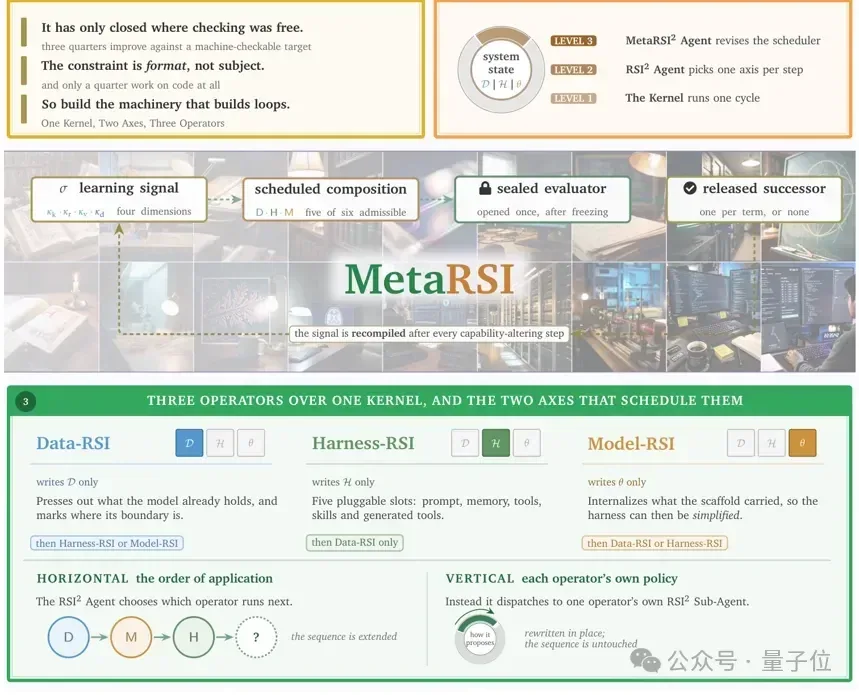
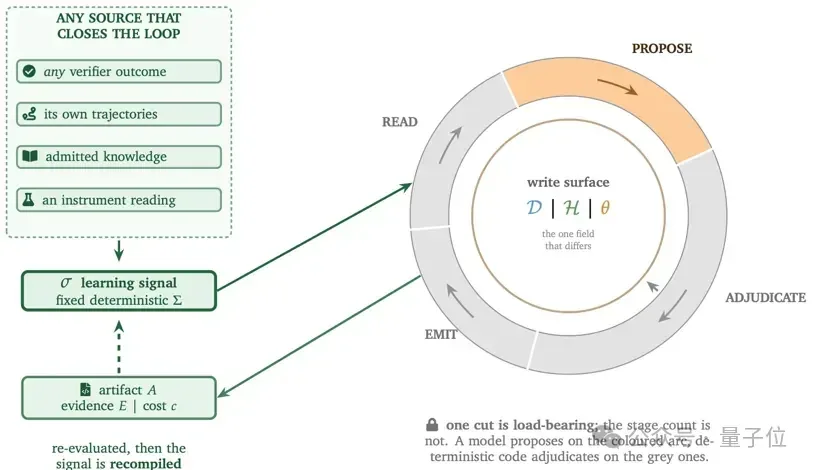
MetaRSI-v1 proposes the Loop Kernel paradigm, abstracting “how progress happens” into an object-agnostic closed loop: consume feedback to obtain learning signals, propose changes to Data, Harness, and Model, submit them to a verifier for judgment, and feed the results back as signals for the next round. Data, Harness, and Model thus become different instantiated operators of the same Kernel—composable and capable of unified scheduling.
Along the same kernel, improvement unfolds in three spaces: Data-RSI extracts learning signals from its own execution traces for synthetic data; Harness-RSI adds or removes pluggable slots such as System Prompt, Skill, MCP, Tools, and Memory; and Model-RSI updates the model’s own parameters and structure to internalize behaviors repeatedly verified as effective. The entire architecture is coordinated by four Agents and can be partially replaced by human experts, forming a human-in-the-loop system.
This aligns with StarWar Technology’s focus on agent collaboration and compute scheduling: when a system tests, evaluates, and iterates on its own, compute consumption and validation quality become prerequisites for continuity. RSI involves