
MIT's research report delivers a startling number to the industry: of all enterprise-grade AI pilots, only about 5% ultimately reach production and generate measurable returns, while the remaining 95% of investments yield no visible payoff. Adoption rates of task-oriented GenAI tools decline progressively through project phases—from 60% entering evaluation, to 20% moving into pilots, down to just 5% achieving successful implementation. Meanwhile, there's a paradoxical picture of near-saturation in enterprise AI adoption: employees are using the tools, companies are buying them, pilots are running—yet the chasm between penetration rates and production-grade implementation marks the true deep water of today's AI industry.
What deserves even greater vigilance is that most enterprises don't realize they're in deep water. IDC China data shows that more than 60% of enterprises in both the global and Chinese markets believe their AI applications are already relatively mature. But measured against rigorous maturity models, fewer than 3% of enterprises have actually entered high-level maturity. As IDC analysts point out, what's dangerous isn't failing to recognize AI's value—it's overestimating one's own maturity and letting that overestimation drive budgets and pacing.
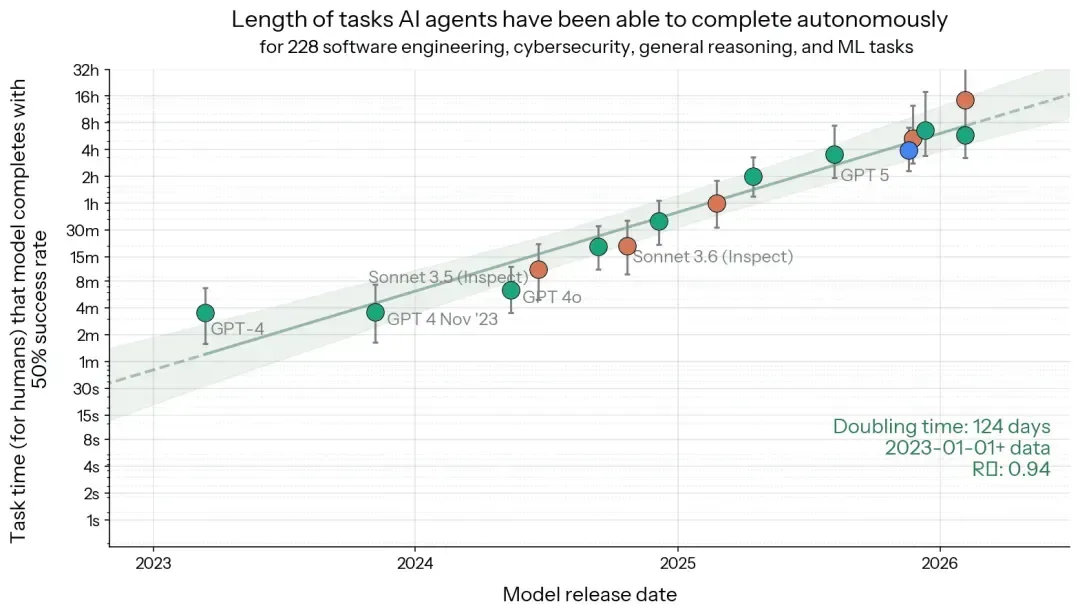
The essence of difficult AI implementation lies in the enormous time gap between the exponential explosion of large-model technology and the linear evolution of enterprise organizations. The duration of tasks that frontier AI Agents can complete autonomously with a 50% success rate has roughly doubled every seven months over the past six years, with models' complex reasoning capabilities leaping across generations on nearly a half-year cycle. But enterprise data architectures, business processes, permission systems, and even accountability frameworks can only change far more slowly. Technology sprints while organizations jog—this is the deepest contradiction in enterprise AI implementation today.
Sangfor founder He Chaoxi attributes this gap to the mismatch between legacy cloud-era infrastructure and AI's new workloads: no matter how powerful a model is, divorced from high-quality data it becomes water without a source. While the unit price per token is declining, the explosion in context length and call frequency is driving compute bills into exponential territory. Once agents are granted execution permissions, the risks of unauthorized operations and accidental data deletion far exceed traditional network leaks. "Can't afford it, can't account for it, don't dare use it"—this has become the shared dilemma facing most enterprises after testing the AI waters.
In response to these challenges, the industry is forming a systematic reconstruction path: establishing unified compute gateways and metering/accounting views so heterogeneous compute resources can be scheduled and costs compressed—with extensive practice showing that granular operations management can deliver 2-to-5x cost reductions; building cross-protocol unified data fabrics to eliminate the overhead of data shuffling by agents; deploying AI-native security systems to counter machine-speed attacks; and establishing governance rules for agents similar to those for human employees—least privilege, auditable trails, and emergency revocation. Every step transforms black-box AI spending into itemized ledgers.
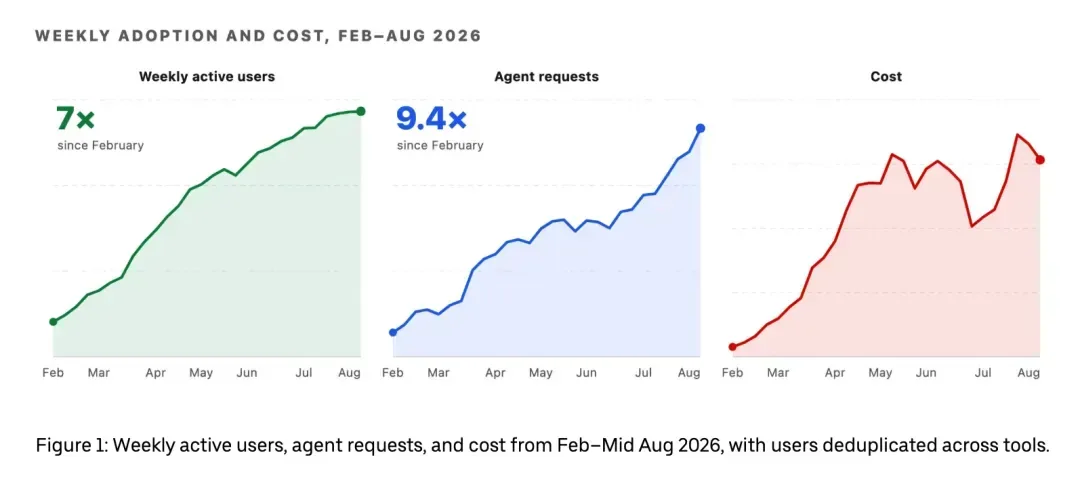
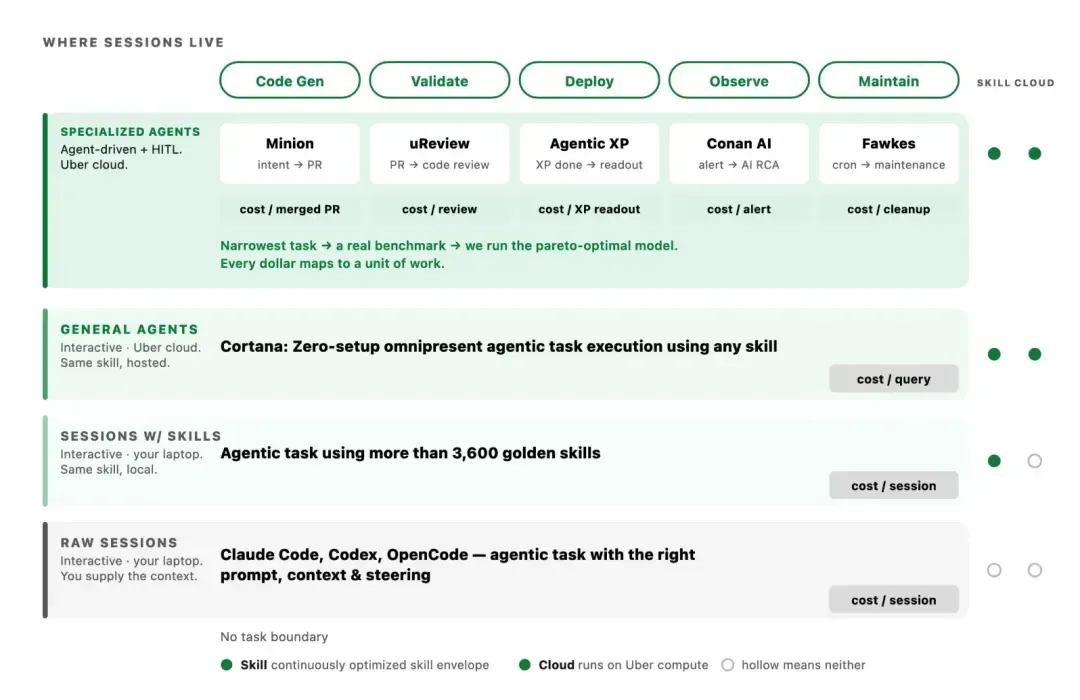
This logic of shifting from buying models to operating AI doesn't merely live in the blueprints of infrastructure vendors. Uber's disclosed data is highly representative: weekly active users of the Agent products used by employees grew 7x, request volume grew 9.4x, yet total AI spending has remained stable since April—achieved not by hunting for cheaper models, but by decomposing a single Agent operation into measurable stages, then reducing costs layer by layer through model routing, caching, and real-task evaluation. Once AI enters production, the competitive focus rapidly shifts from whether you have Agents to whether you can see every call clearly and control every dollar of cost.
IDC forecasts that global AI software and hardware spending will reach approximately $940 billion in 2026, climbing to $2.1 trillion by 2029. The next three to four years represent a reshuffling period where massive capital floods into infrastructure before value has been fully realized. Within this window, companies that can first build solid compute scheduling and cost governance capabilities will establish first-mover advantages before the investment structure reverses. StarWar Cloud's continued investment in GPU computing platforms and compute scheduling orchestration is precisely about helping enterprises establish a measurable, optimizable, and governable AI engineering foundation beyond just the model gateway.
For enterprises, admitting they're still wading through shallow waters isn't shameful—mistaking proof-of-concept for mature productivity is the real risk. In the second half of AI transformation, the competition isn't about who first announces they're using AI, but about who can first honestly see where they stand, and then turn every investment, every call, every agent behavior into something measurable, traceable, and improvable.