
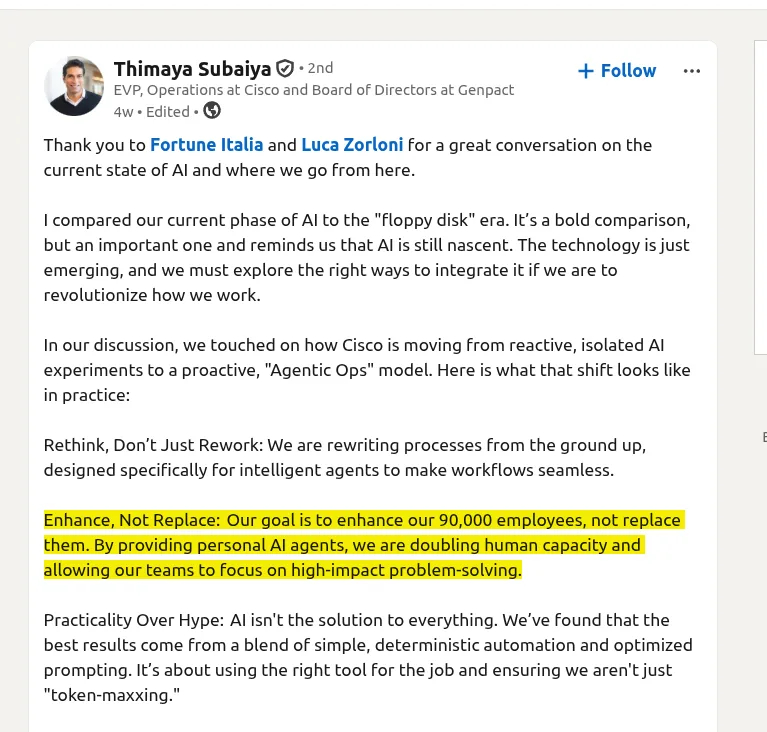
On August 27, Cisco announced it had begun deploying MyAgent, its personal AI agent, to roughly 90,000 employees globally. This is not a small-scale pilot—it is a full-scale rollout covering the entire workforce. Developed by Cisco's internal R&D team on top of the AI platform "Circuit" that has been under construction since 2023, MyAgent is described as a "super agent" or "digital twin."
Placed within the industry landscape, the 90,000-user figure is not entirely unprecedented: JPMorgan's LLM Suite reached 200,000 employees within eight months, and Walmart has been equipping an even larger frontline workforce with AI tools. What makes MyAgent noteworthy, however, is that Cisco is attempting to transform internal AI from a chatbot that employees proactively open into an execution gateway that maintains persistent memory, invokes tools across systems, and progresses tasks autonomously in the background.

Underpinning this is a product philosophy of "supervised autonomous execution": employees provide goals, context, and desired outcomes; the agent determines which systems to call and in what sequence, then operates in the background under appropriate human oversight. MyAgent is connected to more than 800 specialized agents behind the scenes, functioning more like a master orchestrator than a single-model endpoint.

Supporting this system is a multi-model, governed internal AI platform: simple, deterministic operations are routed to traditional automation; routine language tasks are handled by locally hosted open-weight models; and only complex reasoning triggers calls to external frontier models. Cisco is also running open-weight models on GPUs in its own data centers, retaining a portion of its compute capacity in-house. This routing mechanism serves both as a cost-control measure and a data sovereignty strategy.
In practice, the challenges Cisco has encountered are equally typical: the reliability of AI tools depends on the quality of training data, requiring early teams to ensure only clean, structured data is fed in; meanwhile, driving adoption among cautious or non-technical employees necessitates robust training and awareness-building. Scaling agents across an enterprise has never been purely a technology problem.
As enterprise agents multiply and cross-system invocations become more frequent, underlying compute orchestration and platform governance emerge as hard constraints—with multiple models and hundreds of agents running in parallel, a stable compute foundation and unified management interface become essential. StarWar Cloud's focus on GPU compute platforms and scheduling orchestration is precisely aimed at providing scalable compute support for this class of enterprise-grade agent deployments.
The Cisco case demonstrates that the next phase of enterprise AI is no longer about "whether to use it," but "how to use it well at scale." From point tools to platforms, from proactive usage to autonomous execution, engineering capabilities around memory, permissions, orchestration, and governance will determine the real-world productivity of enterprise agents.