
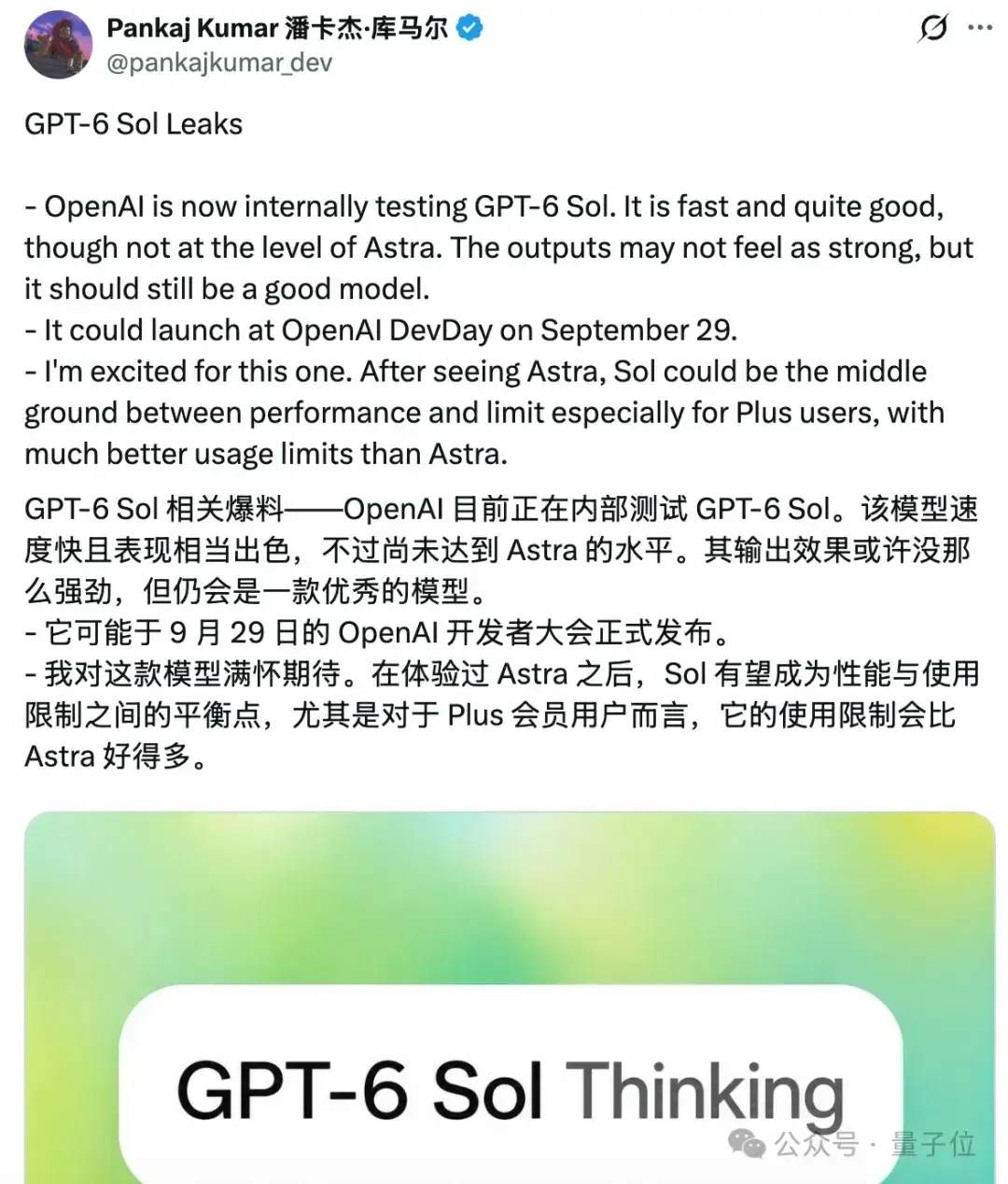
GPT-6 is not just Astra. Only days after Astra’s release, GPT-6 Sol was reported to be in internal testing, and its performance stands out. According to leaker Lentils, Sol’s overall output capability is noticeably weaker than the just-launched Astra, but it is faster—about six times faster in a single test—and still belongs to the “monster-class” of models. A user tested different models on the same task: generating an SVG image of a BMW M4 Competition. GPT-6 Sol, using Max mode with zero-shot generation, took about 3 minutes and output about 28,000 tokens, while GPT-6 Astra, also in Max mode, output about 25,000 tokens and took about 19 minutes.
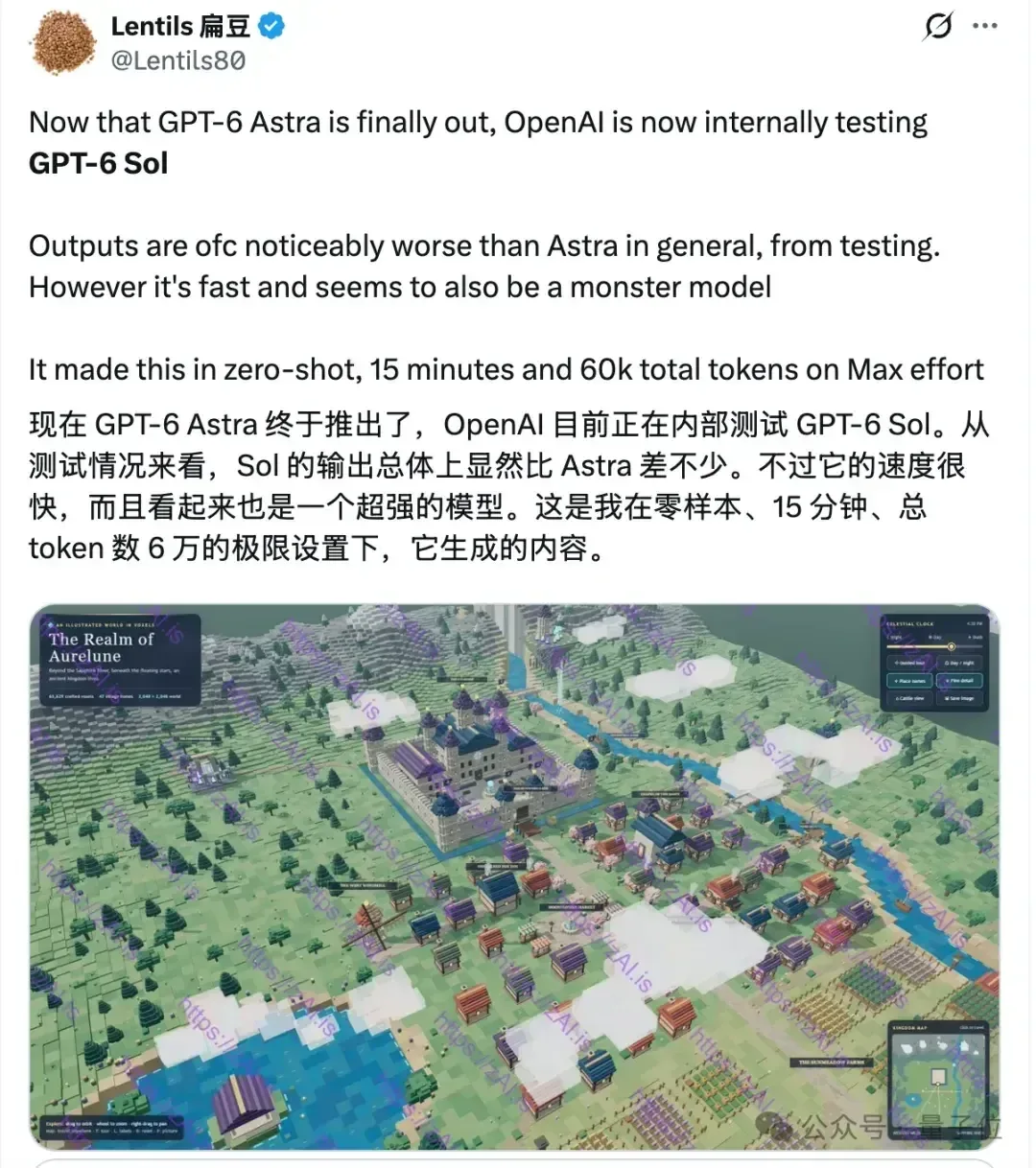
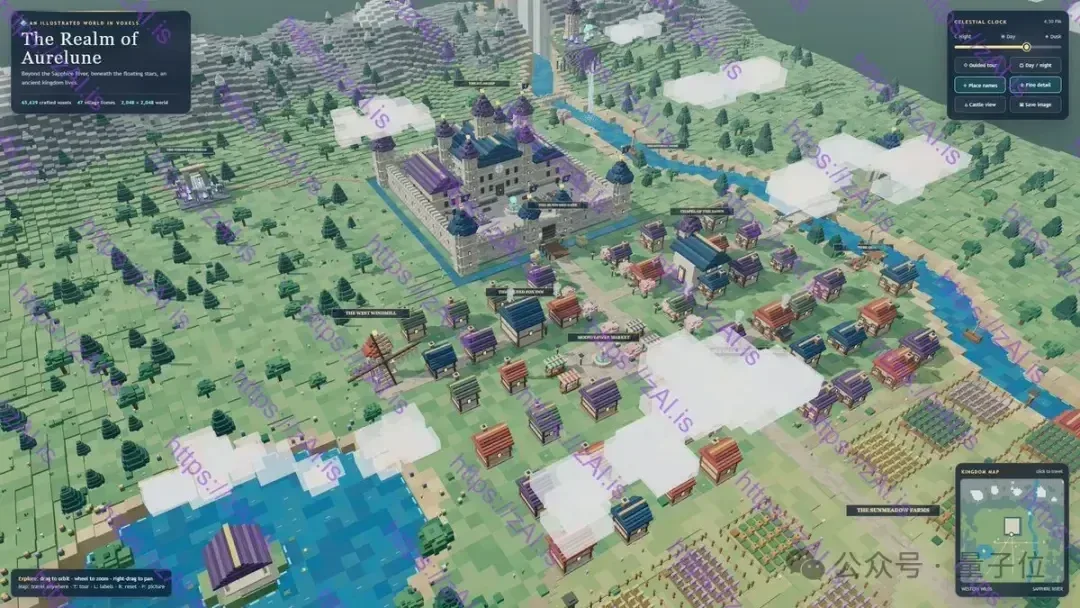
Another demo is even more telling. A user showed a pixel-art sandbox world prototype called “The Realm of Aurellune.” GPT-6 Sol generated a town, farmland, river, castle, and minimap in one pass, along with control panels for day/night switching, placing place names, and adjusting details. The result looked more like a simulation management game with a ready-made prototype—produced zero-shot, at the Max inference tier, in 15 minutes, for a total of 60,000 tokens. It can currently be inferred that Astra leans toward the highest-difficulty deep reasoning, while Sol leans toward speed, throughput, and scaled agent invocation. As for launch timing, some users say it could arrive at OpenAI’s developer conference on September 29.
On the same day, OpenAI also disclosed a set of internal research data: as of mid-August this year, for every 8 hours a researcher worked, about 3.1 agent-workdays were running in parallel behind them; based on API pricing, the median researcher consumed more than $600 worth of agent inference resources per day. OpenAI also announced it had achieved its “automated AI research intern” goal—a research and development node capable of working, able to independently complete clearly bounded research tasks under human guidance. Nvidia CEO Jensen Huang offered high-profile congratulations, saying Astra was trained using roughly 100,000 NVIDIA Grace Blackwell NVLink72 systems, with another 400,000 GPU systems coming online.
Once models begin to divide labor between “depth” and “speed,” demand on the industry side will diverge accordingly. Deep-reasoning models are suited to complex planning and highly difficult problems, but they are time-consuming and costly. Throughput-oriented models can handle more tasks per unit of time and are better suited to handing large volumes of repetitive, process-driven work to agents for batch execution. The former is rare, expensive, and used sparingly; the latter is massive, cheap, and routinely invoked—two capabilities that correspond to two entirely different forms of compute supply.
Behind this lies a new challenge around model safety and controllability.