
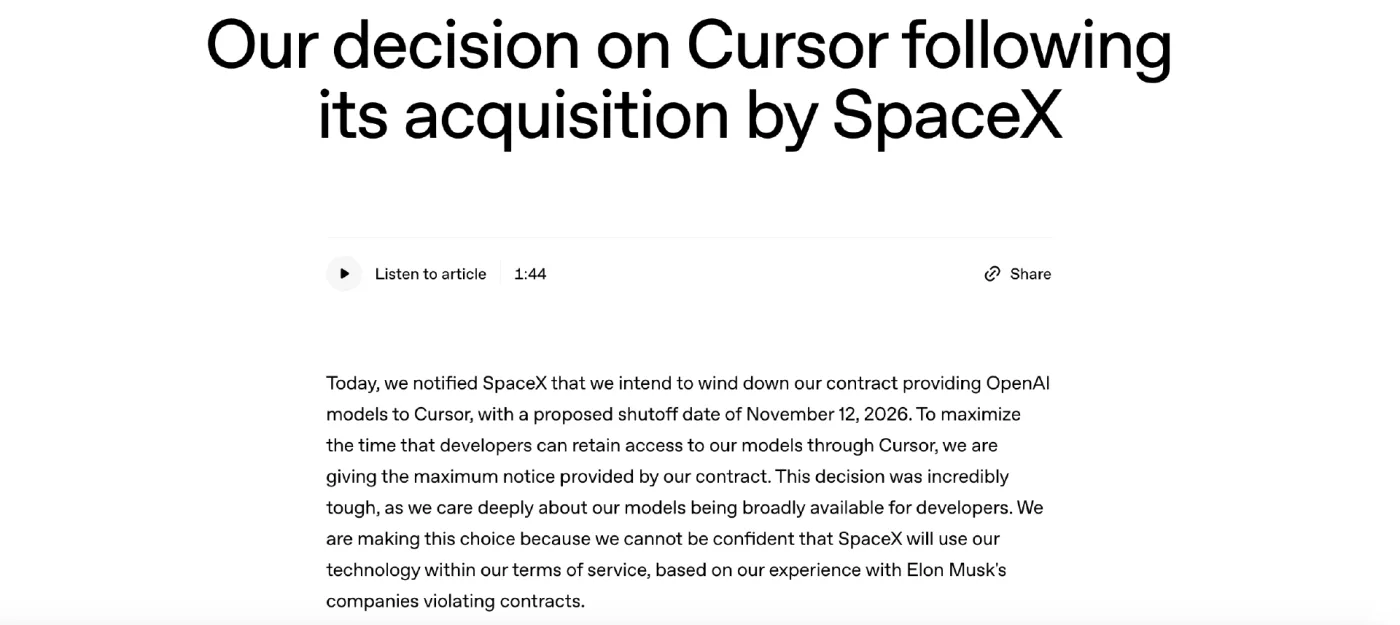
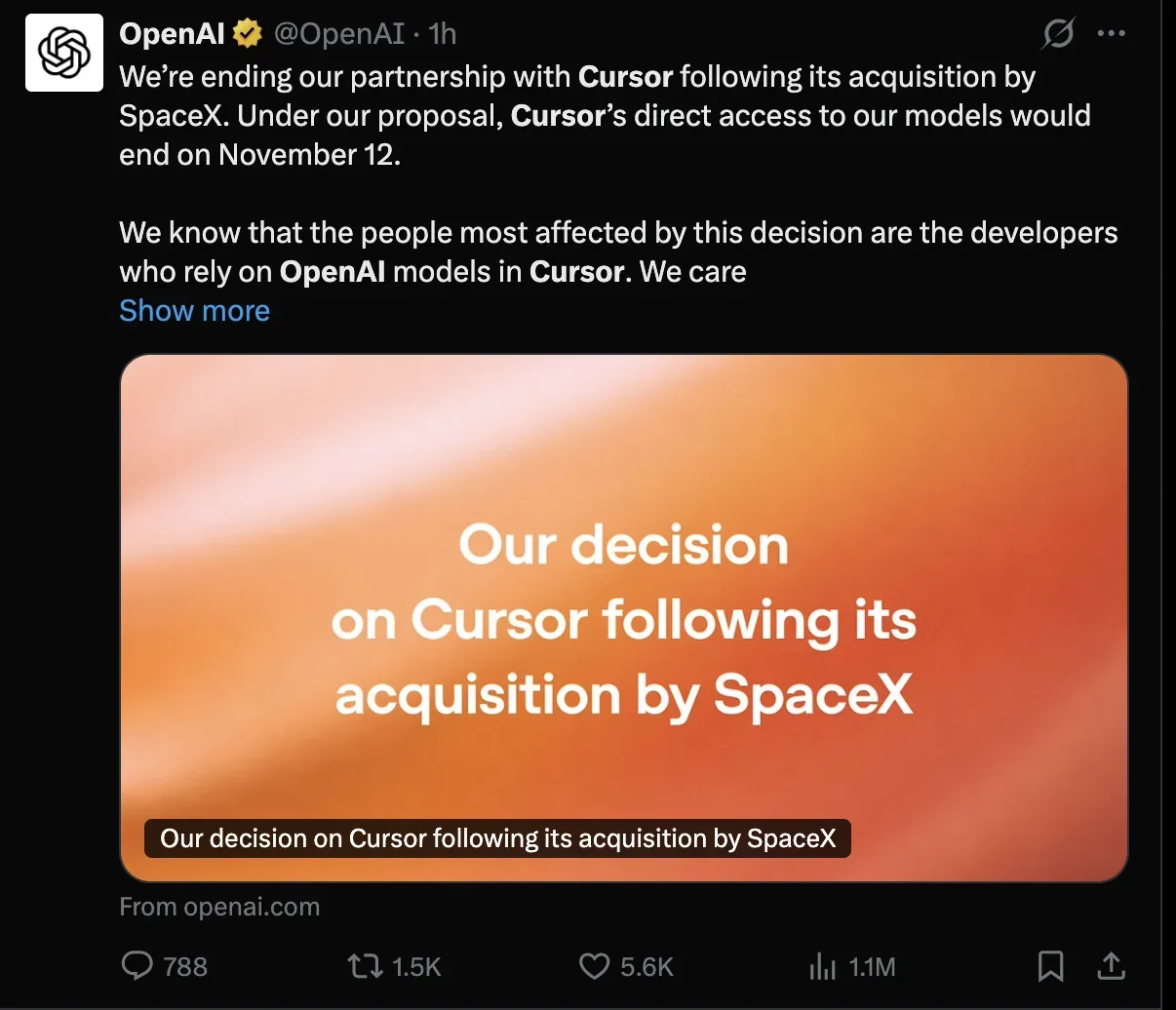
On August 28, local time, OpenAI issued a statement confirming it had formally notified SpaceX of its intent to terminate the agreement under which Cursor receives OpenAI models, with the planned cutoff date set for November 12, 2026. OpenAI also stated that no future models—including the unreleased Astra—would be provided to Cursor going forward.
The immediate trigger for the termination was a change in Cursor's ownership: on August 14, Cursor announced its acquisition by SpaceX in an all-stock deal valued at $60 billion. That transaction activated a "change of control" clause in the parties' custom agreement, granting OpenAI a limited-time cancellation window. OpenAI's stated rationale, however, goes beyond mere competition: the company says it "cannot be confident that SpaceX will comply with the terms of service."

OpenAI pointed to a history of disputes in its prior dealings, including allegations that Elon Musk violated contract terms after acquiring Twitter, and that xAI had used OpenAI's technology in ways inconsistent with the terms of service. The head of OpenAI's Codex product was even more direct in his assessment: at the end of the day, this is a trust issue.
For developers, the episode serves as a lesson in risk exposure: approximately 5% of Cursor's user traffic flows from OpenAI models. Should the supply cutoff come to pass, products that rely on a single model vendor will face significant switching costs. Models are no longer undifferentiated commodities—vendor relationships, corporate control structures, and external strategic maneuvering can all rewrite the API supply that developers depend on.
What makes the Astra exclusion particularly notable is its role as a dividing line: OpenAI has explicitly declined to provide Cursor with future models. This signals that model supply is no longer merely an API commercial arrangement, but a matter of safety capability assessment, downstream platform compliance, and unified policy enforcement. As model capabilities approach critical safety thresholds, vendors' control over distribution channels is tightening to an unprecedented degree.
This incident sounds an alarm for the AI application layer: binding core capabilities to a single model vendor is tantamount to handing one's fate over to someone else's business decisions. The industry is voting with its feet—multi-model integration, replaceable model routing, self-owned compute capacity, and open-weight models are increasingly being adopted by enterprises as hedging instruments against vendor risk. This is precisely the rationale behind StarWar Cloud's push for diversified model access and unified management across its large-model API plaza.
From Cursor's rapid expansion to OpenAI's supply cutoff, the strategic alliances and realignments within the AI programming ecosystem continue to unfold. For individual developers and enterprises alike, building a capability portfolio that does not depend on any single vendor may prove safer than chasing whichever frontier model happens to lead the pack.