
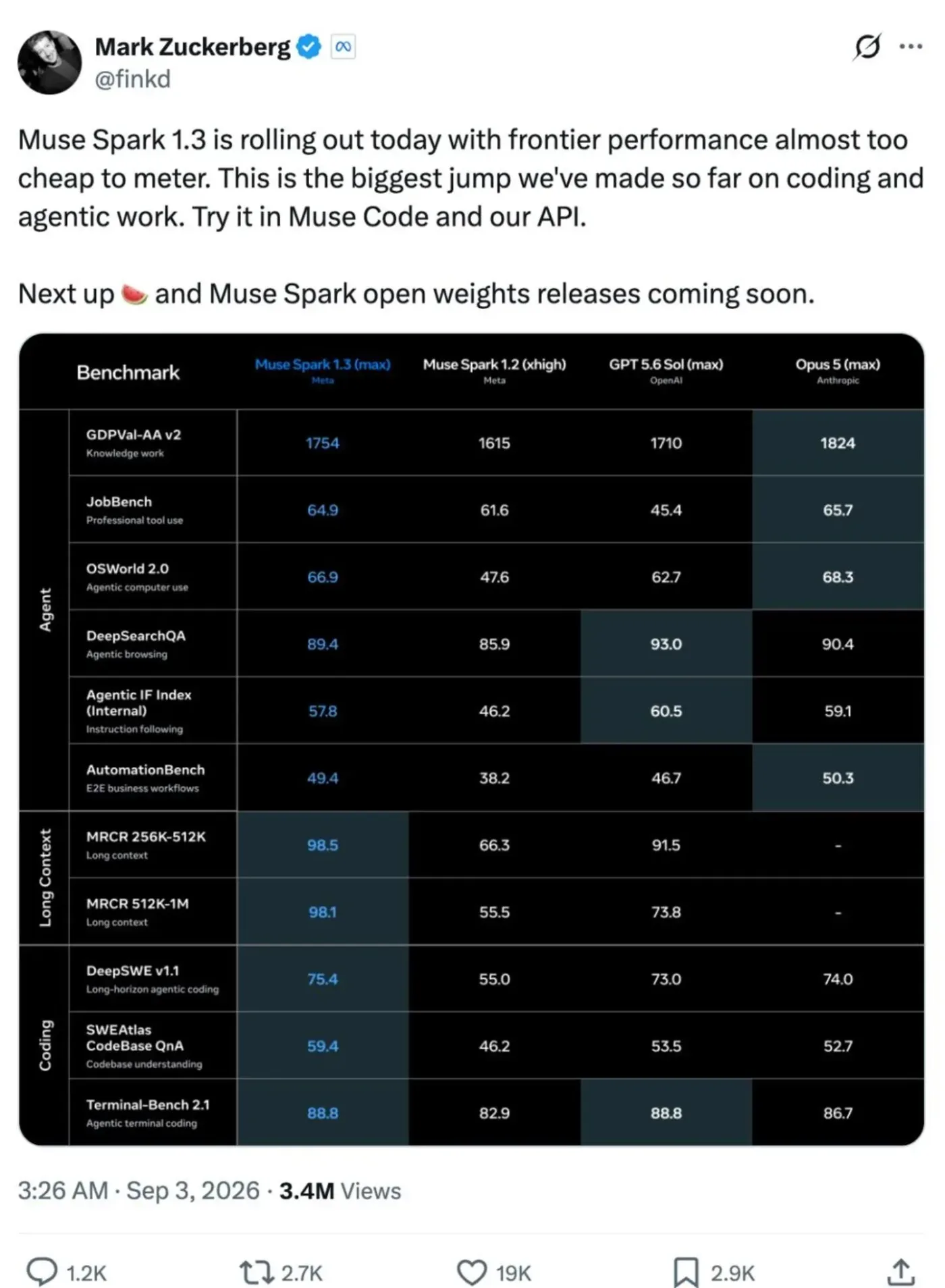
Meta’s new model has finally caught up. The company officially released Muse Spark 1.3, whose public version scored 61 on Artificial Analysis’s Intelligence Index, tying GPT-5.6 Sol and Grok 4.6 and trailing only two flagship models in the Claude series. Mark Zuckerberg personally promoted it, with the key message being “strong performance and still cheap.”
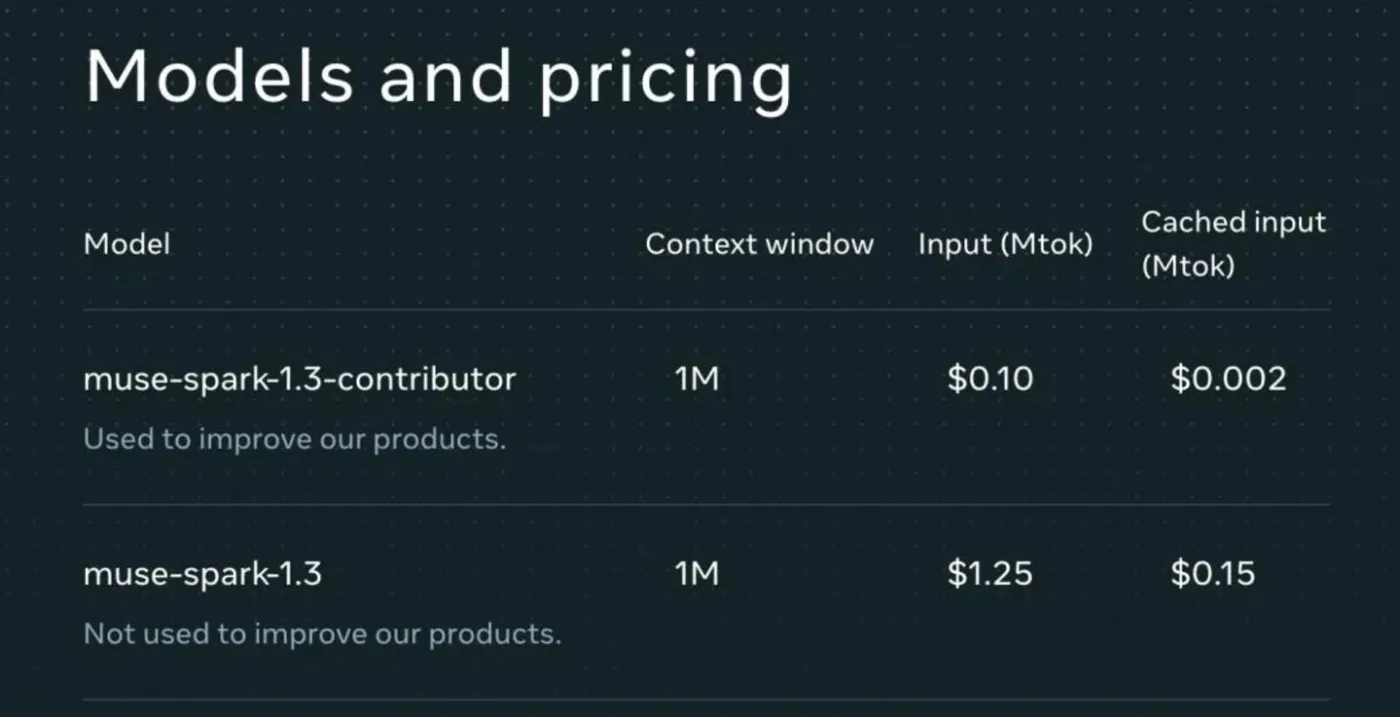
“Cheap” does not mean an explicit price cut. Muse Spark 1.3’s API pricing is $1.25 per million input tokens and $4.25 per million output tokens, essentially flat versus the previous version. The real change is teaching the model to spend less to get work done: official tests show that, compared with version 1.2, version 1.3 uses about 20% fewer tool calls and consumes about 25% fewer tokens in coding workflows. Same unit price, smaller bill—this is another kind of pricing war.
According to Artificial Analysis estimates, completing the same task with Muse Spark 1.3 costs about $0.55, while comparable Grok 4.6 and GPT-5.6 Sol cost about $0.94 and $0.95, respectively—nearly half as much. Meta also offers a “floor price” option: the Contributor version costs $0.10 per million input tokens and $0.20 per million output tokens, in exchange for allowing Meta to use invocation data to improve its models. Developers save money, and Meta gets real-world feedback.
The price of this catch-up is a staggering bill: Meta’s capital expenditures rose from $39 billion in 2024 to $72.2 billion in 2025, with guidance of $130 billion to $145 billion this year; R&D expenses reached $57.4 billion in 2025, while long-term debt increased from about $28.8 billion at the end of September last year to $83.7 billion at the end of June this year. Wall Street’s concern about “never earning it back” is not unreasonable.
But Meta’s accounting is different from that of pure model companies. Its main revenue comes from advertising: second-quarter total revenue was $60.8 billion, up 28% year over year, with advertising revenue at about $59.4 billion. After putting large language models into its ad retrieval system, Meta says Facebook ad clicks rose 8.3% and conversions rose 15.7%; the annual revenue run rate of its AI-driven Advantage+ solutions has exceeded $75 billion. The model does not have to recoup its costs by being sold; making the advertising system earn a little more already pays it back.
Meta’s path can be summarized as a loop: advertisers spend more, revenue rises, continued investment flows into GPUs, data centers, and talent, stronger models improve ad recommendations, and advertisers become more willing to spend. Model companies must first prove that AI is a business; Meta makes AI a booster for the business it already has. This ledger explains better than benchmark comparisons alone why giants are willing to keep spending.
As model competition enters the dimension of “cost per same task,” the real gap is no longer just parameters and leaderboard rankings, but how many tokens and how many tool calls are needed to complete a job. This extreme pursuit of efficiency and metering is reshaping the pricing and delivery logic of large language model APIs—every call should have its cost and output clearly accounted for. This is also the observation coordinate StarWar Cloud maintains in the LLM API marketplace through transparent metering and task-level cost optimization.