
Tobi Lütke, CEO of global e-commerce giant Shopify, recently issued an ultimatum: support AGENTS.md or face a comprehensive ban of Claude Code inside Shopify. In his view, Claude Code’s refusal to read AGENTS.md — a file format now used by over 60,000 open-source projects — forces large engineering teams to pay an avoidable “complexity tax.”
The root of the controversy is a split over project instruction file standards. OpenAI introduced AGENTS.md in August 2025 as a way to provide project-level instructions to coding agents, and within months it had been adopted by tens of thousands of repositories. Anthropic’s Claude Code, meanwhile, relies on its own CLAUDE.md format and has never natively supported AGENTS.md, despite repeated developer requests over nearly a year.

In an organization like Shopify, where thousands of developers maintain a massive monorepo, a single format mismatch quickly becomes a platform engineering problem. Different tools read different instruction files, agents may follow conflicting rules, and some developers end up running "agents with a chunk of their brain removed." Lütke described the situation as a “stupid complexity tax.”
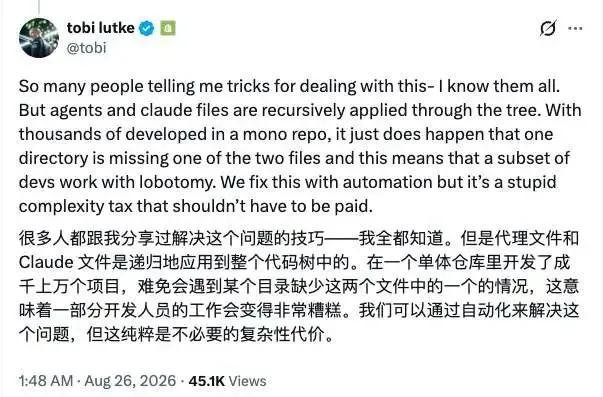
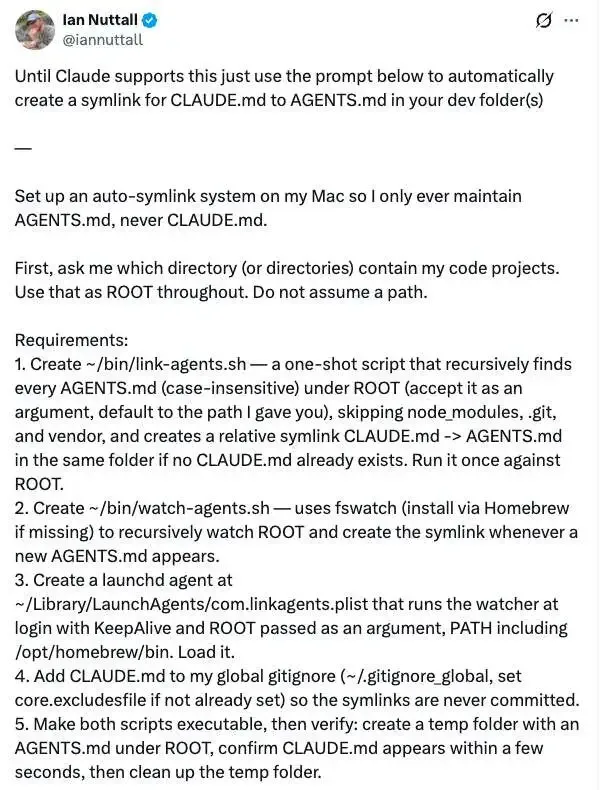
To work around the limitation, developers have resorted to patches and synchronization scripts: recursively scanning for AGENTS.md files, creating symlinks, using file-watching tools to keep copies in sync, launching processes at startup, and adding generated configuration to Git ignore lists. These workarounds may appear to solve the immediate problem, but they are a textbook case of the “complexity tax” — teams must maintain a parallel system that is nearly impossible to keep consistent.
This standoff reveals a deeper issue: standardized tooling for AI programming has not kept pace with its rapid adoption. Tool vendors have their own commercial incentives, and the fragmentation of instruction-file formats is ultimately paid for by developers. From an industry perspective, consensus on agent-related standards will require joint effort from platforms and the broader ecosystem. At the same time, engineering-grade agent governance is emerging as a product category of its own. StarWar Cloud’s OPC intelligent agent collaboration platform, with its emphasis on engineering discipline and controllability, is a systematic response to this fragmented reality.
Critically, Anthropic only responded after a prominent CEO went public. Earlier feature requests asking for AGENTS.md support were repeatedly closed as “won’t fix.” Behind that resistance lies a familiar platform play: binding developers more tightly to a vendor’s own configuration ecosystem may be commercially attractive, but it imposes long-term costs on the entire development community.