
ScienceClaw, the research-native AI agent under Zidong Taichu, has completed a critical upgrade with the launch of AutoProject, a project-level autonomous research engine. The engine builds its capabilities around project planning, long-horizon execution, and evidence verification, allowing researchers to submit nothing more than a research vision or macro objective while the AI autonomously manages everything downstream. The system is architected on three interconnected layers: Project2Task for project-level planning, TaskExecutor for long-horizon autonomous execution, and EviGraph for evidence-driven verification.

Over the past several years, rapid advances in large language models and agent technology have pushed AI into virtually every stage of the scientific workflow—from literature retrieval, data analysis, and code generation, to simulation, computation, and experimental analysis. Whether AI can assist scientists in research is no longer the only question. A new one has surfaced: Can AI truly take ownership of a complete research project, rather than merely completing one task at a time? This shift reflects a fundamental transformation in the AI4S capability paradigm.
Real research is not a simple collection of tasks. A scientific project typically begins with a vague research concept, encompasses multiple interdependent subtasks, and requires constant recalibration of the research roadmap in response to new literature, experimental results, and anomalous data. Doing a string of tasks well does not equal delivering a project. Project-level research demands that AI understand scientific objectives, proactively decompose tasks, coordinate dependencies, sustain execution over extended periods, and dynamically adapt based on feedback—precisely the breakthrough capability the next phase of AI4S must achieve.
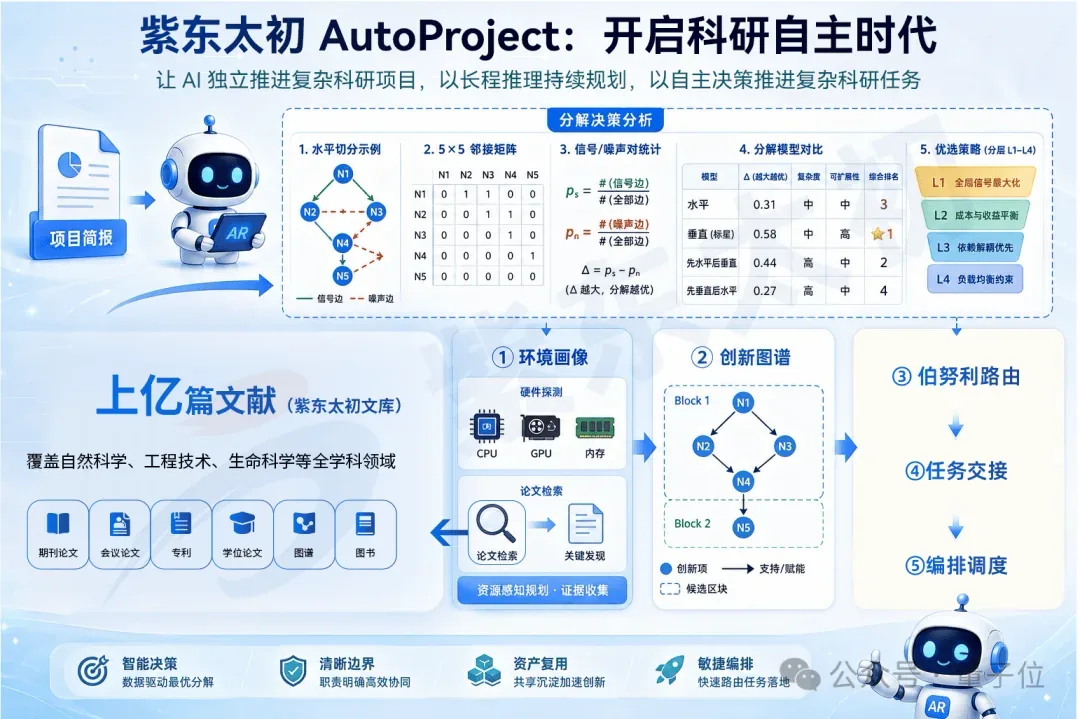
Achieving project-level autonomy is no small feat. Science is a cyclical, evolving exploration loop in which any anomaly in a subtask can ripple through upstream and downstream workflows. Conventional one-call, one-response AI models are ill-suited to the nonlinear, iterative nature of research. And when AI begins executing long-running projects, reliability becomes an equally pressing concern: scientific conclusions cannot merely read fluently—every claim must be anchored in clearly defined research questions, scientific