
Anthropic today unveiled an upgrade to the memory architecture linking Claude Cowork and chat, bringing the two systems' memory into a unified, centrally managed framework. According to the official announcement, Cowork now operates with exactly the same memory as chat: when executing tasks in the cloud, it can read information Claude has remembered from users' chat histories—and conversely, relevant memories generated during Cowork execution remain available for use in ongoing conversations.
The significance of this update lies in eliminating repetitive interactions across workflows. Previously, project context, preferences, and background established in chat sessions often had to be re-explained from scratch when transitioning to Cowork. That information discontinuity kept agent collaboration stuck at a one-question, one-answer level. With memory unified, Claude can now pick up where prior work left off without requiring users to repeat themselves. For the first time, intelligent agents genuinely possess the ability to "work with memory."
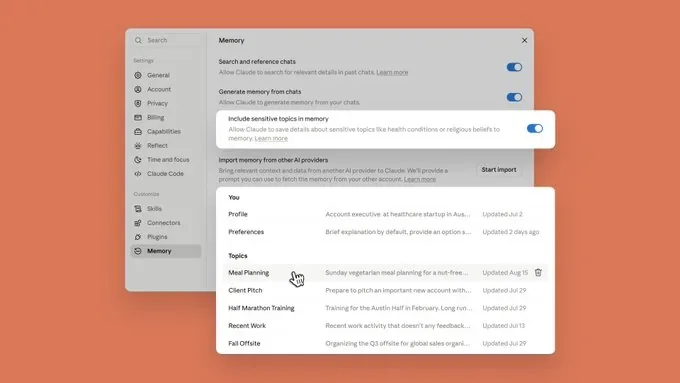
Notably, Anthropic has exercised restraint when it comes to sensitive information: memory related to sensitive topics such as health conditions and personal beliefs remains disabled by default, and users can manually enable it on demand. As agents become increasingly embedded in enterprise workflows, returning the decision of "what to remember" to users is both a prerequisite for the practical deployment of memory capabilities and the foundation for building trust in enterprise environments.
From a product logic perspective, memory unification is transforming point-solution agents into continuously operating work units. Context is no longer a one-time resource that resets at the end of a session; it is becoming an organizational asset that accumulates across tasks and conversations. For enterprises, this is a double-edged sword: collaboration efficiency improves dramatically on one hand, while on the other, stricter governance is required over the content boundaries, permissions, and audit trails of agent memory.
The convergence of memory capabilities with collaboration orchestration is precisely the critical step toward enterprise-grade Agent maturity. StarWar Cloud, focused on GPU computing power platforms and OPC agent collaboration platforms, helps enterprises incorporate cross-session memory, task context, and permission management into a unified system through standardized role assignment, task routing, and collaborative orchestration—ensuring continuously operating agents run in a controlled, auditable environment.
Zooming out to the industry level, memory mechanisms are rapidly becoming a standard feature in the competitive landscape of agent products. Whoever can make context flow naturally across workflows will bring agents closer to how work truly happens. The memory integration between chat and Cowork is only the starting point of this trend; cross-application and cross-team memory collaboration will unfold in the next phase.
The value of an intelligent agent lies not in how accurately it answers a single question, but in whether it can persistently follow up on a project like a real team member. When memory, collaboration, and computing power are orchestrated as a unified whole, enterprises can transform agents from tools into genuinely viable working partners—a direction the entire industry is now actively exploring.