
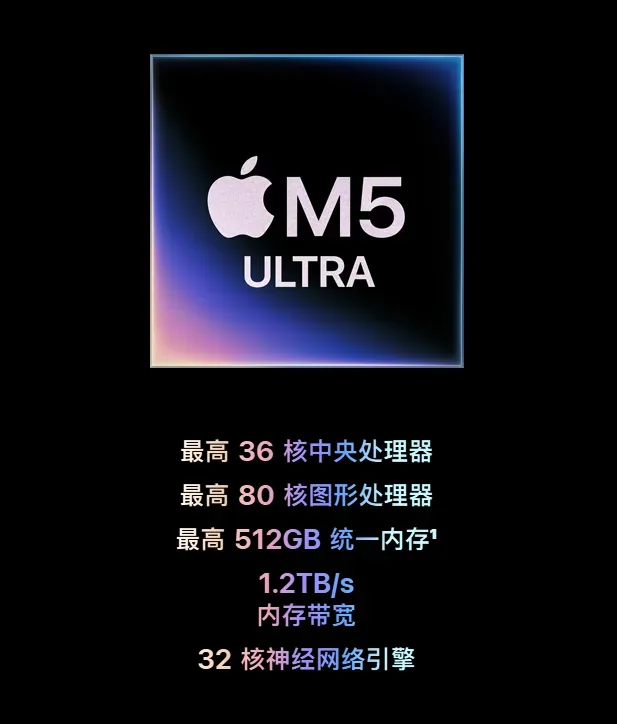
Apple today introduced the M5 Ultra chip in its new Mac Studio, the most powerful chip the company has ever produced. The M5 Ultra uses UltraFusion technology to connect two dual-die M5 Max chips into a four-chip architecture, delivering up to a 36-core CPU, 80-core GPU, and 32-core Neural Engine. Unified memory bandwidth reaches 1.2TB/s—50 percent higher than the M3 Ultra—with support for up to 512GB of unified memory.
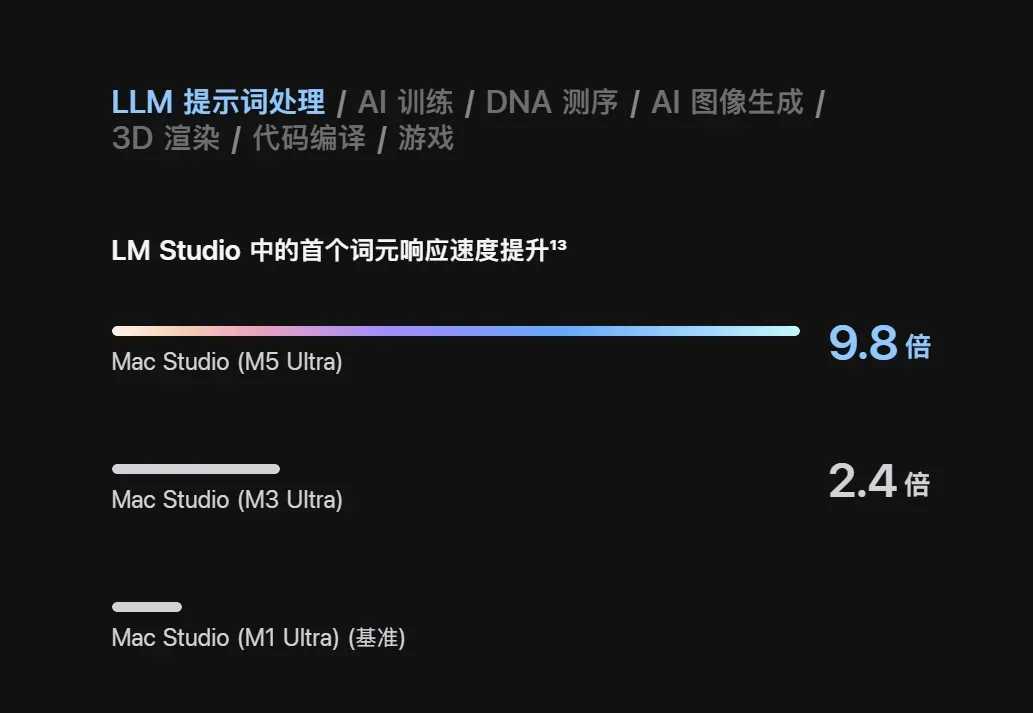
The most closely watched capability of this chip is its ability to run large-scale AI models on-device. With 1.2TB/s of unified memory bandwidth and a 512GB local memory pool, the M5 Ultra can load large language models with hundreds of billions of parameters entirely into local memory. Combined with a neural accelerator embedded in every GPU core, peak AI compute performance improves by up to 4.5 times over the M3 Ultra, making local inference and model fine-tuning practical, real-world scenarios.
Behind this is a concentrated release of the edge computing roadmap. In the past, large-model inference was almost exclusively tied to data centers and the cloud, with local devices limited by memory capacity and bandwidth to running only small-to-medium-scale models. The M5 Ultra pushes unified memory bandwidth and capacity to a new magnitude, meaning a significant share of AI workloads can now return to the desktop—offering an alternative on privacy, latency, and cost.
That said, the significance of edge computing should be understood within reasonable bounds. The fact that hundreds-of-billions-parameter models can run on a desktop does not mean every task is suited for local execution. Training and large-scale concurrent inference still depend on cloud clusters; local and cloud are complementary, not substitutive. For enterprises, the key is not choosing one over the other, but knowing which workloads belong locally and which belong in the cloud.
The synergy between edge and cloud is becoming the standard architecture of AI infrastructure. StarWar Cloud focuses on GPU computing platforms and compute scheduling capabilities, helping enterprises uniformly orchestrate inference and training workloads across cloud compute and local devices based on task characteristics, dispatching on demand so every calculation lands on the most appropriate compute resource—balancing performance, cost, and data security.
The rise of edge computing will also change how AI applications are developed. Developers can leverage high-performance local environments to rapidly iterate models and agents, then deploy to scalable compute once validated, smoothing the transition from R&D to production. The stratification of compute capabilities allows enterprises of different sizes to find an AI implementation path that suits them.
The compute relay from cloud to desktop shows that the distribution of AI computing power is becoming more multidimensional. End devices take on an increasing share of local inference; the cloud handles heavy lifting and large-scale training. The orchestration and coordination between the two will become the new technological depth. For enterprises and developers alike, mastering compute orchestration across edge and cloud is holding the ticket to the next generation of AI applications.