
On August 19, the 2026 World Robot Conference opened in Beijing under the theme "Human-Machine Coexistence, Supply-Demand Integration." The Beijing Humanoid Robot Innovation Center took the stage to release Pelican-Unify 1.0, an embodied multimodal large model built around the core capabilities of "perception, comprehension, decision-making, and execution." The model is designed to drive deeper integration between large models, robot platforms, and real-world scenarios. According to project leaders, this marks the transition of embodied intelligence from fragmented function stacking to a phase of systematic collaborative evolution.
Heterogeneous multi-robot collaboration emerged as the conference's biggest highlight. In a world-first live demonstration, two humanoid robots coordinated to jump rope while a quadruped robot dog followed and leaped in sync, offering a vivid display of motion control and multi-machine cooperation. Embodied intelligence is accelerating from "running and jumping" toward "thinking and doing," with the fusion of large models and robotic hardware entering deeper waters.
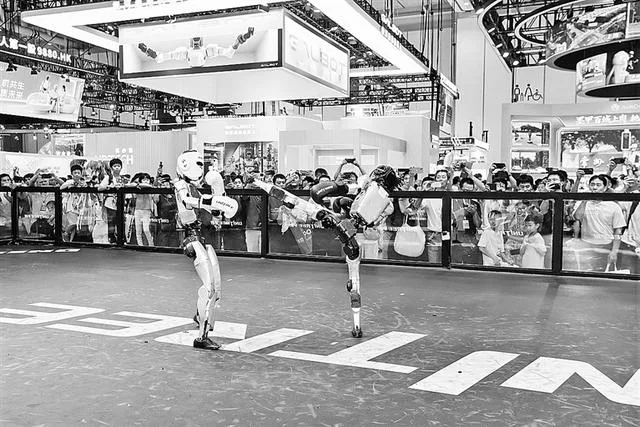
The significance of Pelican-Unify 1.0 lies in extending multi-agent collaboration from the pure software layer into the physical world. Previously, agent coordination largely occurred between cloud services and APIs. The embodied large model, by contrast, requires multiple heterogeneous robots to execute joint scheduling and divided tasks toward a unified objective. This places extreme demands on the consistency of perception, decision-making, and real-time control—and signals that multi-agent collaboration has officially entered a new phase of virtual-physical integration.
This integration does not come without challenges. Heterogeneous multi-robot coordination involves different platforms, sensor suites, and control stacks. Unified scheduling demands substantial computing power and stable communication links. Moreover, the journey from laboratory demonstrations to factory-floor deployment at scale still faces significant hurdles in data quality, system reliability, and cost—making sustained industry patience and infrastructure investment indispensable.
From cloud-based agents to physical robots, the demands on computing power and orchestration are escalating across the board. StarWar Cloud's strategic focus on GPU computing platforms and the DiWorker multi-agent collaboration platform directly addresses the compute supply and coordination orchestration behind multi-agent systems, providing foundational support for scaling embodied intelligence use cases.
Across the broader industry, embodied large models and robot hardware are forming a new closed-loop industrial chain: models serve as the "brain," chips and computing power as the "nervous system," and robotic platforms as the "hands and feet." HuiXi Intelligence's release of a full-stack "China Chip" solution and Lingzu Times' launch of integrated joint modules both demonstrate that the supply chain is stockpiling the capabilities needed for large-scale deployment of embodied intelligence. The physical-world blueprint of multi-agent collaboration is rapidly taking shape.
Pelican-Unify 1.0 is only the beginning. When multiple robots can coordinate around a unified objective, embodied intelligence will truly step off the exhibition floor and into workshops and daily life. The ultimate value of the multi-agent era will be measured by whether these systems can execute joint tasks stably and efficiently in real-world environments.