
IP bearer networks are the digital foundation of thousands of industries; a card payment or an online hospital appointment depends on them. When a network fails, however, clues are often buried in alarms and configurations, and the first step in troubleshooting is to clarify what the network actually looks like at that moment.
Real networks are dynamic, and each fault produces a different topology. Senior experts can reconstruct the dynamic network in their minds and locate root causes, but such talent is scarce. Handing troubleshooting over to large model agents has therefore become an industry consensus for breaking the bottleneck.
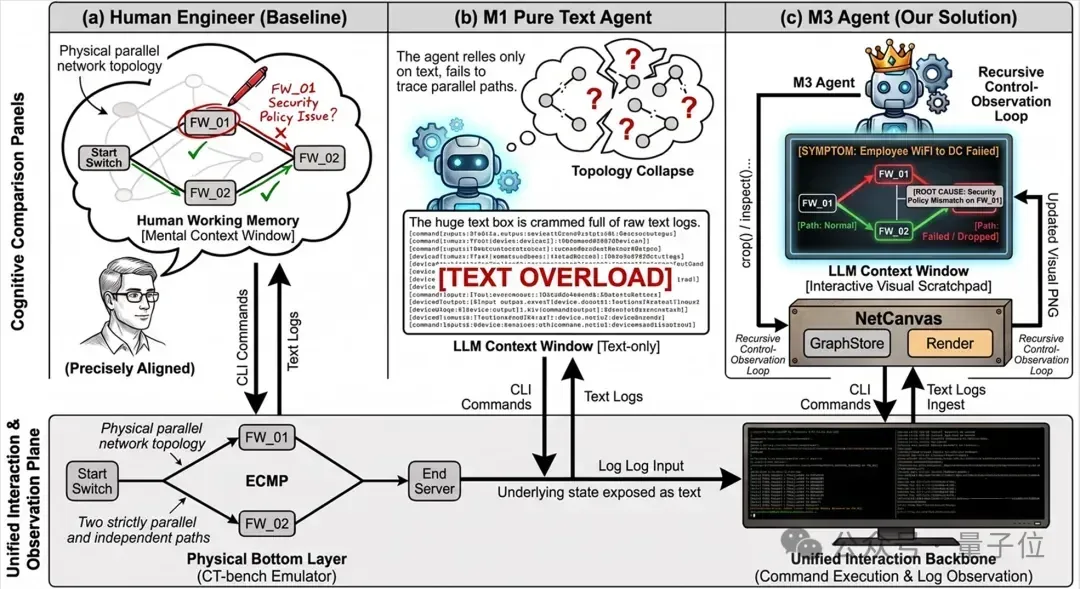
But Huawei GTS’s algorithm team found a counterintuitive pain point: an agent’s reasoning ability is online and it can read logs, yet it cannot remember what the network looks like. The team calls this topology amnesia, essentially a lack of spatial memory.
A text-only agent faces a one-dimensional scrolling command line, and at every step it must re-imagine the network structure from fragmented logs. The longer the context, the more easily these spatial relationships collapse within long text.
The solution is to give the agent a living map. NetCanvas uses an interactive visual topology to accomplish three things: query while growing, merging newly discovered devices and links in real time; switching between global and local views on demand while highlighting focus nodes; and using layouts that match network engineers’ habits, allowing the model to record its reasoning hypotheses on the map.
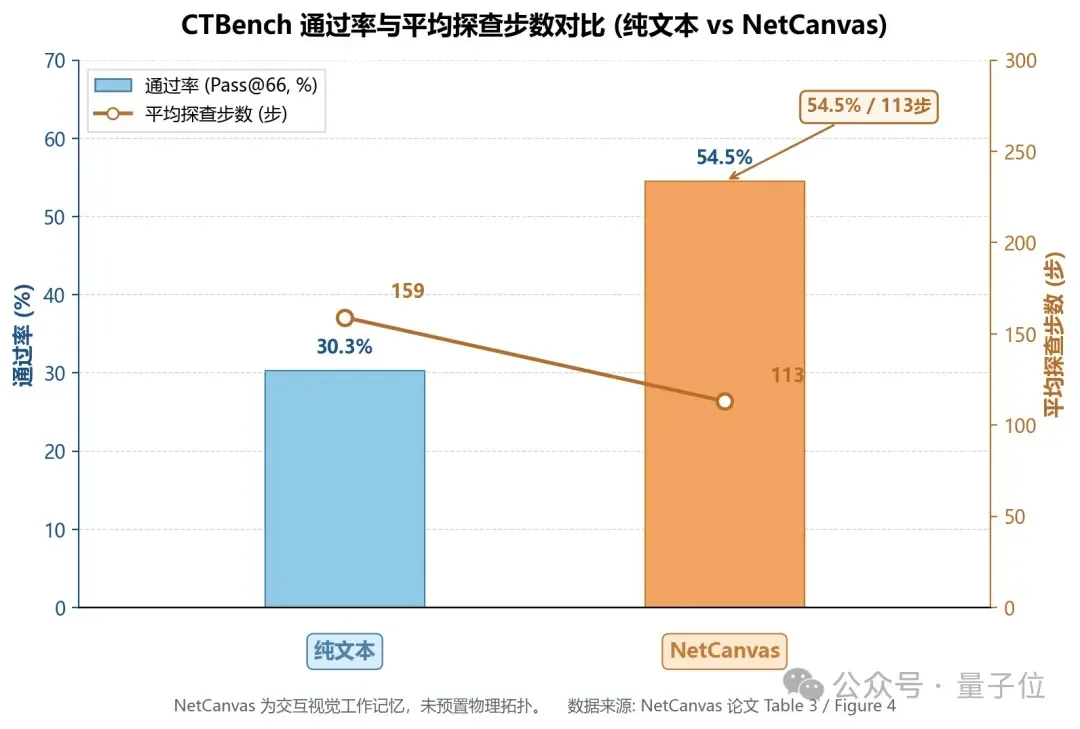
On the public CTBench benchmark, NetCanvas raised the overall pass rate from 30.3% to 54.5%. Complex subtasks such as dual-firewall and equal-cost multipath scenarios jumped from about 10% to about 90%, while average exploration steps fell from 159 to 113.
This reveals a broader proposition: what determines a professional agent’s effectiveness is not only the knowledge and reasoning inside the model, but also how peripheral systems present the real world