
After more than five years of investment in self-developed chips, Xiaomi has officially unveiled the next generation of its XRING chip family: XRING O3, XRING O100, and XRING D100. The three chips target mobile devices, large-model acceleration, and intelligent driving, respectively, and all have completed post-silicon validation. This marks a move by Xiaomi’s self-developed chip strategy from dual-track breakthroughs in smartphone SoCs and basebands toward an AI computing power layout covering human, car, and home scenarios.
As the core product, XRING O3 is Xiaomi’s first AI flagship SoC. Built on a 3nm process and integrating 24 billion transistors, it delivers 200TOPS of Tensor compute. Designed for the AI era, it deeply rearchitects the NPU architecture and co-develops a custom quantization scheme with Xiaomi’s MiMo large model. On-device AI inference speed improves by 45% while operating power consumption drops by 26%. It will debut in the new flagship foldable Xiaomi 18 Fold.
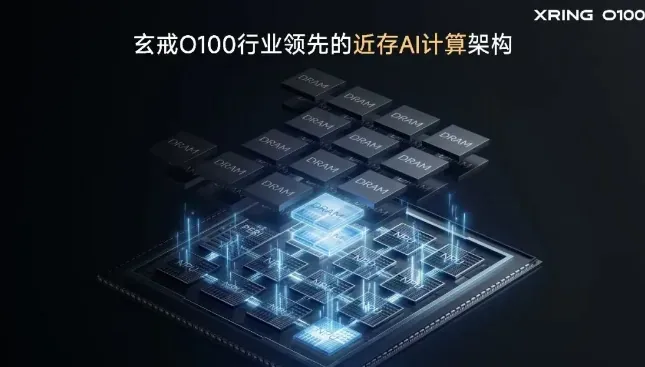
The bigger story lies in the extension of computing boundaries. XRING O100 is the world’s first 6nm 3D wafer-level stacked AI accelerator chip. With 1.22TB/s ultra-high bandwidth, it addresses the industry’s “memory wall” challenge. It can work in concert with XRING O3, enabling on-device large-model inference speeds of up to 330 tokens/s. XRING D100 is China’s first 3nm intelligent-driving AI chip, supporting up to 160GB of unified memory and capable of locally deploying large models with 200 billion parameters.
Together, the three chips turn “running large models on the edge” from a demonstration into a deliverable capability. For users, this means faster response, lower latency, and stronger privacy protection. For the industry, it means cloud computing power is no longer the only place to run large models; edge and cloud are beginning to divide labor—complex training and general-purpose inference return to the cloud, while low-latency tasks stay local.
The surge in on-device computing power is also raising the bar for coordination between models and platforms. On one hand, models need to be quantized and compressed for edge hardware. On the other hand, enterprises need a platform that can manage edge-cloud collaboration and uniformly schedule computing resources. This is precisely the direction of intelligent agents and computing power scheduling that StarWar Cloud is focused on—when devices themselves have stronger compute, how to make them collaborate efficiently with cloud models will become a new engineering challenge.
From smartphones to cars and then to homes, the computing power base is becoming a core competitive advantage for device companies. Xiaomi’s strategy is not merely about self-developing hardware; it is about building a physical foundation for its AI strategy. Whoever controls the on-device computing power base will control the entry point to full human, car, and home scenarios in the AI era.
The accelerated formation of on-device AI computing power is rewriting the old narrative that “large models must run in the cloud