
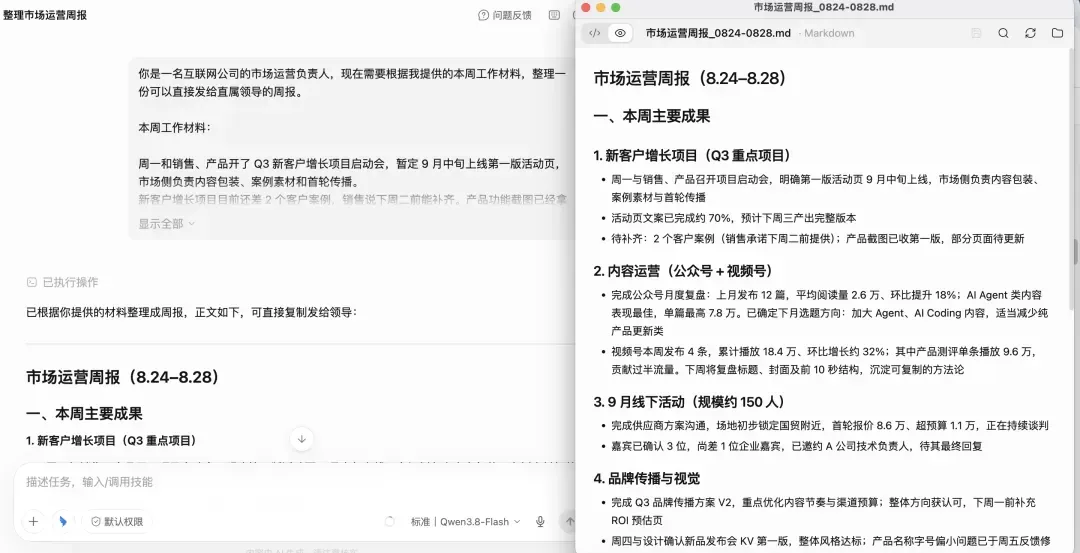
On August 26, Alibaba's Qwen large model team unveiled and open-sourced Qwen3.8-Flash. This multimodal MoE model packs 125 billion total parameters but activates only 6 billion per token, with input tokens priced at just 0.8 yuan per million and output at 2.7 yuan per million. Nearly in tandem, the model made its debut in Qwen Office's standard mode, achieving roughly 100% faster single-task generation and trimming average token consumption by 75%.
As office agents' feature sets converge, competitive momentum is shifting toward deep synergy between models and agent architectures. The old playbook was straightforward: pick a powerful general-purpose model, then bolt on planning, tools, memory, and a sandbox externally. Each side was optimized in isolation—until two pain points surfaced immediately: tool invocation and context handling. Every extra step in an agent workflow triggers another model call and another surge in token burn.

Qwen's latest update attacks the problem on two fronts. Inside the model, the MoE architecture and high intelligence density continue compressing per-unit compute costs. Outside the model, an Agent Harness, context management, and refined tool invocation put those capabilities to work far more efficiently. Qwen3.8-Flash's newly introduced QSA sparse attention mechanism delivers up to 7.6x and 4.9x acceleration in the Attention Kernel during the PreFill and Decode stages, respectively, at a 1M-token context window.
Office agents are born heavy users of long contexts—the longer a task runs, the more tokens accumulate. Without effective compression and filtering in the Harness layer, the model ends up re-reading previously processed information on every turn, grinding down speed while costs snowball. Qwen answers this with a GDN-plus-Attention hybrid architecture that compresses historical information; QSA first performs a coarse-grained sweep, then precisely pinpoints the relevant spans, so the model no longer plows through the entire context on each pass.
By simultaneously driving down the unit price of tokens and the volume of tokens required per task, Qwen has turned LLM invocation costs into a manageable, optimizable engineering variable. StarWar Cloud's push for multi-model integration and unified management on its LLM API plaza rests on the same conviction: enterprises should obtain model capabilities at transparent, controllable token costs—without being held hostage by a single vendor's opaque billing black box.

Silicon Valley's token anxiety has even escalated into a "Tokenmaxxing" contest. Meta employees have voluntarily tracked token usage across more than 85,000 people; the top individual consumer racked up 281 billion tokens—roughly valued at over $4 million. The distance between "pinching pennies with a small model" and "casually handing the job to an agent" is, in the end, a matter of cost predictability.
By lowering both the price per token and the number of tokens needed per job, Qwen has redrawn the viability line for practical office agents. What ultimately determines whether an office agent becomes a true everyday tool isn't just how many complex tasks it can conquer—it's whether users, staring down the small tasks that recur daily, still need to run a mental token calculation before hitting Execute.