
SF Intra-city's 2026 interim report tells a compelling story: total H1 revenue of RMB 11.74 billion (up 15% YoY) and net profit of RMB 350 million (up 155% YoY), with profit growth continuing to outpace revenue growth. This comes against a backdrop of the State Administration for Market Regulation cracking down on "involutionary" competition and seven government departments issuing administrative guidance on worker rights in new employment forms — constraints that make this performance from the leading independent third-party instant delivery platform all the more noteworthy.
The instant delivery industry has long sworn by a simple formula: flood the streets with couriers to maximize fulfillment density, and burn subsidies to shape user habits. But in 2026, while order volumes continue climbing, both the "labor squeeze" and "reckless spending" playbooks have been effectively locked off. The entire industry now faces a single question: beyond hiring more couriers, what can sustain the next phase of growth?
SF Intra-city has turned its urban logistics system into a predictive neural network. Leveraging big data and AI algorithms to forecast order fluctuations in advance, the platform fuses commercial district characteristics, courier behavior patterns, and real-time market dynamics, using order-batching strategy optimization to dynamically match demand with dispatch capacity. The results are written into the earnings report: average delivery time of 22 minutes for orders within 3 kilometers, a punctuality rate of approximately 95%, and fluctuation of no more than 3 percentage points even in severe weather.
The industry's universal challenge has always been maintaining stable delivery performance across order volumes that can swing several-fold between peak and off-peak hours. In the past, the answer was hoarding couriers — but that meant sunk labor costs in off-peak periods and still insufficient capacity during surges. Couriers aren't code; they cannot be deleted or added on demand. The value of algorithmic dispatch lies precisely in smoothing this steep curve, keeping capacity perpetually aligned with demand.
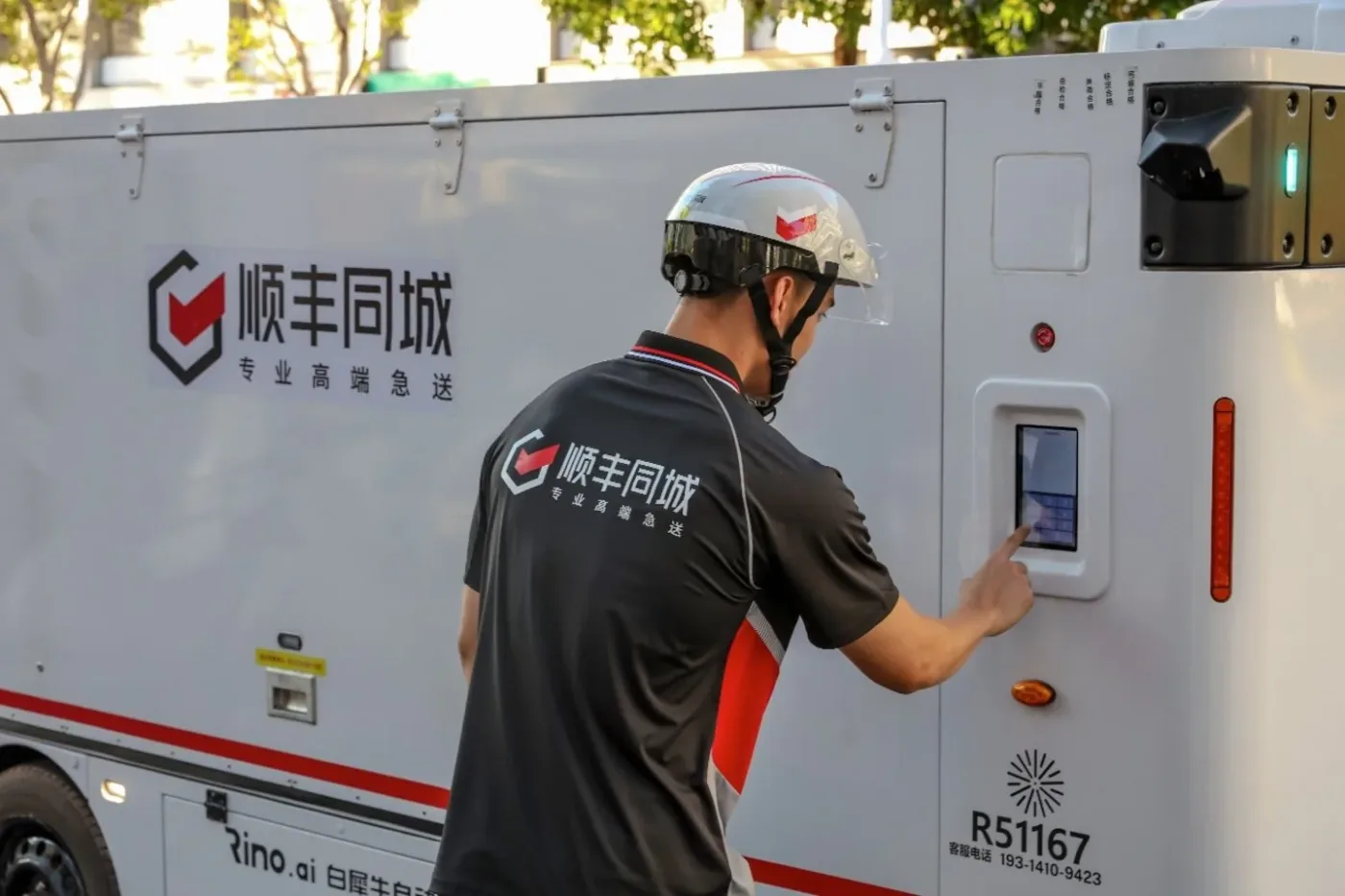
SF Intra-city's autonomous vehicle network now covers 124 cities nationwide, with over 1,000 vehicles in operation and more than 60,000 active monthly trips. Standardized segments — intra-city relay transport, hub-and-spoke sorting, and restaurant and supermarket runs — have been absorbed by driverless vehicles. At its core, this dispatch-relay-distribution model replaces repetitive human labor with algorithmic scheduling efficiency — precisely the direction StarWar Cloud has committed to investing in GPU computing platforms and compute scheduling orchestration, providing a stable, high-performance computing backbone for algorithm-driven operators like SF Intra-city.
An even subtler shift is unfolding at the interaction layer. SF Intra-city has completed integrations with mainstream AI Agents including WeChat's "Xiaowei" and Alipay's "Abao," allowing users to complete ordering and fulfillment with a single spoken sentence. Its neutral positioning enables the same CLS dispatch system and the same autonomous vehicle network to be replicated across restaurant, supermarket, e-commerce, and travel scenarios — effectively amortizing the scale benefits of technology investment across multiple verticals.
When scale, efficiency, and scenario reach resonance, growth no longer necessarily comes from more people — it can come from smarter algorithms and harder-working autonomous vehicles. The day large language models learn to deliver food is not the day couriers lose their jobs; it is the day urban instant logistics finally escapes the trap of labor-driven competition. SF Intra-city's interim report has charted that path clearly.