
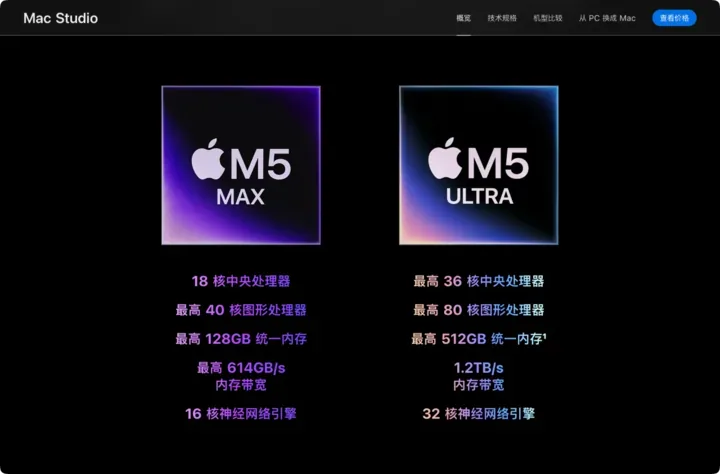
Apple's recent Mac lineup reset performance expectations for AI PCs. The Mac mini is now positioned as an always-on productivity tool for running AI agents, while the Mac Studio supports up to 512GB of unified memory. But the truly impressive numbers hide in a spec that previously drew little attention — memory bandwidth. The standard M6 delivers 170GB/s, the M5 Pro pushes to 307GB/s, and the top-tier M5 Ultra crosses the terabyte-per-second threshold outright.
Not to be outdone, Xiaomi unveiled its on-device AI accelerator chip Xuanjie O100 just one day before the new Mac Studio launch, achieving 1.22TB/s memory bandwidth. NVIDIA's latest consumer flagship RTX 5090, armed with 32GB of GDDR7 memory, delivers bandwidth approaching 1.8TB/s. Desktop SoCs, on-device NPUs, and standalone GPUs take fundamentally different architectural paths, yet they're all chasing the same goal: making data in memory flow faster.
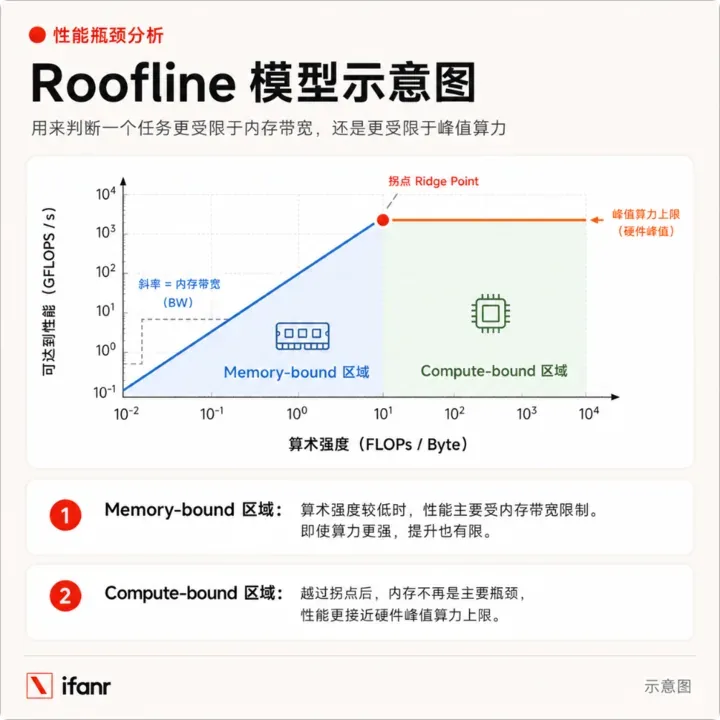
The reason is straightforward: AI is increasingly compute-capable, but it's also increasingly being starved by memory. Large language models, once running, consume far more resources moving data than performing computations. During the decode phase of autoregressive generation, for every new token generated, the compute unit must read through billions or tens of billions of parameter weights in full. No matter how fast the compute unit is, it spends most of its time waiting for memory to feed it — a state computer architects call "memory-bound."
Capacity and bandwidth are two fundamentally different things. Capacity determines how large a model a machine can hold; bandwidth determines how fast those data can be fed to the compute cores each second. The industry used to default to "bigger is better," but as models balloon to tens and hundreds of billions of parameters, the throughput bottleneck from insufficient bandwidth is becoming unmistakable. That is precisely why Apple, Xiaomi, and NVIDIA are collectively fixated on bandwidth — they are all redefining the computer for the era of large models.

Behind the memory bandwidth race is a shift in how on-device AI and large models are deployed. When AI agents need to perceive and operate continuously on local devices, on-device compute and memory bandwidth become the deciding factors in user experience. For enterprises and developers, this means real-world AI deployment is no longer just about model size — it's about the balance between bandwidth and power consumption. Placing the right model on the right compute resource matters more than chasing the largest model. StarWar Cloud's emphasis on end-cloud collaborative compute supply is precisely designed for this reality: when local bandwidth is limited, enterprises can flexibly switch between on-device and cloud computing power, relieving memory pressure on any single piece of hardware.
Faster memory also costs more, and the supply chain ripple effects are already visible. Price hikes and capacity competition for DRAM and HBM are pushing up overall system costs. For consumers, the performance bar for AI computers is rising; for vendors, whoever balances bandwidth, pricing, and ecosystem best will seize the early advantage in the on-device AI market. This battle against the memory wall will profoundly shape the AI hardware competitive landscape over the next two years.
Compute has been sprinting ahead, and memory falling behind has become the most structural problem in AI hardware. As memory bandwidth becomes the new performance benchmark, "grinding through the memory wall" is no longer vendor marketing rhetoric — it is a threshold the entire on-device AI era must cross.