
China Unicom Yuanjing recently introduced a computing power metering solution for multi-agent scenarios. Aimed at multi-agent clusters, the solution can calculate computing power consumption dimensionally by individual agent and individual task, delivering precise metering and sub-account billing. It provides usage-based statistics capabilities for government and enterprise clients, industrial parks, and universities, directly addressing the industry challenge of accurately accounting for computing costs when numerous AI employees run concurrently.
Over the past year, as large language model applications move toward real-world deployment, enterprise AI adoption has shifted from "single-point calls" to "multi-agent collaboration." With product forms such as office agents and industry-specific agents, it has become common for companies to run dozens or even hundreds of AI employees at once. Computing power has evolved from occasional use to continuous consumption, completely transforming the cost structure.
Computing power metering is exactly the new demand born from this shift. When agents are scheduled by task and run on demand, enterprises need to know exactly how much computing power and money each AI employee and each task consumes. Turning computing power into a resource that can be tracked, measured, and billed is a necessary path for enterprise AI to move from "usable" to "understandable and cost-efficient."
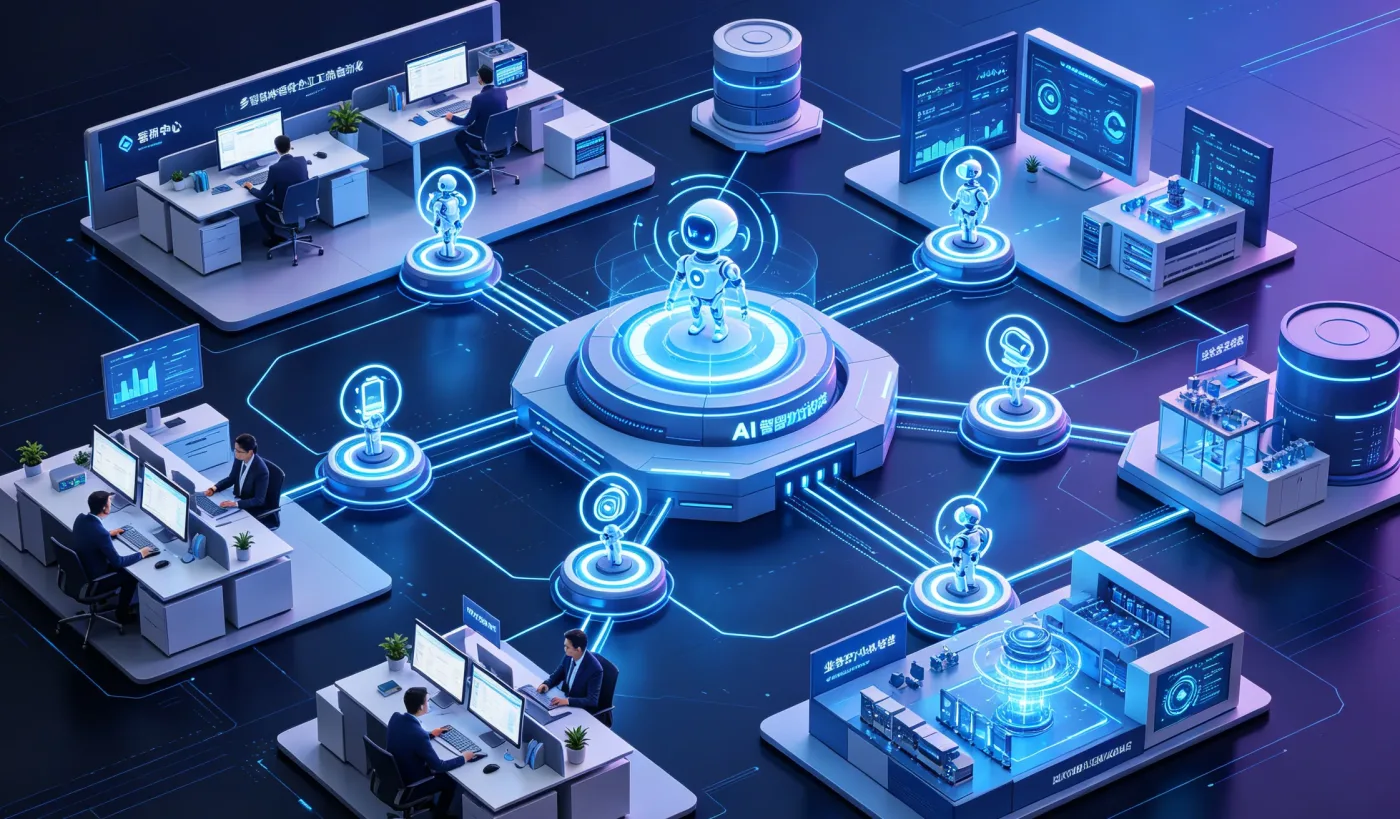
Previously, for most companies, computing power costs were nearly an "opaque account": GPU clusters were procured and billed as a whole, making it hard to attribute costs to specific business lines or agents. The direct consequences include difficulty in calculating AI project ROI, allocating costs across departments, and approving budgets—which in turn restricts the deployment of larger-scale multi-agent systems.
Unicom Yuanjing's solution provides a benchmark for the industry. StarWar Cloud, in its evolution of the Intelligent Computing Cloud and DiWorker platform, also focuses on refined computing power cost management. Offering per-AI-employee and per-task compute statistics and cost accounting is precisely the prerequisite that gives enterprises confidence to hand more positions to AI agents—only when the accounts are clear can they be willing to invest.
Looking more broadly, computing power metering is especially significant for "computing power operators" such as government and enterprise clients, industrial parks, and universities. Industrial parks providing intelligent computing services to external clients and universities building AI training environments both require foundational capabilities for usage-based metering and settlement. Computing power is moving from one-time procurement to a service- and commodity-based operation.
The emergence of computing power metering marks the beginning of refined computing power management for enterprises in the multi-agent era. Those who can clearly account for computing power will be able to achieve more stable, large-scale deployment of AI agents.