
ScienceClaw, the next-generation research-native intelligent agent developed by Zidong Taichu, has completed a major upgrade with the launch of AutoProject, a project-level autonomous research engine. The goal of this engine is to move AI from executing isolated tasks to owning complete projects: researchers only need to submit a research idea or macro objective, and the AI autonomously handles the full chain of “project planning — subtask decomposition — long-horizon execution — evidence verification — dynamic error recovery — results consolidation.”
Behind this shift lies a fundamental change in the AI4S capability paradigm. In the past, AI largely served as a tool or task-specific agent, completing relatively independent tasks once the goals, boundaries, and paths were clearly defined. But real scientific research is not a simple collection of tasks. A project begins with a vague idea, contains interdependent tasks, and constantly adjusts its course in response to new literature, experimental results, and anomalous data. Doing individual tasks well is not the same as truly completing a project.
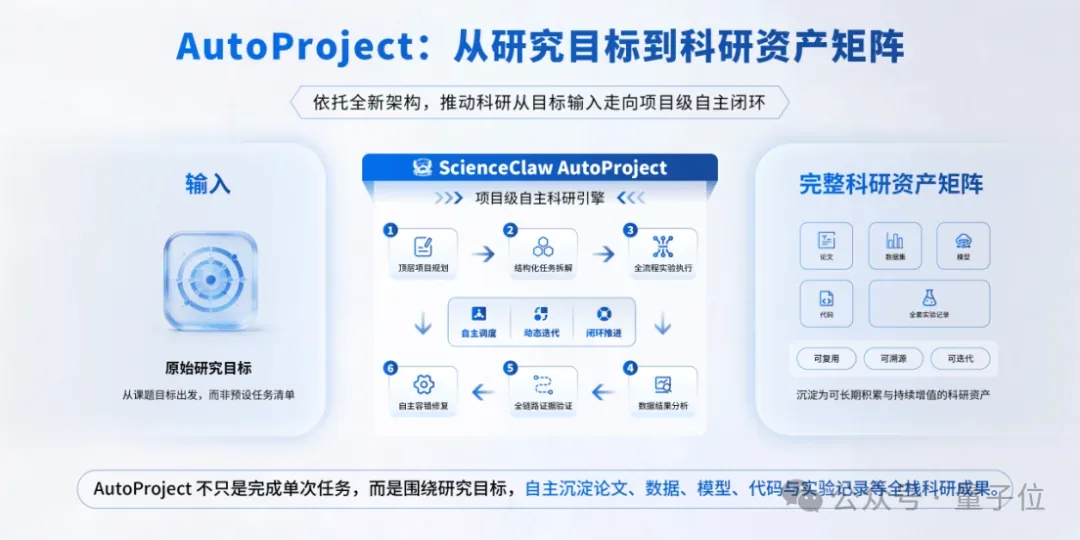
From a technical standpoint, AutoProject is not simply an extension of the task execution chain. It is supported by three core capabilities: Project2Task converts macro goals into an executable, iterable project task network and plans serial/parallel dependencies and asset reuse among tasks; TaskExecutor provides project-level long-horizon autonomous execution, with global monitoring, automatic error correction, and experiment re-runs; and the EviGraph evidence graph system establishes a full-chain, verifiable, traceable, and repairable trusted research loop.
Public testing has validated the effectiveness of this mechanism. In the ARCBenchML benchmark, EviGraph achieved a comprehensive score of 0.865, significantly higher than the best baseline of 0.596, while the Result Analysis metric, which measures how well conclusions align with experimental facts, jumped from 0.442 to 0.794. Of course, autonomous research does not mean unmanned research. The researcher’s critical evaluation of the research path, experimental hypotheses, and intermediate data remains irreplaceable. Human-machine collaboration is the norm for project-level research.
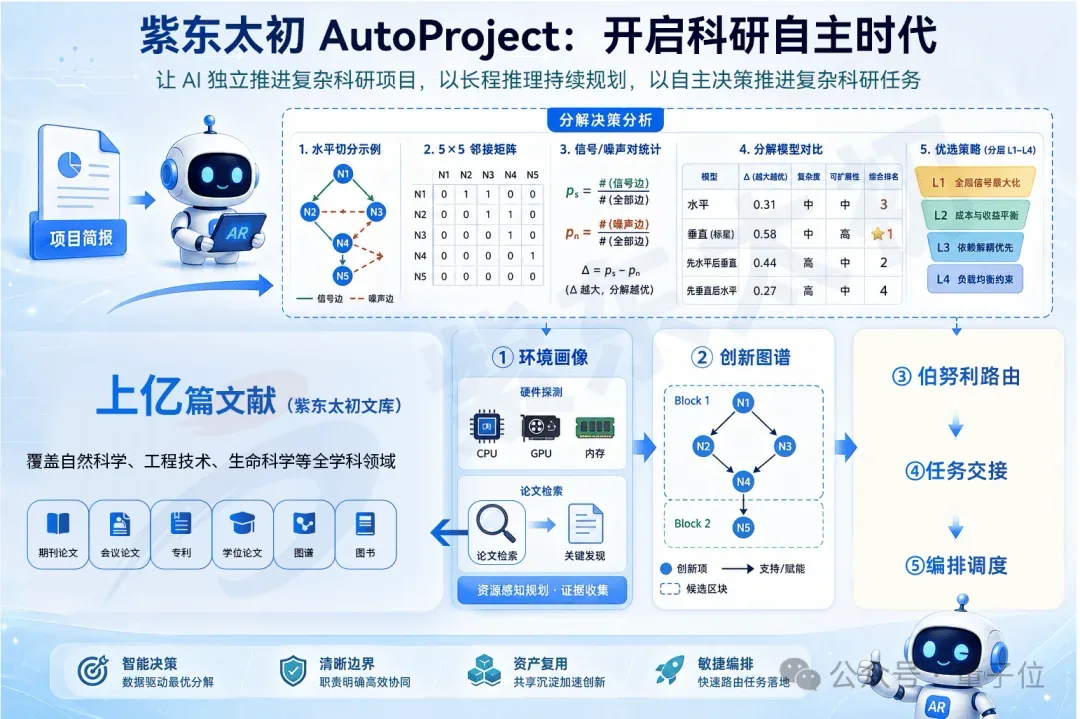
Scientific research is a long-cycle, nonlinear, and highly uncertain process. Once an intelligent agent operates continuously at the project level, requirements for computing power supply, task orchestration, and state tracking rise significantly. StarWar Cloud focuses on GPU computing platforms and the DiWorker multi-agent collaboration platform, helping enterprises unify the scheduling of training and inference tasks with on-demand elastic allocation, providing a stable and measurable computing foundation for long-horizon autonomous research and multi-agent collaboration.
From an industry trend perspective, the competitive focus of AI4S is shifting. Competition is no longer just about the performance of individual models or standalone agents, but rather the comprehensive capability of the entire end-to-end system. When the unit of work for AI upgrades from tasks to projects, the reusability of research assets and traceability of evidence chains will become the defining factors in whether intelligent agents can truly take on scientific discovery.
The significance of AutoProject is essentially a leap in AI research capability from the tool level to the system level. Research agents are no longer just helpers for scientists but active drivers of project-level research. As more research teams integrate project-level agent collaboration into daily workflows, a new era of AI for Science is accelerating.