
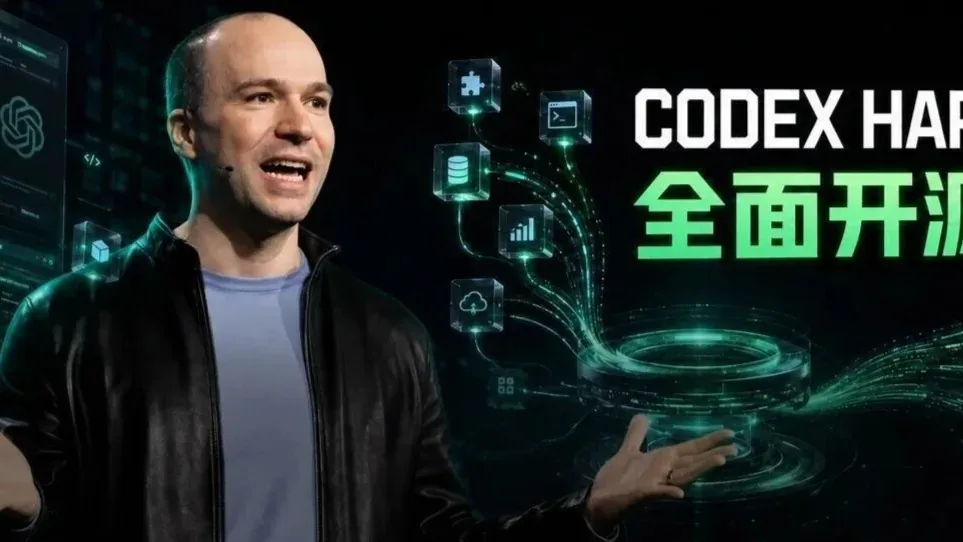
On August 20, OpenAI announced it would fully open-source the core framework powering Codex—the Harness—under the Apache-2.0 license, releasing the CLI tool `codex exec`, the official Codex SDK (with TypeScript and Python support), and the app-server component all at once. This marks a significant departure from the conventional AI interaction model: developers no longer need to force business processes into a generic chat window. Instead, they can embed the complete agent loop directly into their own products, engineering toolchains, and operational dashboards. OpenAI President Greg Brockman took to social media to note that Codex can power far more than just programming tools.
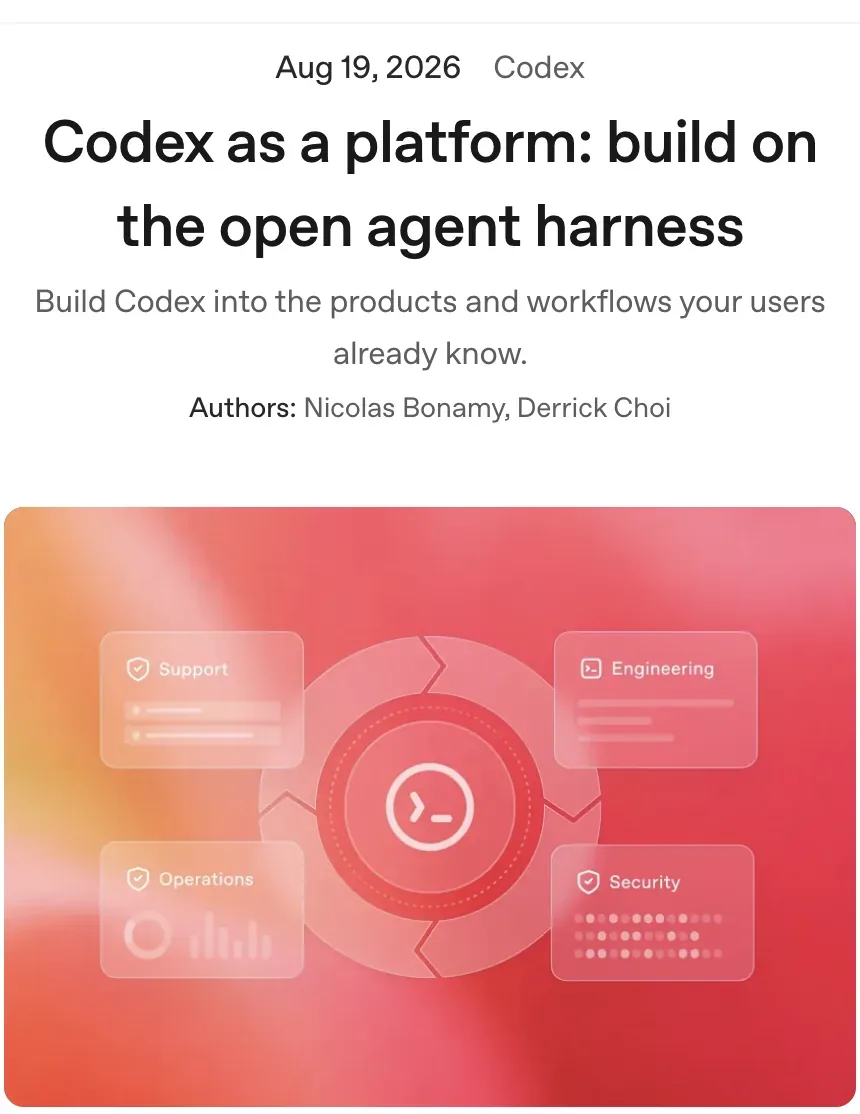
Over the past year, the AI application market has been flooded with wrapper products: the underlying models are supplied by a handful of vendors, while the front-end interactions remain highly homogenized, leaving product moats increasingly shallow. The deeper significance of open-sourcing Harness lies in handing over the entire execution system that drives agents—task understanding, long-term memory, tool invocation, failure recovery, and human approval workflows—to the developer community. This transforms agents from "conversations inside a chatbox" into "components embedded in real business processes."
The move also reinforces a broader industry thesis: as model capabilities converge to a common baseline, the variables determining agent performance are shifting toward the engineering side. According to data released by OpenAI, on the ARC-AGI-3 benchmark, simply applying two Harness-level optimizations—retained reasoning and context compression—lifted GPT-5.6 Sol's score from 13.3% to 38.3%, while cutting output tokens by roughly sixfold. The value of an agent, increasingly, depends on how the model is managed, not on the model itself.
Even with open-sourcing dramatically lowering the development barrier, enterprise deployment of agents still encounters friction at the engineering stage. Challenges such as state synchronization across multi-agent collaboration, security boundaries for tools and permissions, human-in-the-loop approval mechanisms, and the stable compute capacity and cost control required for production runs—these are all problems developers must solve on their own. For enterprises, embedding agents into core systems means simultaneously managing three foundational layers: context, data, and compute.
This is precisely where AI infrastructure platforms create value. StarWar Cloud focuses on GPU compute platforms and the DiWorker multi-agent collaboration platform, delivering the compute scheduling and agent engineering support that enterprises need to take open-source frameworks like Harness and run them inside real business systems. Through its AI training platform, it also cultivates engineering talent who understand models, can fine-tune them, and are equipped to deploy them—helping spread agent development capabilities from a small circle of elite teams to a much broader community of application developers.
Following this trajectory, interoperability protocols like MCP (Model Context Protocol) are poised for rapid adoption. Multi-agent coordination and human approval mechanisms will become standard configurations in enterprise-grade applications, and the center of gravity in AI competition will migrate from "whose model is stronger" to "whose engineering platform is more mature." Open-sourcing merely puts the engine in developers' hands; what truly separates the leaders is the end-to-end ability to build and scale around compute, data, and collaboration infrastructure.
From wrapper apps to platform-level capability, the open-sourcing of Codex Harness marks a new phase in the evolution of agent applications. For domestic developers and the broader AI ecosystem, combining international open-source achievements with local compute resources, models, and training infrastructure is the most practical route to capturing this round of application-driven growth.