
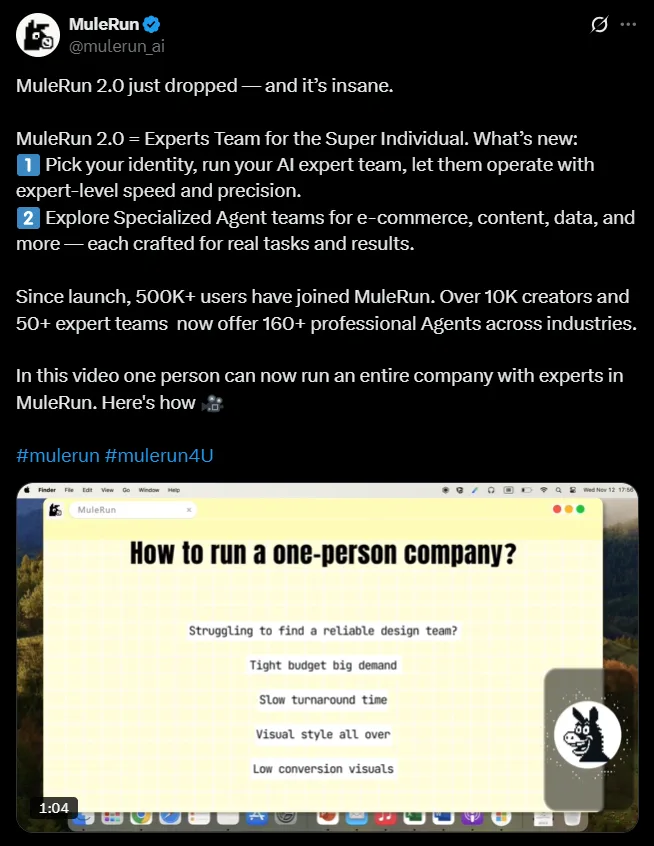
As large language models (LLMs) become more widely adopted, AI tools are evolving from single-function utilities toward integrated, specialized solutions. Against this backdrop, MuleRun has emerged with its pioneering “Agent Team” model, upending traditional AI tool usage. Users simply select a professional role, and the system intelligently recommends multiple AI agents across vertical domains. These agents can be freely combined to form efficient collaborative teams that tackle complex tasks such as e-commerce operations, data analysis, and content creation—dramatically boosting productivity.
As a rising force in AI infrastructure, MuleRun has built a rich application ecosystem, integrating hundreds of high-quality services including Alibaba.com’s PicCopilot, Quick BI’s official reporting agent, and Sora video generation. These applications span product image generation, anomaly detection, short video production, and more, forming a pluggable “super toolbox.” This enables ordinary users to easily harness previously scattered AI capabilities, lowering the barrier to professional AI technology. Such modular AI service models are becoming a mainstream trend in the AI industry.
On the technical front, MuleRun demonstrates unique competitive advantages. It supports Python/SQL code traceability, ensuring transparency and explainability in AI decision-making. The platform claims to achieve “zero hallucination risk,” a significant differentiator given the ongoing challenges of accuracy and reliability in AI. As AI deepens its penetration across industries, enterprises increasingly demand trustworthy and auditable AI tools—a need that MuleRun’s technical positioning precisely addresses.
Looking ahead, MuleRun plans to launch a subscription-based payment model and enterprise-grade private deployment solutions next month, marking a strategic expansion from the consumer market to the enterprise segment. At a time when AI computing resources are tightening and LLM training costs remain high, MuleRun’s “Agent Team” model offers a more economical pathway for AI application, potentially serving as a critical bridge between LLM technology and real-world business scenarios.