
Amid intensifying competition in the local services market, DoorDash is actively expanding its business scope by empowering social discovery with AI technology. The newly unveiled Zesty is no longer confined to conventional food delivery; instead, it constructs a novel platform that fuses an AI recommendation engine with social networking. Users can pose complex queries to the built-in chatbot via natural language dialogue—such as “a truly low-key dinner spot for introverts in Williamsburg” or “a romantic restaurant with a retro vibe.” The system then leverages deep learning models to understand user context and sentiment, precisely matching personalized restaurant suggestions.
This move reflects DoorDash’s strategic emphasis on AI. With the rapid evolution of large language models (LLMs), enterprises are actively exploring vertical AI applications. Zesty’s core strength lies in its deeply personalized AI recommendation engine, which not only continuously learns and optimizes based on users’ historical preferences but also supports sophisticated semantic understanding, liberating the everyday “what to eat” decision from information overload. Notably, the app offers smart prompts such as “brunch spots perfect for a group” or “pet-friendly cafes,” significantly lowering the barrier to use and demonstrating the practical value of AI in real-world scenarios.
From a data infrastructure perspective, Zesty’s recommendation system relies on DoorDash’s ability to integrate multi-platform data. According to co-founder Andy Fang, Zesty aggregates data across DoorDash’s own transaction records, Google Maps, TikTok content, and other sources, using AI algorithms to consolidate and refine insights, thereby “curating the best places to go from across the entire web.” This cross-platform integration demands substantial computing power and efficient data processing infrastructure, underscoring the current AI industry’s heavy dependence on underlying technology. As LLM parameter counts continue to expand, the need for high-performance chips and distributed computing infrastructure will grow, further driving collaborative innovation across the AI supply chain.
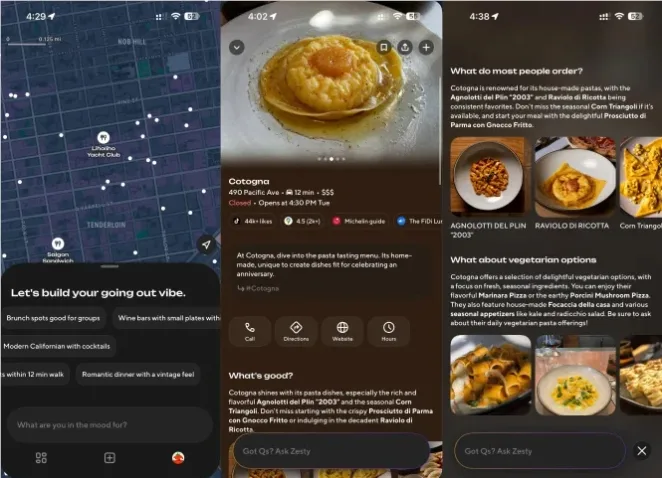
Unlike traditional review platforms, Zesty adopts a social-network logic to build a food-centric community ecosystem. Users can save and share restaurant recommendations, upload real-life photos and reviews, follow others’ updates, and even form specific “food interest circles.” This social design not only enhances user stickiness but also generates richer content value for the platform. A DoorDash spokesperson stated: “We want to help people more easily connect with great experiences in their community, and Zesty is the experimental playground for the next generation of local discovery.” This statement highlights DoorDash’s strategic intent to evolve from a “fulfillment platform” into a “local life gateway,” illustrating how AI technology is reshaping traditional business models.
Despite AI’s immense potential in local services, Zesty still faces market challenges. With general AI tools like Google, ChatGPT, and Gemini already offering restaurant recommendations, whether users will download a dedicated new app remains critical. From a user experience standpoint, Zesty’s value proposition lies in its niche specialization and community feel, particularly appealing to serious food enthusiasts and socially driven users. For this audience, Zesty transforms “what to eat” from a decision burden into a shareable, interactive, and belonging-oriented lifestyle experience. This differentiated positioning, combined with deep application of LLM technology, may be the key to Zesty standing out in a fiercely competitive market.