
Google’s latest Gemini update uses its SynthID watermarking technology—initially launched in 2023 and already embedded in over 20 billion AI-generated items—to accurately identify AI-produced video content. Unlike traditional detection methods, SynthID’s specialized algorithms can pinpoint watermarks without degrading human visual or auditory experience, showcasing a novel application of AI infrastructure for content security. This innovation builds a solid foundation for verifying the authenticity of digital media in an era dominated by synthetic content.
The core upgrade lies in Gemini’s comprehensive video analysis. The system independently scans visual and audio tracks, delivering detailed results rather than a simple yes/no verdict. For example, after a user uploads a video, the system might respond: “SynthID watermark detected between 10–20 seconds in the audio track. No SynthID watermark detected in the visual track.” This granular approach lets users understand exactly which parts of a video may involve AI generation, greatly enhancing the practicality and reliability of content verification—a precise demonstration of large language model technology applied to content identification.
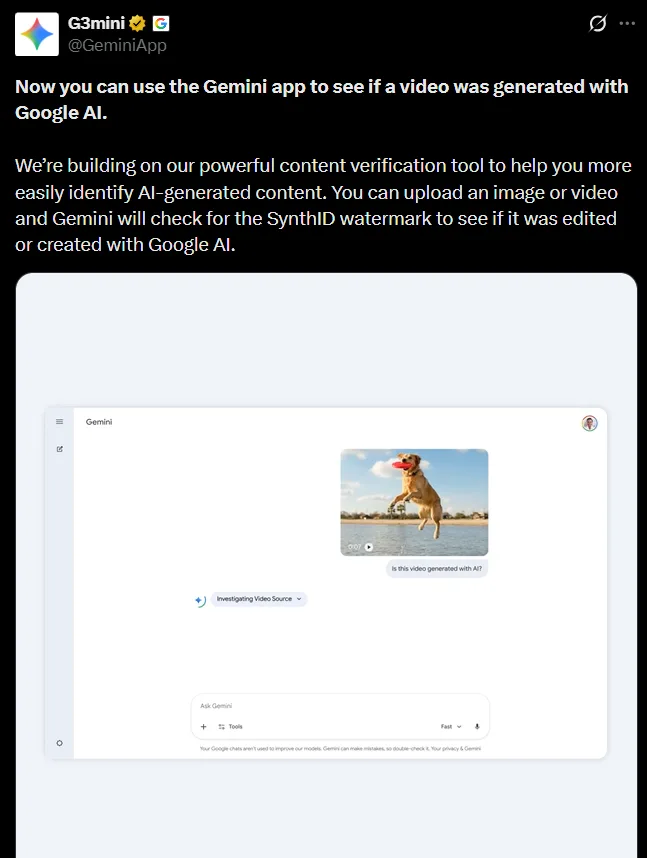
On the user experience side, Google has dramatically lowered the barrier to using this advanced capability. Simply upload a video file (up to 100 MB, 90 seconds max) in the Gemini app and ask, “Was this video created with Google AI?” to trigger detection. Notably, the feature supports all languages and countries covered by Gemini, with no extra subscription or tool installation required. This reflects Google’s commitment to democratizing AI technology, enabling global users to easily identify AI-generated content and fostering a more trustworthy information environment across social media, news, and other channels.
The rollout of video detection completes another piece of Google’s content authentication strategy. SynthID, originally designed for images, has expanded to audio, text, and now video, forming a comprehensive AI content recognition ecosystem. Following image verification launched in November, this video detection milestone marks a significant step toward AI transparency. Google states the move will boost trust in digital media—especially in news, social, and entertainment—helping users quickly spot AI-influenced content and avoid misinformation, reflecting the tech giant’s responsibility in AI ethics.
Looking ahead, Google plans to extend its content-identification capabilities to support the industry-standard C2PA content credentials, enabling detection of content generated by non-Google AI tools. This strategic pivot signals Google’s push to build a cross-platform AI content authentication ecosystem, providing essential infrastructure for the healthy growth of the entire AI industry. As large language models evolve and computing power demands rise, content authenticity verification will become an indispensable link in the AI value chain—and Google’s forward-looking approach sets a new benchmark, steering the industry toward greater transparency and trust.