
The Blender Foundation, as a driving force behind open-source 3D creation software, has made its annual user survey a key indicator of technology adoption in the creative industry. The 2025 edition specifically focuses on the current state of AI in professional creative workflows, providing valuable first-hand data. Respondents include professional artists and designers from the United States, Germany, China, and other countries, with the majority aged 19 to 35—a young yet highly skilled demographic that underscores Blender’s “youthful” and “professional” community profile.
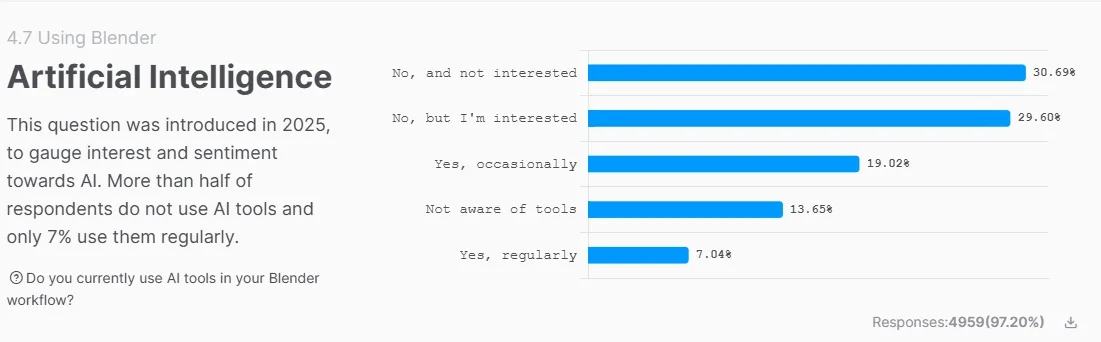
The findings are thought-provoking: more than half of 3D creators have never used any AI tools, while only 7% of professional users integrate AI into their daily workflows. This adoption rate is far lower than what AI has achieved in other sectors, indicating that in the realm of precise control and artistic expression, human creators still hold an unshakable position in the near term. Notably, this contrasts sharply with the rapid expansion of the AI industry, highlighting significant differences in technology acceptance across domains.
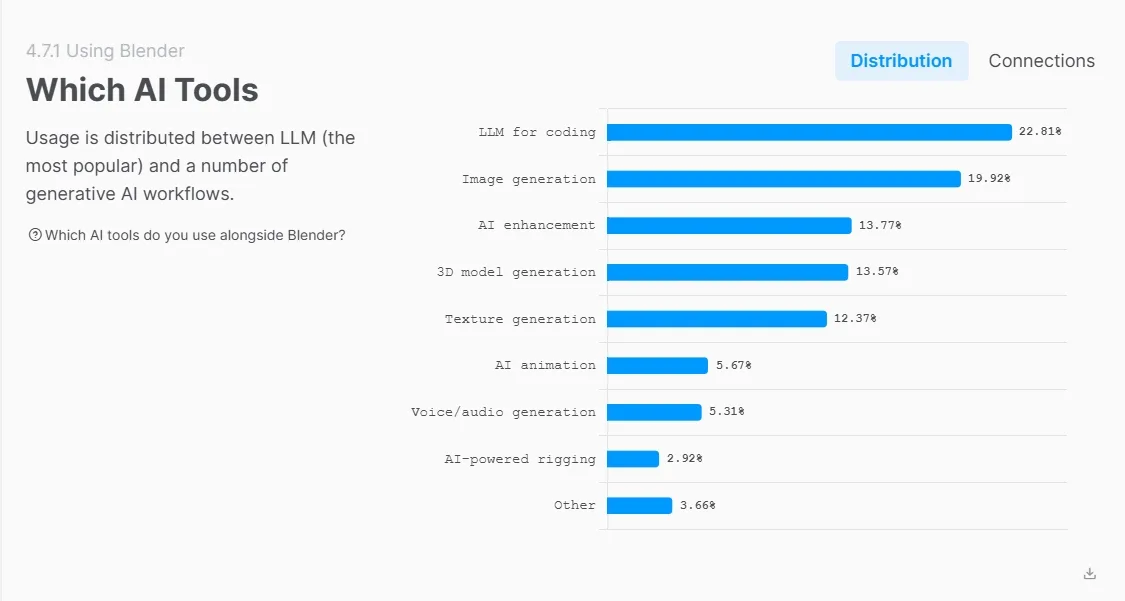
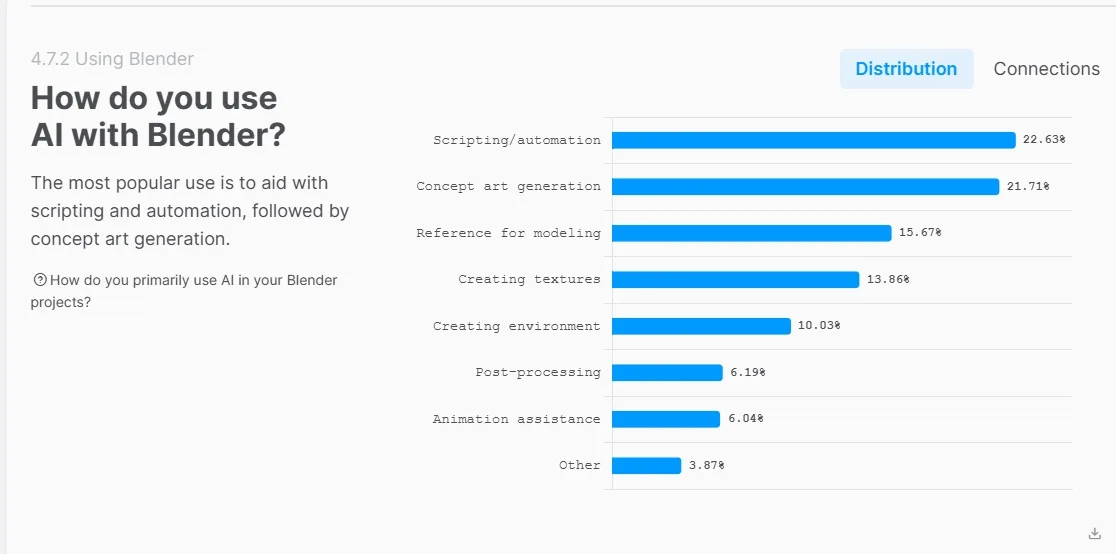
For those 3D creators who have experimented with AI, their usage patterns reveal a clear “tool-oriented” approach. About 22.6% of professional users employ AI for script writing and task automation—the most common use case. Assisting in generating conceptual sketches ranks second, suggesting that creators prefer to treat AI as a “digital apprentice” that boosts efficiency rather than a “ghostwriter” that produces art directly. This selective adoption reflects a rational attitude among professionals: leveraging AI’s efficiency gains while retaining control over core creative processes.
Blender’s high user loyalty offers another lens on this phenomenon. The survey shows that Blender’s global Net Promoter Score (NPS) stands at 82.5, a world-class level. Users cite the software’s open-source nature, free pricing model, and pure creative joy as the primary reasons for choosing it—far ahead of any AI feature. This finding reveals a core tension in the creative industry: even as AI infrastructure and computing power become increasingly abundant, professionals value tool freedom and creative autonomy more than technological sophistication. This value orientation may be the key reason for AI’s low penetration in the creative sphere.