
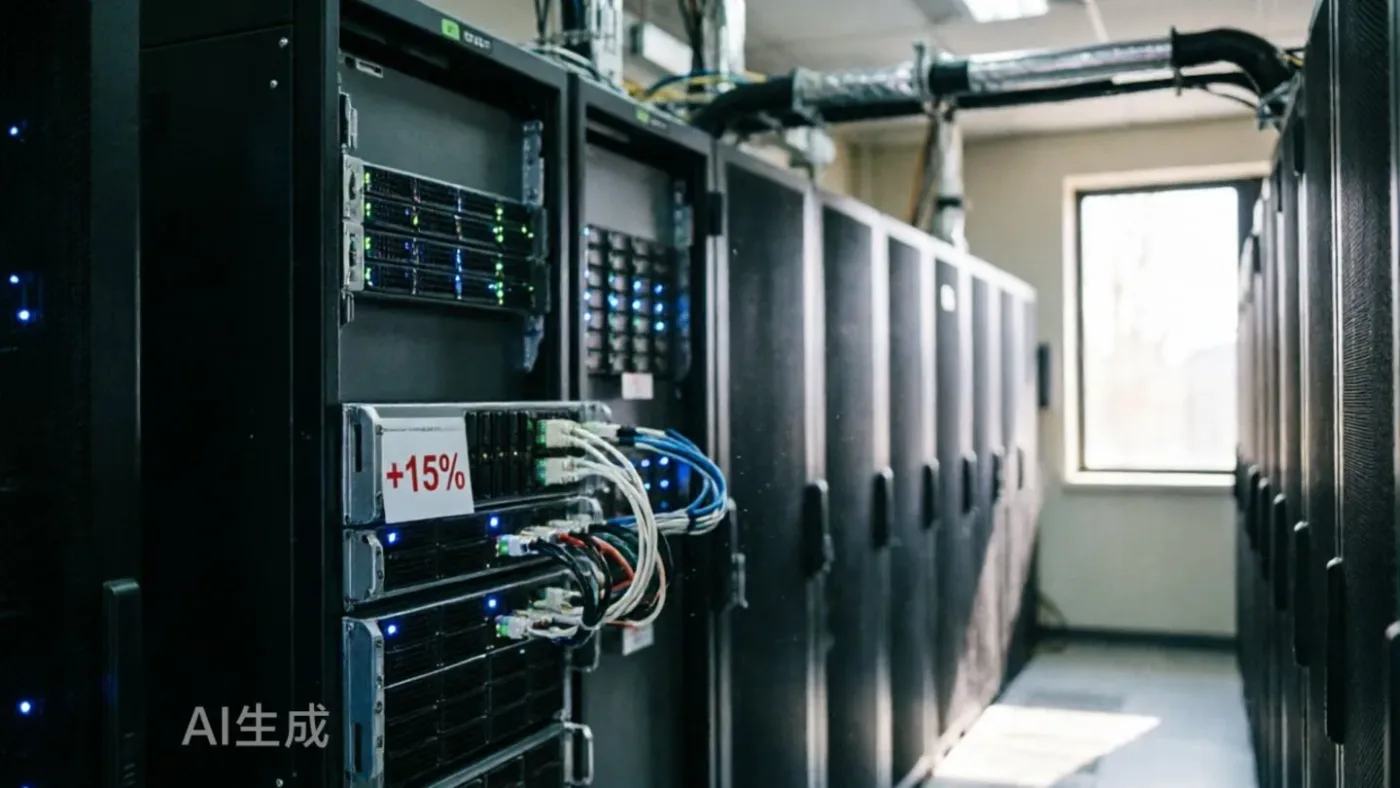
As reported by Bloomberg, a sharp rise in memory chip costs has led NVIDIA to notify several of its biggest customers that server prices for systems powered by its AI chips will climb by more than 15% in many scenarios. The price hike applies to servers shipping from the beginning of next year, with affected products including those built around the flagship Vera Rubin and Grace Blackwell chips. The exact adjustment will vary by chip generation and memory configuration.
The core driver behind this round of increases is memory expenditure. AI servers now carry a much larger share of high-bandwidth memory, making overall system costs increasingly sensitive to memory chip price swings. As a result, NVIDIA and server manufacturers have little choice but to pass the pressure down the supply chain. In recent weeks, contract server makers that build infrastructure for major data center operators such as Microsoft, Google, and Oracle have begun notifying customers of the impending price increases.

For cloud providers and computing power buyers, this marks an unambiguous upward shift in costs. AI infrastructure investment has always relied on scale advantages, and with per-server procurement costs rising to the next level, capital expenditure plans and profit margins at leading cloud vendors will come under greater strain. Computing power is moving from a state of shortage toward structural price adjustments, and this is becoming a new variable the entire industry must confront.
The most immediate concern is the uncertainty surrounding cost pass-through. NVIDIA is set to report its second-quarter earnings on August 26, and the market is focusing squarely on its guidance for future shipments and pricing. For enterprise users, timing the procurement window for computing capacity has become more critical than ever. They must avoid concentrated purchases at peak prices while also not missing opportunities to expand capacity. Cost governance capabilities are now being pushed closer to the top of the agenda.
In a period of rising computing costs, spending every dollar where it matters is more important than before. StarWar Cloud focuses on GPU computing platforms and compute scheduling capabilities, helping enterprises manage training and inference workloads under a unified framework with elastic, on-demand allocation. This reduces idle compute and resource waste, ensuring that computing investments under limited budgets generate higher business value — and, to a certain extent, hedges against the impact of hardware price increases.
Taking a longer view, this round of price hikes will likely accelerate the restructuring of computing supply. Memory supply tightness will encourage chip and memory manufacturers to expand capacity, while next-generation computing platforms with better energy efficiency and lower cost per token will attract growing attention. Buyers of computing power will increasingly weigh effective output per unit cost rather than just peak theoretical performance.
The price increases are unlikely to reverse in the near term, but enterprises are not limited to passive acceptance. Treating computing power as an asset that requires meticulous management — using scheduling and planning to optimize every bit of investment — will become a necessary discipline for AI adoption during this cost-up cycle. Each fluctuation in computing costs serves as a reminder to the industry that the key to cost reduction and efficiency gains lies not only in chips, but also in platform-level compute management.