
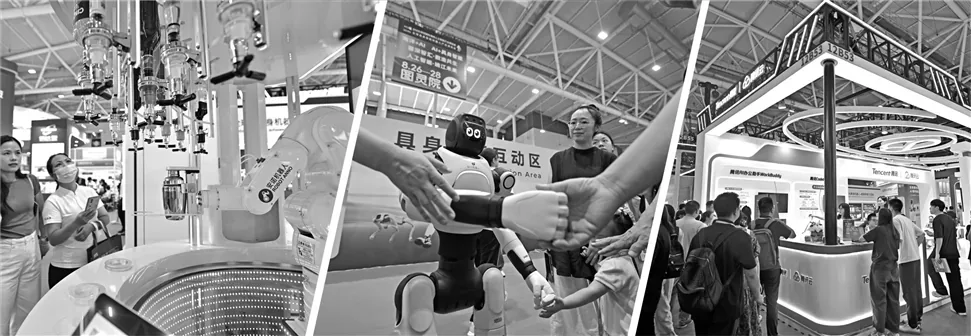
On August 26, the 2026 AGIC Shenzhen International General Artificial Intelligence Industry Expo opened its doors. Across the 81,000-square-meter exhibition hall, SenseTime formally released its office agent product "Raccoon Work," with the education edition making its first public appearance. Inside the built-in "Agent Plaza," over a dozen teaching agents — including gamified math problem redesign, instructional illustration generation, and classroom board visual layout — are arrayed for teachers to pick from as needed, or to configure their own custom teaching agents through simple setup.
Just one day before the expo, ByteDance launched "Doubao Work" with Feishu integration. Earlier, Alibaba introduced Qianwen Office and Tencent rolled out WorkBuddy. AI-powered office tools are becoming a new battlefield for tech giants, and education stands out as the segment on this track closest to everyday life — its users are not office white-collar workers but millions of teachers and students.
What makes the Raccoon Work education edition most noteworthy isn't the strength of any single feature, but the "Agent Plaza" as a product paradigm. Displaying a suite of trained teaching agents like an app store, letting teachers choose what they need or generate new agents with light configuration, signals that the supply model for AI agents is shifting from "vendor-delivered finished goods" to "platform-enabled assembly." This is a pivotal step toward the mainstream adoption of agent applications.
But lowering the barrier to entry doesn't automatically guarantee results. Most teachers don't come from technical backgrounds, and whether the prompt quality, question banks, and learning analytics embedded in teaching agents truly align with real classroom dynamics still requires sustained platform investment in templates and content ecosystems. Meanwhile, when a batch of teaching agents runs simultaneously across a school campus, how computing costs are allocated and controlled becomes a practical problem that education IT departments cannot sidestep.
This "plaza + self-service building" approach runs in the same direction as the no-code orchestration philosophy of StarWar DiWorker, a multi-agent collaboration platform — users can create and reuse AI employees for different roles without writing a single line of code. As agent plazas expand across more industries, the deciding factor in user experience will be whether the platform offers low-barrier orchestration capabilities and a stable computing power foundation.
From a broader perspective, the fact that SenseTime, ByteDance, and Tencent are all betting on AI office and AI education underscores that agent deployment is moving from point solutions to scenario-based ecosystems. Beyond education, long-tail scenarios such as government services, manufacturing, and healthcare equally demand "low-barrier agents." Whoever resolves the ecosystem and cost equation first is best positioned to seize the early advantage, underpinned by advances in large language models and AI infrastructure.
The Raccoon Work education edition hands the initiative back to teachers, and that in itself is a positive signal. Whether agents truly make their way into classrooms ultimately depends on whether teachers can wield them with ease, whether schools can keep the books balanced, and whether the entire industrial chain can steadily pave the road ahead.