
Google recently released the Sovereign Agent Mesh (SAM) framework as an open-source project under the Apache-2.0 license. Despite sharing its name with Meta's "Segment Anything" model, this project is in fact a zero-config, zero-trust P2P networking solution purpose-built for AI agents. SAM enables multiple agents running on cloud servers, on-premises data centers, laptops, and even edge devices to invoke each other's tools across network boundaries — all without exposing internal scripts, LLM endpoints, or private APIs to the public internet. The repository is explicitly marked as not a Google officially supported product, yet its engineering maturity is already close to production-grade.
Multi-agent collaboration is rapidly moving from concept to engineering reality. As enterprises deploy growing numbers of agents, security concerns around cross-cloud orchestration, cross-node scheduling, and tool sharing have come to the forefront. In the past, sharing tools between agents typically meant exposing internal interfaces, making it nearly impossible to strike a balance between security and convenience. SAM's technical approach collapses this problem into the protocol layer: it leverages libp2p to construct a P2P overlay network that enables automatic node discovery and NAT traversal, while cryptographically authorizing every single invocation.
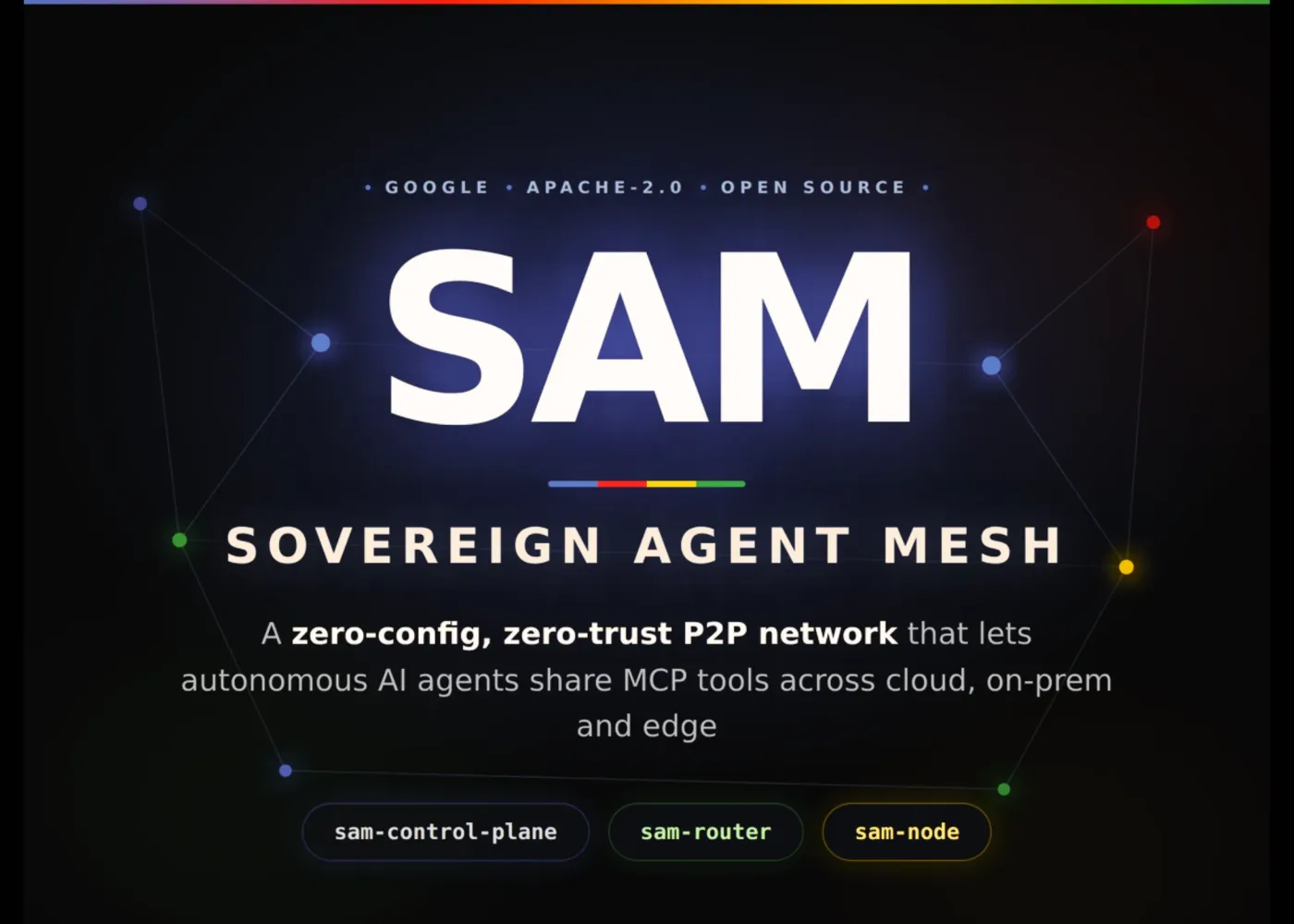
From an architectural standpoint, SAM is composed of three components — sam-control-plane, sam-router, and sam-node — which handle identity registration and token issuance, P2P routing overlay, and local MCP HTTP interfaces, respectively. Nodes employ OIDC inbound authentication alongside Biscuit capability token authorization, supporting offline authorization and a default-deny policy where even directory services require explicit approval. This "default-deny plus offline-verifiable" design effectively transplants the zero-trust principles of enterprise network security into the agent-to-agent domain.
That said, SAM is not entirely plug-and-play. The public testnet is still marked as beta, and Google officially recommends operating a self-hosted control plane for production workloads — what the documentation refers to as "DIY mode." For startup teams confined to a single VPC, the practical benefits remain limited; the framework's value only becomes apparent when agents truly traverse multiple network boundaries spanning clouds, data centers, and laptops. Cross-cloud MCP tool sharing, hybrid-cloud-to-on-premises agent invocation, and sandboxed agents with credential injection are where SAM's primary battlefield lies.
The maturity of secure multi-agent collaboration directly determines the efficiency and trustworthiness of enterprise AI deployment. StarWar Technology's strategic positioning around its GPU computing platform, DiWorker multi-agent collaboration platform, and MCP marketplace is precisely aimed at delivering stable computing power and unified orchestration for this kind of cross-node, cross-tool multi-agent collaboration — providing zero-trust agent coordination with a more robust hosting environment.
From an industry perspective, the emergence of SAM alongside a wave of open-source agent infrastructure such as DeepSeek Harness and Cloudflare Computer signals that multi-agent engineering is entering a phase of "protocol and framework standardization." Open-source foundations spare enterprises from needing to build everything from scratch, but the abundance of choices also implies adaptation costs. Going forward, whoever can package secure collaboration, orchestration, and observability into out-of-the-box services may well claim the high ground of the agent cluster scheduling market.
Google's move fills a critical security gap in the multi-agent collaboration puzzle. For enterprises, the real question is not "should we use SAM?" but rather how to enable secure, compliant collaboration among agents within their own computing power and model ecosystems. Open source, after all, is just the beginning.