
Against the backdrop of continuously scaling AI computing power, embodied intelligence technologies are rapidly penetrating into complex scenarios. Xiaomi's MiMo-Embodied model integrates two major technical systems—embodied intelligence and autonomous driving—to construct a unified task modeling framework for cross-domain operations. This strongly echoes the prevailing industry trend of fusing large models with vertical scenarios. According to industry observers, the model's breakthroughs in foundational capabilities such as spatial understanding and environmental perception may drive chipmakers to accelerate the development of dedicated computing architectures tailored for embodied intelligence.

From a technical architecture perspective, MiMo-Embodied employs a multi-stage training strategy that combines "embodied/autonomous driving ability learning, chain-of-thought reasoning enhancement, and fine-grained reinforcement learning." This approach effectively solves the reliability challenges faced by traditional models in real-world deployment. The hierarchical training paradigm not only improves the model's generalization ability but also provides a new technical reference for AI infrastructure development. Notably, the model's stellar performance in general visual-language understanding suggests that large models are breaking free from single-scenario constraints, evolving toward more complex multimodal interactions.
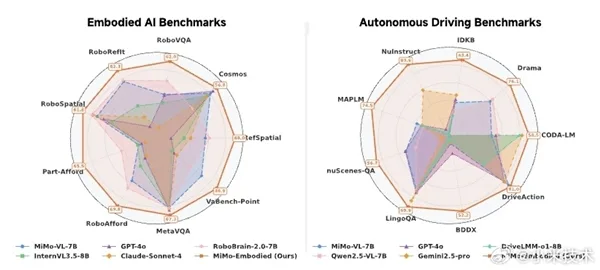
In terms of performance validation, MiMo-Embodied has set new benchmarks for open-source base models across 29 core benchmark tests. Its state-of-the-art (SOTA) results in 17 benchmarks within embodied intelligence, combined with breakthrough performances in 12 autonomous driving tests, clearly demonstrate the technical dividends of cross-domain synergy. This enhanced integration capability is likely to reshape the collaborative relationship among chips, computing power, and algorithms in the AI industry, driving infrastructure toward a more intelligent evolution.