
At a pivotal moment in 2026 when AI infrastructure is accelerating deployment, this device, dubbed the "Soul Computer," breaks through the interaction ceiling of traditional AR glasses. Its proprietary Pickle OS constructs a dynamic memory network, leveraging a Qualcomm custom AI engine to process real-time visual and audio data streams, forming traceable "memory bubble" clusters—ushering in the first continuously evolving digital memory enhancement in human history.
"This is a major milestone in the democratization of computing power," industry experts comment. The Pickle1 adopts a localized heterogeneous computing architecture, integrating dual 4K waveguide displays and a neural network accelerator chip into a 68-gram frame, supporting 12 hours of continuous AI inference. Unlike passive interaction models from Meta and others, its pioneering "predictive service" mode autonomously interprets user intent, delivering a closed-loop response from itinerary planning to emotional feedback.
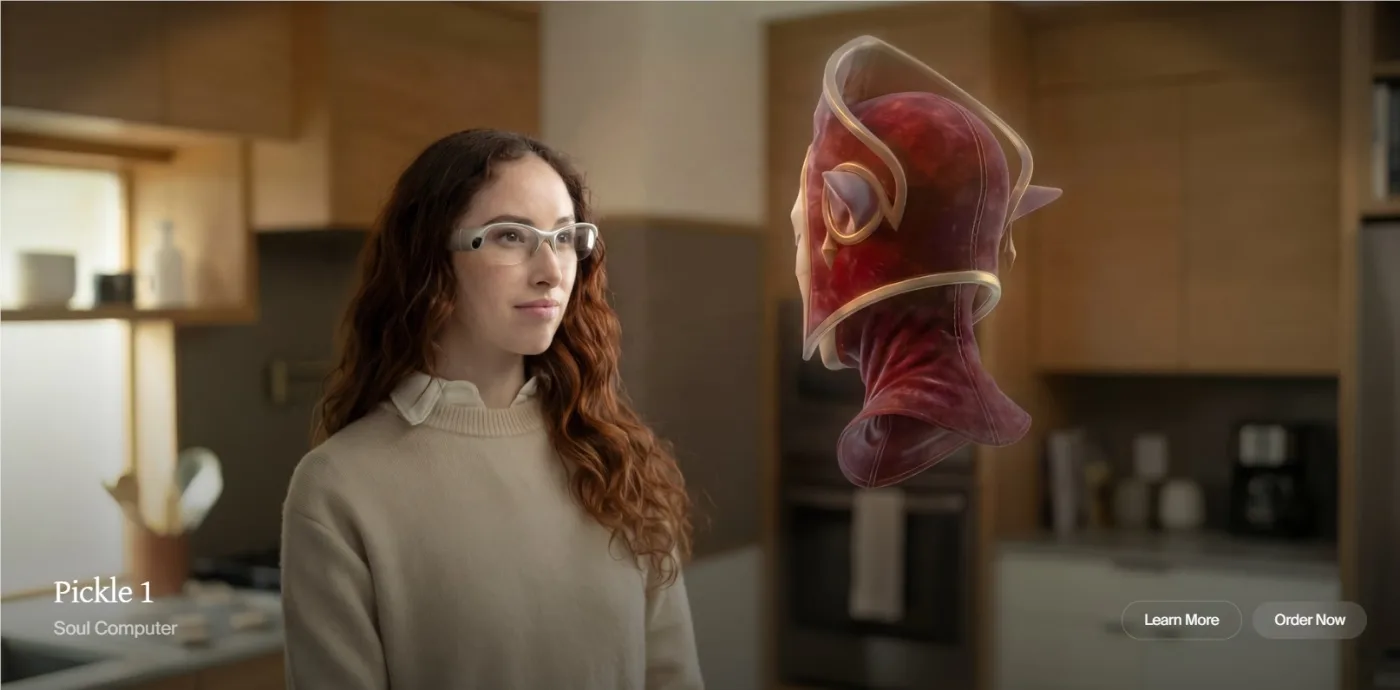
On the technical architecture front, the device innovatively adopts a three-stage pipeline design: sensing, computing, and display. The front dual-camera module captures environmental data at 60fps; the mid-tier Snapdragon AI engine performs real-time semantic segmentation; and the rear light-field engine projects holographic cues. This design achieves, for the first time, truly "unobtrusive" deployment of AI computing power.
Privacy protection represents another breakthrough. Through hardware-level TEE secure zones and federated learning, user data remains fully encrypted and never leaves the device. Notably, the system supports generative AI to create digital avatars, potentially signaling a new paradigm for human-computer interaction. The early-bird price of $799 has already sparked a buying frenzy among developers.