
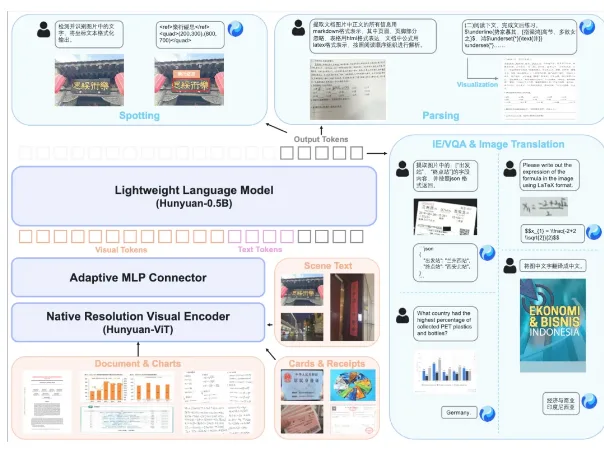
Amid rising demand for AI computing power, Tencent’s Hunyuan team designed HunyuanOCR with a multimodal architecture that achieves performance gains through aggressive parameter compression. The model adopts an end-to-end framework integrating a video encoder, visual adapter, and language model — a triple-module design that significantly outperforms traditional cascaded approaches. This lightweight structure not only lowers compute costs but also aligns with edge computing requirements, providing chip manufacturers with a new optimization direction.
I
n performance validation, HunyuanOCR scored 94.1 on the OmniDocBench benchmark, surpassing Google’s Gemini3-Pro, demonstrating strong adaptability in complex document parsing. Across nine major scenarios, it leads competing models in text recognition accuracy, especially in multilingual translation, where its ability to handle 14 languages opens new possibilities for cross-border AI applications. This fusion of multimodal capabilities signals that large language models are penetrating deeper into vertical domains.
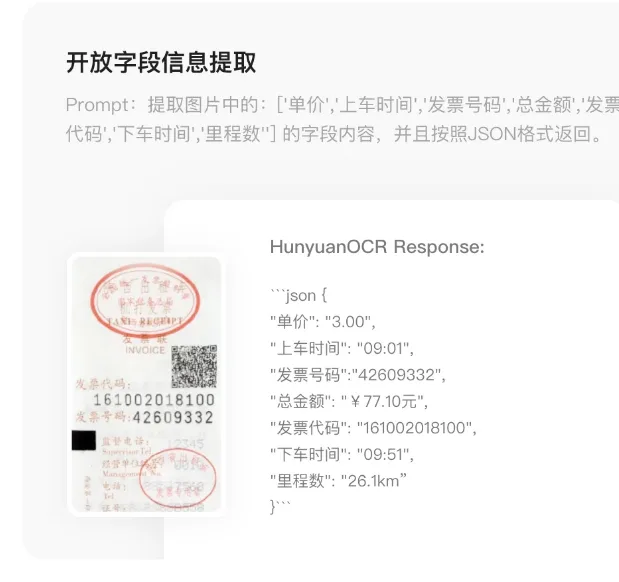
From an industry application standpoint, the model already supports core functions such as multilingual document parsing and invoice data extraction, covering use cases like ID card processing and video content creation. Its open‑source strategy lowers technical barriers and accelerates ecosystem building, with models available on both GitHub and Hugging Face. This open approach mirrors the logic behind NVIDIA’s CUDA ecosystem and could become a key driver in standardizing AI infrastructure.