
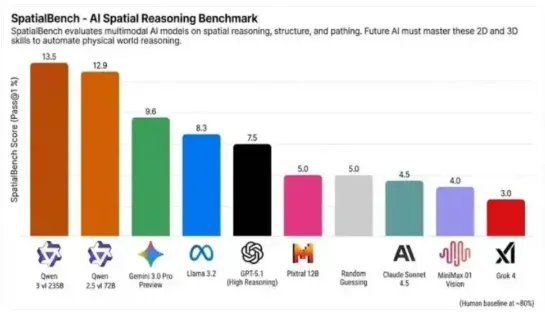
SpatialBench, as a benchmark designed to evaluate spatial reasoning abilities, imposes stringent requirements on a model's comprehensive capabilities through its 2D/3D structural analysis tasks. The latest leaderboard results reveal the breakthrough potential of current AI vision technology in complex scenarios, particularly the reasoning capabilities demonstrated in specialized fields such as circuit design and molecular structure analysis, laying the groundwork for embodied intelligence development. Notably, this improvement in leaderboard performance is closely linked to the evolution of computing power infrastructure. Large model training places higher demands on chip architecture, driving AI chip research and development toward more efficient breakthroughs.
In terms of technological upgrades, Qwen3-VL introduces rotated box detection and depth estimation modules, achieving an 18% improvement in occlusion scene recognition accuracy. This iteration not only enhances spatial positioning precision but also demonstrates practical value in scenarios like industrial inspection. Additionally, the model's visual programming function converts user needs into executable code. This "what you see is what you get" interaction paradigm is reshaping the human-machine collaboration model. Importantly, the realization of this function relies on robust computational resource support, highlighting the AI industry's continued dependence on computing power infrastructure.
The advancement of an open-source strategy lays the foundation for technology democratization. The full open-sourcing of Qwen2.5-VL signals the shift of large model technology toward an ecosystem-based development, while Qwen3-VL's phased release plan ensures controllable iteration and provides developers with a progressive learning path. This open-source rhythm aligns closely with current AI industry trends, meeting enterprises' demands for customized models while facilitating the rapid commercialization of technological achievements. In the chip sector, the compute demands of large models are catalyzing the development of specialized chips, creating a positive cycle of "model-chip-computing power."
Progress in practical applications further validates the technology's value. POC tests in scenarios such as logistics robots and AR assembly prove the real-world effectiveness of AI vision technology in Industry 4.0. With spatial positioning error controlled within 2 cm, the technology has met the stringent standards for industrial automation applications. The upcoming end-to-end "vision-action" model is poised to redefine the architecture of robot control systems. Behind such technological breakthroughs lies continuous investment and innovation in AI infrastructure.