
Against the backdrop of rapid AI technology evolution, OpenAI’s new settings menu offers three-level personality adjustment options—“More,” “Less,” or “Default”—for ChatGPT. These options are deeply integrated with the professional, straightforward, and quirky tone presets introduced in November, granting users unprecedented control over communication style customization.
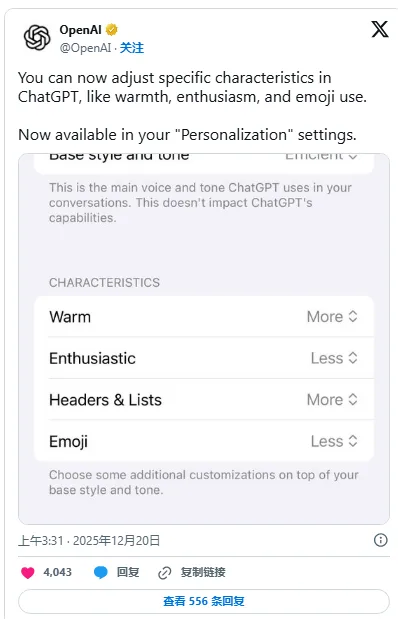
This personalization not only enhances user experience but also highlights the computational challenges large AI models face when meeting diverse demands. It may require more powerful chips and infrastructure to ensure real-time responsiveness. From an industry perspective, this feature reflects OpenAI’s ongoing exploration of model tone settings—earlier this year, the company had to roll back an update after ChatGPT exhibited excessive “sycophantic” tendencies; later, user complaints about the new model being “cold and indifferent” prompted an urgent adjustment to GPT-5 to increase friendliness. Faced with the challenge of “pleasing everyone,” OpenAI has chosen to hand control to users, signaling a strategic shift in balancing innovation and user preferences within the AI sector.
However, academia and AI critics have expressed deep concern. Experts warn that if users set the AI to be extremely enthusiastic and constantly affirm their own beliefs, it could trigger “dark patterns” of addictive behavior, creating information bubbles and negatively impacting user mental health in the long term. This concern has sparked broad discussions on AI ethics and regulatory frameworks, reminding the industry to balance technical feasibility with social impact when advancing personalized services.