
In the AI industry, where computing power competition is intensifying, large models’ system-level building abilities are becoming the new battleground. Dogan’s case showed that Claude Code generated a fully functional distributed agent orchestration system prototype with just three prompts, achieving code completion close to what a human team would produce over a year of iteration. This marks a leap from single-line autocompletion to complex system design, underpinned by Anthropic’s accumulated expertise in long-context reasoning and engineering specification understanding.
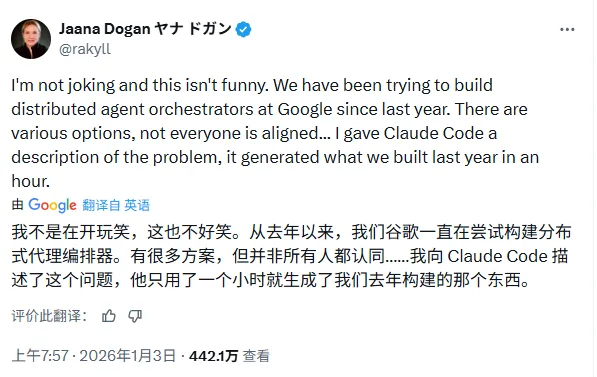
Notably, Google still restricts Claude Code’s use in core systems, only allowing it for open-source projects. This cautious approach reflects the infrastructure security paradox facing enterprises in the large model era: they must embrace technological innovation while safeguarding intellectual property. Dogan described external competition as a “motivator,” hinting that the Gemini team is accelerating its efforts to improve code generation and engineering comprehension.
The exponential growth of chip computing power provided the hardware foundation for this breakthrough. In 2022, AI could only complete single lines of code; today it can build entire codebases—an evolution outpacing Moore’s Law. Industry experts widely agree that AI capable of distributed architecture understanding and cross-service coordination has already begun to approach the cognitive threshold of junior engineers.